
Automatic Pool Covers
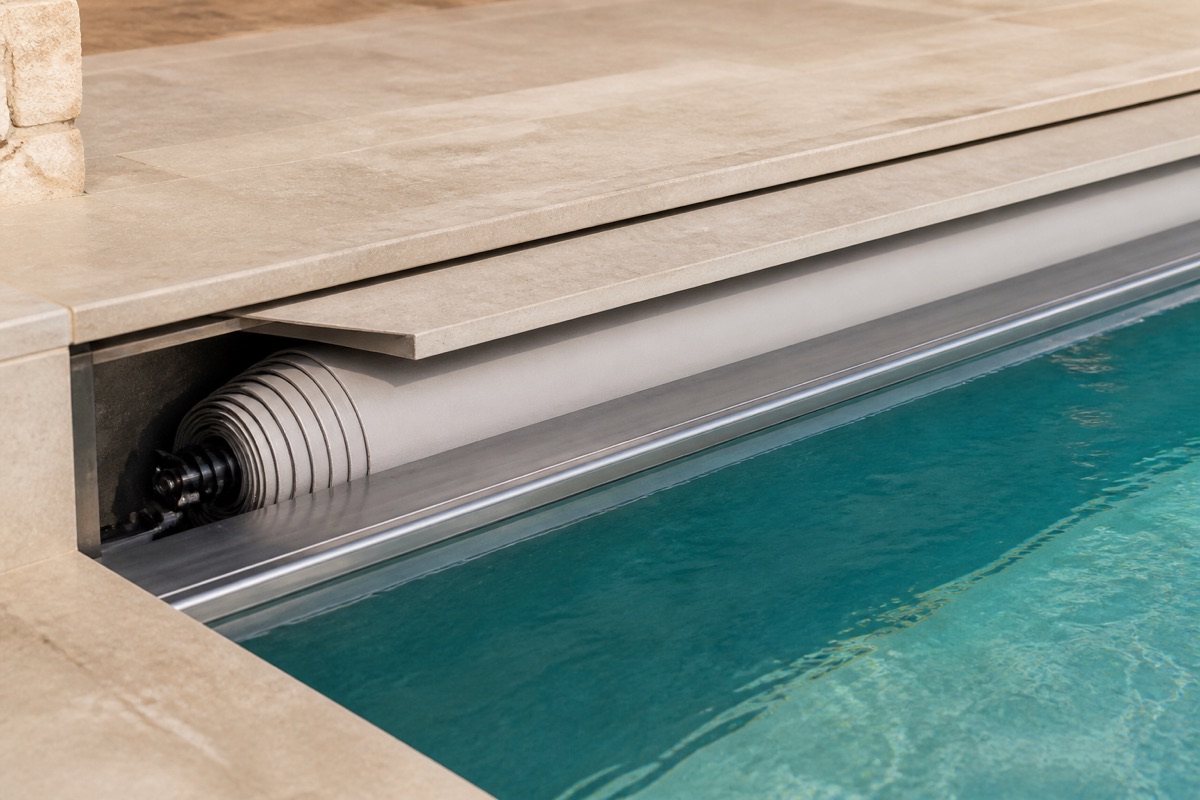
Selecting a drive before confirming the opening and track can leave the cover box needing redesign. Record opening geometry, track details, duty, environment and safety evidence before choosing an electric or hydraulic system. This is a comparison of requirements from public documentation, not a journal test or a manufacturer ranking.
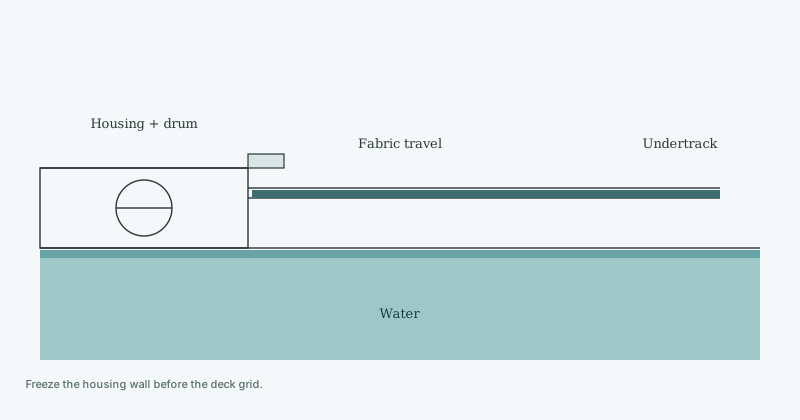
What does the drive documentation establish?
An electric cover uses a motor; a hydraulic cover uses a hydraulic drive. The manufacturer’s public T4 Versa owner manual covers an electric mechanism, while the Hydramatic in-wall manual addresses a hydraulic system and its receptor details. Those documents do not establish a universal maximum opening, commercial cycle rating or advantage on a curved track.
For each candidate, obtain the approved opening range, track drawing, operating duty and environmental limits. Enter values only from the selected product’s submittal. Neither drive label proves that a freeform pool can use a non-rectangular travel path.
Which track and structure details need confirmation?
New construction allows the housing, conduit and track interface to be recorded with the shell and deck drawings. A retrofit needs the existing structure and routing checked before a recessed track is assumed. Track position and drive type are separate decisions.
Show the travel envelope, housing access and drainage. If a weir, step or offset spa interrupts it, ask the cover designer to accept or reject that geometry before the deck detail is approved.
What changes for spas, hotel decks and safety?
Record every opening, including a spa outside the pool cover path. Decide whether it can share a cover or needs a separate arrangement. For a hotel, add opening and closing hours, trained operators, wind exposure and inspection responsibility.
Powered, motorized and retractable describe movement. Safety performance is a separate, documented property: identify the applicable standard and the evidence for the selected installation. Check the safety hub for the barrier decision and the energy hub for hours-covered assumptions.
When should a candidate be excluded?
Do not accept a candidate whose approved dimensions, track geometry or duty cannot be matched to the drawings. If an automatic travel path is not accepted, review another cover and barrier arrangement with the project designer and local authority. Automatic convenience alone does not resolve that review.
Copyable electric / hydraulic cover requirements
Scroll horizontally to see all columns →
| Input | Electric candidate | Hydraulic candidate | Project evidence / record |
|---|---|---|---|
| Maximum opening | Obtain model’s approved length and width | Obtain model’s approved length and width | Opening ____ / approved range ____ / document ____ |
| Track geometry | Approved track, travel envelope and housing detail | Approved track, receptors and housing detail | Drawing ____ / accepted by ____ |
| Duty | Obtain permitted operating duty | Obtain permitted operating duty | Hours / cycles ____ / manufacturer confirmation ____ |
| Environment | Confirm exposure and housing drainage limits | Confirm exposure and housing drainage limits | Wind / weather ____ / limits document ____ |
| Drive and supply | Motor load, circuit and disconnect to confirm | Power-unit load, hose route and disconnect to confirm | Selected drive ____ / electrical drawing ____ |
| Operators | Training and control sightline to confirm | Training and control sightline to confirm | Operator ____ / inspection owner ____ |
| Safety documentation | Product evidence separate from powered operation | Product evidence separate from hydraulic operation | Standard / edition ____ / evidence ____ / local decision ____ |
Related hubs
- Pool and Spa Safety
Safety covers, barriers, inspection, and why the local authority decides what counts.
- Pool Energy Efficiency
Evaporation, heat loss, covers, solar heating, and water conservation with stated assumptions.
- Commercial Pool and Spa Design
Hotel, resort, and commercial aquatic planning for developers, consultants, contractors, and operators.
Standards to verify
- Manufacturer public owner manual: electric cover operation
T4 Versa, document 800235 REL-0001, ©2020; operation, drainage and maintenance sections. Product example only, not a recommendation. Accessed October 8, 2026.
- Manufacturer public installation manual: hydraulic in-wall track
Hydramatic In-wall Receptors. No revision identifier found in the retrieved file; confirm the applicable issue. No universal opening or cycle rating is inferred. Accessed October 8, 2026.
- CPSC barrier guidance
Publication 362, April 2023. Confirm local requirements separately from product safety evidence.
Questions
- Does an automatic cover replace a pool barrier?
- Only if the local authority having jurisdiction says so. Some places treat a listed safety cover as a barrier option. Others still require a fence. Confirm the edition of the code that applies to the property.
- Are motorized, retractable, and automatic safety covers different products?
- Motorized, powered and retractable describe how a cover moves. They do not establish safety performance. For a safety-cover claim, check the selected product’s documentation against the applicable standard and installation conditions; an automatic drive is not that evidence.
- Can every pool take an automatic cover?
- No. Travel path, radius, infinity edges, steps that interrupt the track, and rooftop structure all constrain the system. Measure before you specify.