
Hot Tub Biofilm: Signs, Hidden Plumbing Slime, Line Purging, and CDC Prevention
Hot tub biofilm is a protective microbial slime lining warm spa pipes; normal sanitizer cannot clear thick deposits without purging, draining, scrubbing, and servicing filters.
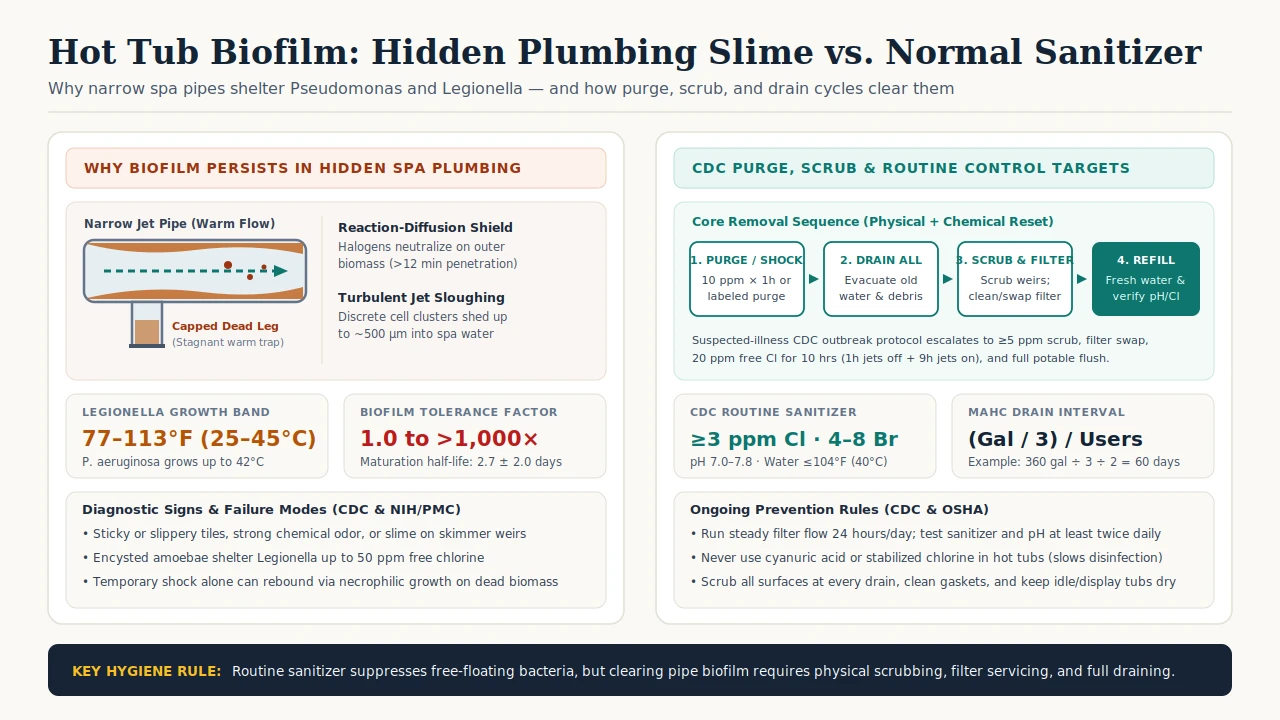
Hot tub biofilm is a slimy microbial layer inside warm spa plumbing, gaskets, skimmers, and filters that shields Pseudomonas aeruginosa and Legionella from routine chlorine or bromine. Because halogens neutralize in thick biomass before reaching pipe walls, clearing established biofilm requires draining, vigorous scrubbing, filter servicing or replacement, and elevated circulation disinfection or pipe-purge treatment.
Hot tubs maintain water temperatures inside the 77–113°F (25–45°C) optimal growth range for Legionella while combining low water volumes, heavy bather loads, and aeration that accelerate disinfectant decay. Narrow premise plumbing adds a high surface-to-volume ratio, intermittent stagnation, and warming cycles that let slime establish inside unseen jet lines long before visible debris reaches the acrylic shell.
Resolving persistent slime means pairing physical removal with disciplined pool and spa equipment filtration circuits, documented pool and spa maintenance routines, and the proper halogen window covered in our bromine vs chlorine hot tub guide.
How Can You Tell If a Hot Tub Has Biofilm or Bacteria?
Sticky or slippery tiles, a strong chemical odor despite chlorination, visible slime inside skimmers or recirculation fittings, and disinfectant residuals that drop below CDC targets are the clearest field indicators of hot tub biofilm and bacterial contamination. CDC instructs bathers that tiles should not feel sticky or slippery and that a properly chlorinated hot tub has little odor, whereas a strong chemical smell indicates a problem.
Operators should routinely inspect accessible recirculation system components for a slime layer and clean them as needed, because sediment and biofilm, temperature, water age, and disinfectant residual are the four key factors driving Legionella growth. OSHA water-treatment guidance adds that high concentrations of organic matter and dissolved solids reduce biocide effectiveness, explaining why contaminated spa water consumes free chlorine or bromine faster than expected.
Before entering or clearing a spa, check water with unexpired test strips against CDC thresholds: free chlorine of at least 3 parts per million (ppm or mg/L), talking to the operator or owner above 10 ppm; bromine of 4–8 ppm, talking to the operator or owner above 8 ppm; pH of 7.0–7.8; and water temperature no higher than 104°F (40°C). In laboratory surveillance, Austrian standard ÖNORM M 6222-1 requires zero E. coli, Pseudomonas aeruginosa, and Legionella spp. in a 100 mL sample taken after 5 minutes of idle circulation, whereas an Austrian hotel hot tub investigation that measured 37,000 colony-forming units (CFU) of P. aeruginosa per 100 mL indicated massive biofilm formation in the bath circulation.
Scroll horizontally to see all columns →
| Indicator | Field Observation or Measurement | Public-Health or Technical Meaning |
|---|---|---|
| Shell & tile feel | Sticky or slippery waterline, steps, or tile surfaces | Direct tactile sign of surface slime; CDC states tiles should not be sticky or slippery |
| Water odor | Strong chemical smell around an active spa | CDC notes a properly chlorinated hot tub has little odor and a strong chemical smell indicates a problem |
| Recirculation hardware | Visible slime on skimmer baskets, weirs, or accessible fittings | CDC directs operators to inspect accessible recirculation components for a slime layer and clean as needed |
| Disinfectant & pH strips | Free chlorine below 3 ppm, bromine outside 4–8 ppm, or pH outside 7.0–7.8 | Low disinfectant allows Pseudomonas and Legionella growth; organic matter and dissolved solids reduce biocide effectiveness |
| Microbiological sample | Austrian standard ÖNORM M 6222-1 requires no E. coli, P. aeruginosa, or Legionella spp. per 100 mL after 5 min idle | High counts such as 37,000 CFU of P. aeruginosa per 100 mL indicate massive biofilm formation in the circulation loop |
Why Are Flakes or Slime Coming From the Hot Tub Jets?
Flakes and stringy slime coming from hot tub jets are detached fragments of mature biofilm sheared off hidden internal pipe walls when high-velocity jet pumps restart. Time-lapse microscopy of mature mixed-species biofilms growing under turbulent flow showed discrete cell clusters detaching from single cells up to aggregates approximately 500 micrometers in diameter, with larger aggregates carrying a disproportionately high fraction of total detached biomass.
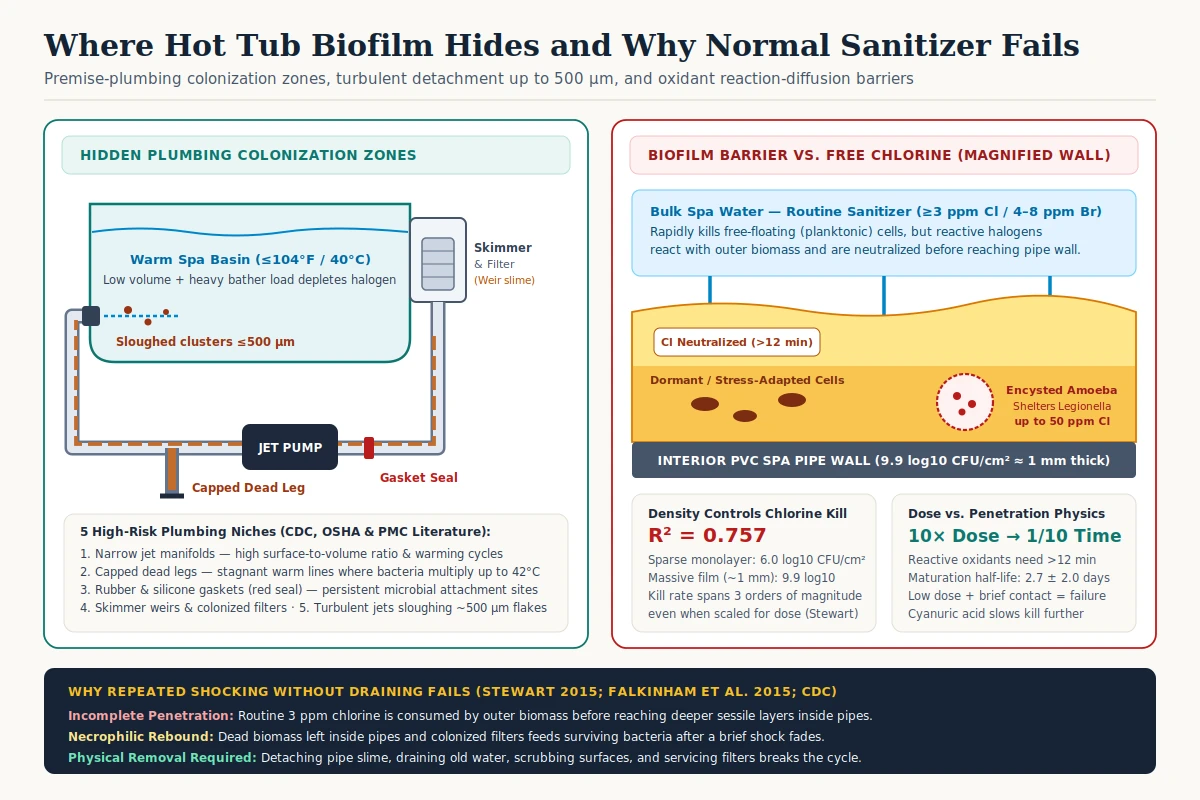
Hidden spa plumbing provides ideal anchoring niches that brushes cannot reach. Falkinham et al. explain that premise plumbing combines a high surface-to-volume ratio, intermittent stagnation, low disinfectant residual, and warming cycles that create large areas conducive to biofilm formation. In stagnant pipes, Pseudomonas aeruginosa multiplies inside wall biofilms and can grow at temperatures up to 42°C, while OSHA flags capped dead legs, non-recirculated lines, and rubber or silicone gaskets as persistent microbial reservoirs that require elimination or periodic removal and cleaning.
Biofilm can also establish before a spa's first regular bather arrives. OSHA advises cleaning and disinfecting new water systems because construction material residue can contribute to Legionella growth, and CDC states that even display hot tubs containing water require continuous disinfection and should be drained completely—removing as much water from the system as possible, drying filters, and keeping the unit as dry as possible between events—to prevent moisture-driven growth.
Is Hot Tub Biofilm Dangerous to Bathers?
Yes—hot tub biofilm shelters opportunistic pathogens including Pseudomonas aeruginosa and Legionella that cause skin, ear, and life-threatening respiratory illnesses when bathers contact contaminated water or inhale jet aerosols. Low water volumes, elevated temperatures, and heavy bather loads deplete free sanitizer rapidly, letting biofilm-protected bacteria multiply and shed directly into bathing water and mist.
CDC identifies Pseudomonas aeruginosa as the cause of hot tub rash (Pseudomonas folliculitis), an itchy, red, bumpy rash with pus-filled blisters around hair follicles that usually appears a few days after sitting in a poorly maintained hot tub and is often worse under swimsuits. P. aeruginosa is also a major cause of otitis externa (swimmer's ear), accounting for 2.4 million cases per year, and rare cases of community-acquired P. aeruginosa pneumonia in previously healthy adults—including a fatal wellness-hotel hot tub case tied to 37,000 CFU per 100 mL—carry a fatality rate over 30%.
Breathing in mist containing Legionella from a hot tub can cause Legionnaires' disease, a life-threatening pneumonia, or Pontiac fever, a milder illness without pneumonia. CDC lists adults 50 years or older, current or former smokers, and people with chronic lung disease or weakened immune systems as having elevated risk for Legionnaires' disease, and advises anyone who develops cough, shortness of breath, fever, or muscle aches within two weeks of hot tub use to see a healthcare provider right away; for skin protection, CDC tells bathers to remove swimsuits, shower with soap after leaving the water, and wash swimsuits after use.
Scroll horizontally to see all columns →
| Pathogen | Exposure Route | Documented Illness & Severity | Key Prevention Action |
|---|---|---|---|
| Pseudomonas aeruginosa | Prolonged skin contact, ear immersion, or contaminated spa aerosols | Hot tub rash appearing a few days after exposure; 2.4 million annual otitis externa cases; rare community-acquired pneumonia with over 30% fatality | Maintain ≥3 ppm chlorine or 4–8 ppm bromine at pH 7.0–7.8; shower with soap and wash swimsuits after bathing |
| Legionella spp. | Inhaling mist or small droplets generated by warm aerated jets | Legionnaires' disease (life-threatening pneumonia) or Pontiac fever (milder illness without pneumonia); elevated risk at age 50+ or with smoking, chronic lung disease, or weak immunity | Control biofilm via scrubbing, filter service, and CDC remediation; see a healthcare provider if respiratory symptoms appear within two weeks |
Will Hot Tub Biofilm Go Away on Its Own With Normal Sanitizer?
No—normal hot tub chlorine or bromine residuals kill suspended bacteria in bulk water but cannot eliminate established plumbing biofilm on their own. In a quantitative meta-analysis across biocides and antiseptics, Stewart found that biofilm antimicrobial tolerance factors range from 1.0 up to more than 1,000 compared with planktonic cells, and that chlorine killing rates span three orders of magnitude even after scaling for applied dose concentration.
Biofilm thickness and age drive chlorine failure. Across nine independent studies, chlorine efficacy correlated strongly (R2 = 0.757) with pre-treatment biofilm areal cell density, spanning from a sparse monolayer around 6.0 log10 CFU per square centimeter to dense layers nearly 1 mm thick at 9.9 log10 CFU per square centimeter. In laboratory datasets, biofilm tolerance developed rapidly with a characteristic half-life of 2.7 ± 2.0 days (n = 12), and reactive oxidants—including chlorine, chlorine dioxide, monochloramine, and hydrogen peroxide—exhibited measured penetration times longer than 12 minutes because halogens react with biomass components and are neutralized as they diffuse inward.
Although penetration time for reactive oxidants scales inversely with concentration—a 10-fold higher dose cuts penetration time to one-tenth—incomplete penetration still dominates whenever low disinfectant levels meet thick biofilms for brief contact periods, and CDC notes that cyanuric acid or stabilized chlorine products slow disinfection further and should not be used in hot tubs. Even aggressive shock doses face biological limits: Falkinham et al. report that Legionella sheltered inside chlorine-resistant encysted amoebae can survive up to 50 ppm chlorine, and temporary high disinfectant treatments alone can allow surviving pathogens to rebound—sometimes to higher counts via necrophilic growth on dead biomass—while colonized filters become ongoing pathogen reservoirs.
How Does a Plumbing Purge and CDC Remediation Protocol Remove Hidden Biofilm?
Removing hidden hot tub biofilm requires pairing chemical disruption inside the circulation pipes with complete draining, physical scrubbing of every accessible surface, and filter cleaning or replacement. Falkinham et al. note that treating plumbing lines with agents such as surfactants or antimicrobials targets surface adherence and biofilm growth, while CDC's Legionella control module defines two tiered remediation protocols depending on whether illness is suspected.
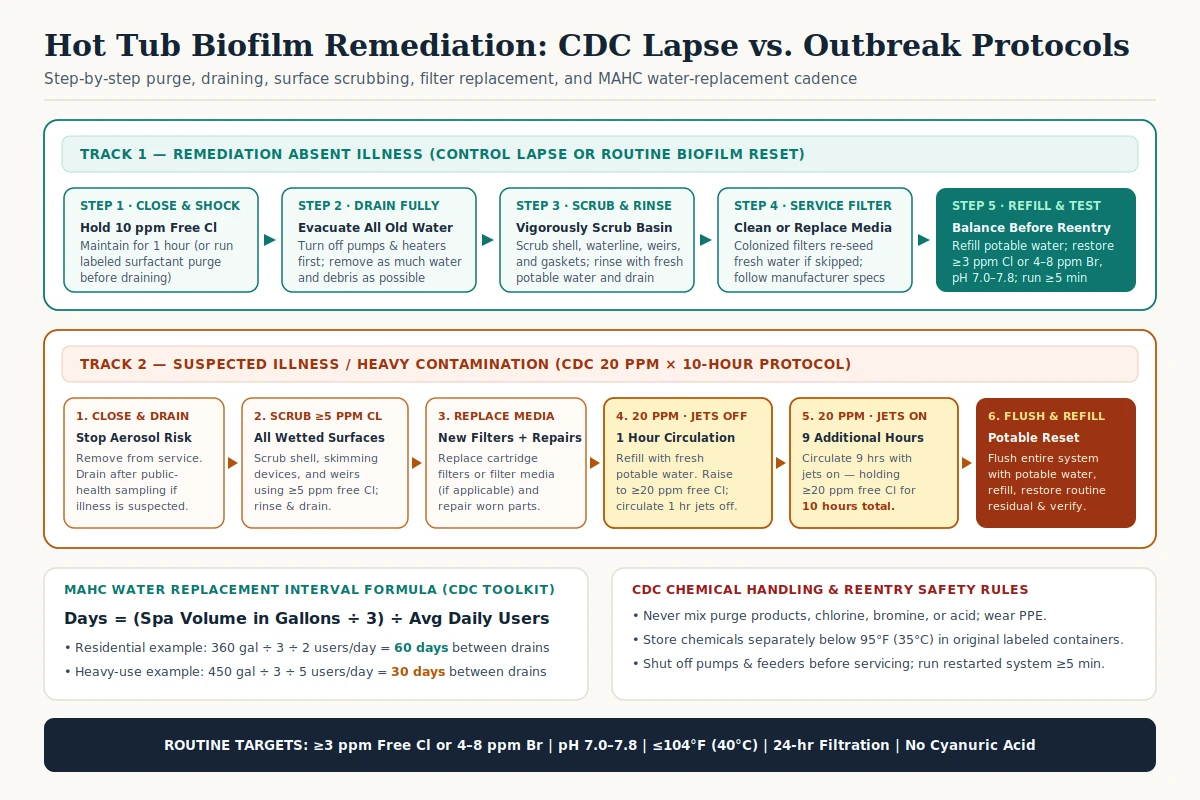
For control lapses absent illness, CDC directs removing the hot tub from service, maintaining 10 ppm free chlorine for 1 hour, draining the water, scrubbing, cleaning, and rinsing all surfaces with fresh potable water, cleaning and servicing filters per manufacturer instructions, and refilling with fresh potable water before restoring routine residuals. When a residential owner applies a manufacturer-labeled spa plumbing purge or surfactant line cleaner before draining, circulate it according to label directions and never mix it with chlorine, bromine, or acid.
During suspected illness or outbreak remediation, CDC escalates the sequence: remove the tub from service, drain after public-health sampling, scrub and clean all surfaces—including skimming devices and weirs—using water with at least 5 ppm free chlorine, rinse with potable water, replace filters or filter media (if applicable), and repair worn parts. Refill with fresh potable water, hyperchlorinate to 20 ppm free chlorine for 10 hours total—circulating 1 hour with jets off followed by 9 additional hours with jets on while maintaining at least 20 ppm free chlorine—then flush the entire system with fresh potable water, refill, and restore routine residuals.
Follow CDC pool chemical safety rules during every purge or hyperchlorination step: wear appropriate personal protective equipment, never mix incompatible chemicals, store original manufacturer-labeled containers separately below 95°F (35°C) in low humidity out of direct sunlight, shut off recirculation and chemical feed before servicing hardware, and run restarted circulation and feed systems for at least 5 minutes while confirming water quality before allowing bathers back in.
Scroll horizontally to see all columns →
| Protocol Stage | Absent Illness (Control Lapse) | Suspected Illness (Outbreak Remediation) |
|---|---|---|
| Initial service stop & dose | Close spa; hold 10 ppm free chlorine for 1 hour | Close spa immediately; collect public-health samples before draining |
| Drain & surface scrubbing | Drain water; scrub, clean, and rinse all surfaces with fresh potable water | Drain; scrub all surfaces including skimming devices and weirs with ≥5 ppm free chlorine; rinse |
| Filter & hardware service | Clean and service filters according to manufacturer recommendations | Replace filters or filter media (if applicable) and repair worn parts |
| Hyperchlorination & flush | Refill with fresh potable water and return to routine disinfectant residual | Refill; hold ≥20 ppm free chlorine for 10 hours (1 hour jets off + 9 hours jets on); flush entire system with fresh potable water and refill |
| Reentry check | Resume once disinfectant and pH sit within control limits and restarted circulation runs ≥5 minutes | Resume service in coordination with the public health authority after verifying control limits |
Can You Get Rid of Biofilm Without Draining, and How Do You Prevent Regrowth?
No—you cannot reliably eliminate established hot tub biofilm without draining, because dislodged slime, dissolved organic load, and colonized filter media stay trapped in the basin and fuel rapid regrowth if old water remains. Because temporary high disinfectant doses alone can trigger necrophilic rebound on residual biomass and organic matter reduces biocide effectiveness, complete water evacuation, vigorous scrubbing at every drain, and filter servicing are key reset steps.
Preventing regrowth relies on continuous hydraulic turnover and uninterrupted chemical control detailed in our commercial hot tub code and filtration turnover guide. CDC recommends steady water flow across the filter 24 hours per day, maintaining at least 3 ppm free chlorine (without exceeding manufacturer upper limits) or 4–8 ppm bromine at pH 7.0–7.8, keeping water at or below 104°F (40°C), excluding cyanuric acid or stabilized chlorine, covering the hot tub when idle to limit disinfectant loss and debris, enforcing maximum bather loads (CDC's MAHC recommends 10 square feet per bather), and testing disinfectant and pH at least twice daily—or hourly during heavy use.
Public and heavily used spas also remove the vessel from service daily for higher-than-normal disinfection—commonly maintaining either 10 mg/L free residual or 10 times the combined chlorine level, whichever is greater, for at least one to four hours—and drain and replace all or portions of the water weekly to monthly depending on usage and water quality. To schedule complete water changes objectively, CDC cites the MAHC replacement formula: water replacement frequency in days equals spa volume in gallons divided by 3, divided by the average number of users per day, paired with vigorous surface scrubbing every time the tub is drained and routine filter cleaning or media replacement.
Pre-Drain Biofilm Inspection, Purge & Prevention Checklist
- Check waterline tiles, steps, skimmer baskets, weirs, and accessible recirculation fittings for sticky or slippery slime and verify test strips read ≥3 ppm free chlorine (or 4–8 ppm bromine), pH 7.0–7.8, and temperature ≤104°F (40°C).
- Before draining after a control lapse, close the spa and hold 10 ppm free chlorine for 1 hour (or run a manufacturer-labeled pipe-purge product separately without mixing chemicals), wearing appropriate personal protective equipment.
- Shut off pumps, heaters, and chemical feeders before draining; evacuate as much water from the system as possible so stagnant residual water does not stay trapped in low lines.
- Vigorously scrub the acrylic shell, waterline, skimming devices, weirs, and removable rubber or silicone gaskets (using ≥5 ppm free chlorine solution during suspected-illness remediation), then rinse thoroughly with fresh potable water and drain.
- Clean cartridge filters thoroughly or replace filters and filter media according to manufacturer instructions so colonized filters do not re-seed freshly refilled water.
- For suspected illness or heavy contamination, complete CDC's 20 ppm free chlorine 10-hour hyperchlorination (1 hour jets off plus 9 additional hours jets on), flush the entire system with fresh potable water, and refill.
- Restore steady 24-hour filter flow, verify sanitizer and pH after running restarted circulation for at least 5 minutes, avoid cyanuric acid or stabilized chlorine, cover the tub when idle, and schedule drains using the MAHC formula: (spa volume in gallons / 3) / average daily users.
Frequently Asked Questions
- How do you know if your hot tub has biofilm?
- Sticky or slippery tiles, a strong chemical odor despite chlorination, visible slime inside skimmer baskets or recirculation fittings, floating flakes released when jets start, and free chlorine or bromine residuals that fall rapidly below 3 ppm chlorine or 4–8 ppm bromine are key warning signs of hot tub biofilm.
- Can you get rid of hot tub biofilm without draining the water?
- No—temporary shock doses alone can fail to penetrate thick biofilm and can allow surviving bacteria to rebound on dead biomass. Both CDC remediation protocols require draining the water, vigorously scrubbing all surfaces including skimmers and weirs, cleaning or replacing filters, and refilling with fresh potable water.
- Why does biofilm resist normal hot tub chlorine or bromine levels?
- Biofilm tolerance factors can exceed 1,000 times planktonic cell susceptibility because reactive halogens are neutralized as they diffuse into dense biomass (>12 minutes penetration time), biofilm thickness strongly reduces chlorine killing (R2 = 0.757), and encysted amoebae inside biofilm can shelter Legionella up to 50 ppm chlorine.
- Can a brand-new or display hot tub already have biofilm inside its pipes?
- Yes—OSHA warns that construction material residue can support microbial growth in new water systems, and CDC emphasizes that display hot tubs containing water require continuous disinfection and complete draining, filter drying, and moisture protection between uses to prevent biofilm colonization.
- How often should you drain and scrub a hot tub to prevent biofilm?
- CDC cites the MAHC formula where water replacement frequency in days equals (spa volume in gallons divided by 3) divided by average daily users, while public hot tubs drain and replace all or portions of water weekly to monthly with vigorous surface scrubbing every time the tub is drained.
Sources
- CDC — Controlling Legionella in Hot Tubs
- CDC — Operating and Managing Public Pools, Hot Tubs and Splash Pads
- CDC — What You Can Do to Stay Healthy in Hot Tubs
- CDC — Preventing Hot Tub Rash
- CDC — About Protecting Yourself from Legionella in Hot Tubs
- CDC — How Legionella Spreads
- CDC — Minimizing Legionella Risk from Hot Tub Displays
- CDC — Pool Chemical Safety
- Stewart PS (2015) — Antimicrobial Tolerance in Biofilms (Microbiology Spectrum, NIH/PMC)
- Falkinham et al. (2015) — Epidemiology and Ecology of Opportunistic Premise Plumbing Pathogens (Environ Health Perspect, NIH/PMC)
- Huhulescu et al. (2011) — Fatal Pseudomonas aeruginosa Pneumonia Associated With a Contaminated Hot Tub (Infection, NIH/PMC)
- Stoodley et al. (2001) — Growth and Detachment of Cell Clusters from Mature Mixed-Species Biofilms (Appl Environ Microbiol, NIH/PMC)
- OSHA — Legionellosis (Legionnaires' Disease and Pontiac Fever) Control and Prevention