
· Centaur Spa Journal Editorial desk
Swim Spa vs Pool: Current, Heater and Lane-Flow Load
A swim spa uses a powered current for swimming in place; a conventional lap pool gives you distance to swim and turn. A pool fitted with a counter-current unit is a third option. For a swim spa vs pool decision, compare the hydraulic load, heater duty, electrical operating modes and clear swimming space before choosing the shell.
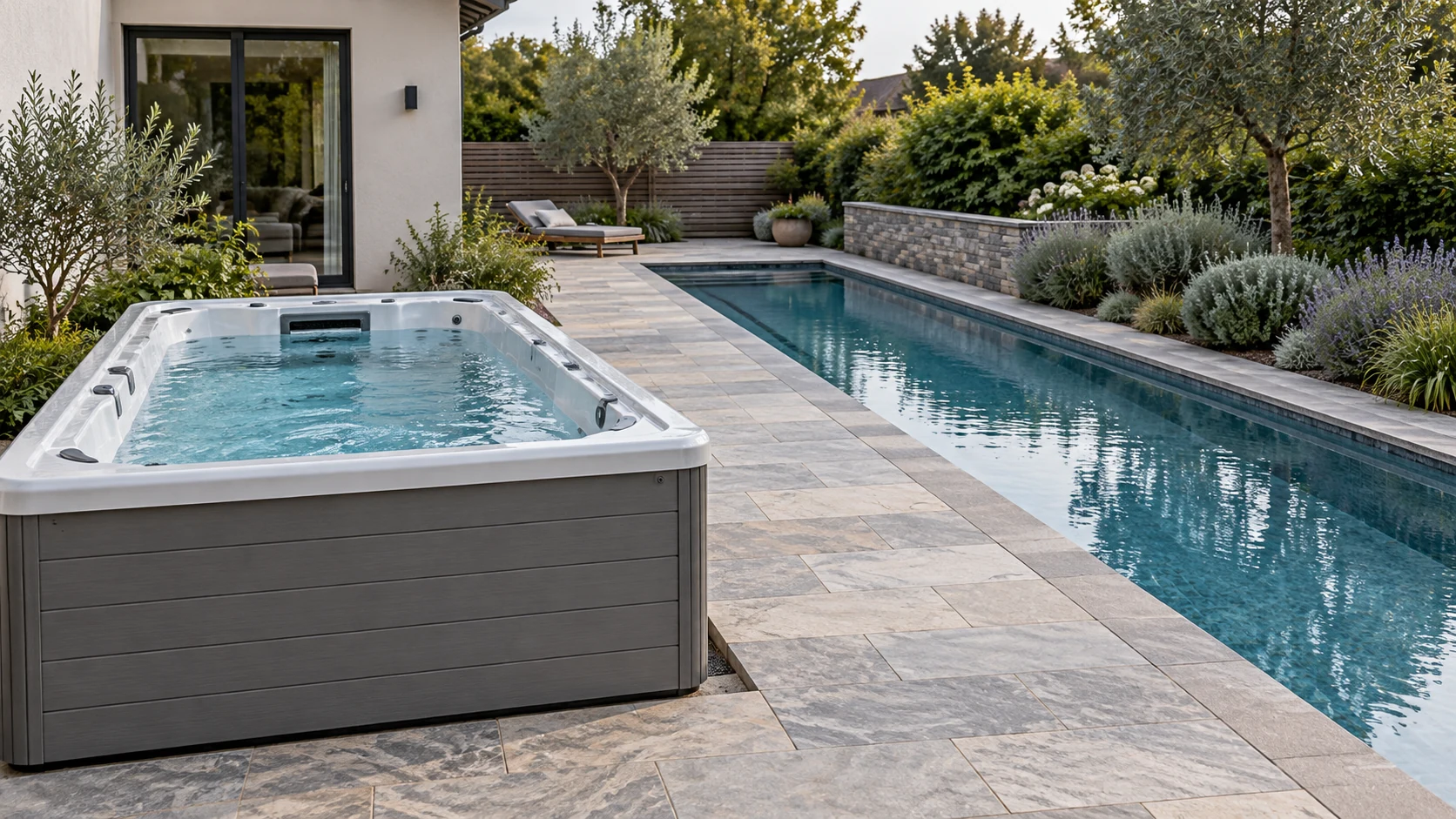
Start with the swimming experience, then trace each equipment duty. Current flow describes propulsion; filtration flow serves water treatment. Heating may share the filtration path, while controls determine which loads can run together. A smaller water volume needs less stored heat for the same temperature rise, but annual energy also depends on temperature, cover use and operating hours.
Which configuration matches the way you want to swim?
Choose a swim spa when stationary swimming and a factory vessel suit the site. Choose a lap pool when traveling lengths and turning are central to the brief. Choose a pool with a current unit when the pool layout must also accommodate swimming in place. Use the same equipment and space questions for all three.
| Decision | Factory swim spa | Conventional lap pool | Pool with a current unit |
|---|---|---|---|
| Swimming mode | Swim in place against an adjustable current | Travel lengths and turn | Swim in place; travel swimming depends on pool geometry |
| Propulsion equipment | Specified with the selected vessel | Swimming distance provides the exercise route | Current unit, mounting and equipment space added to pool design |
| Filtration and heating | Check the model’s shared or separate duties | Select the circulation path and heater for the pool | Check treatment and current duties on the actual schematic |
| Thermal inputs | Water volume, exposed area, temperature and cover schedule | The same inputs, using the designed pool geometry | The same inputs, including current-use and cover-open hours |
| Space to reserve | Usable swim well plus delivery and service access | Lane, turns, entry and equipment access | Unobstructed current envelope, mounting and service access |
Why swim spa current and filtration flow need separate checks
A strong swim spa current depends on how water reaches the swimmer: outlet geometry, flow distribution, adjustment range and the space around the body all matter. Gallons per minute (GPM) is a volume-flow measure. Read it alongside the current technology and measurement location, rather than treating it as swimmer speed.
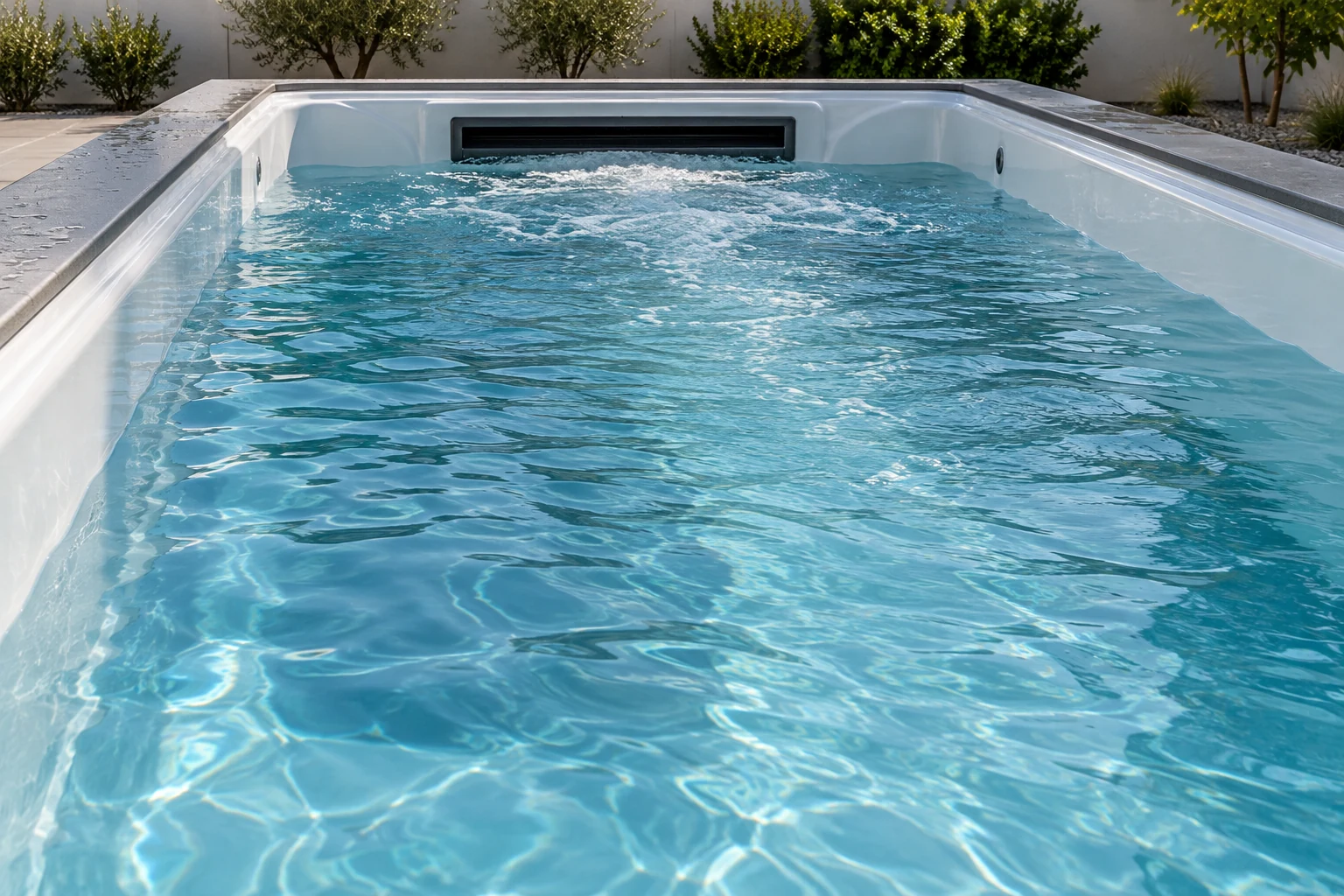
The 2025 BADU SwimJet Planning Guide gives useful model-specific examples. Its super-sport II uses two jets and a 4 HP pump, rated at 230–400 GPM. Its Turbo uses one propeller and a 2 HP motor mounted to the housing, rated at 560–1,100 GPM. These ratings describe different architectures; compare their current envelopes and electrical input at the intended setting before drawing an efficiency conclusion.
BADU’s planning page also distinguishes water discharged near a jet from the larger induced current farther into the pool. Identify whether a quoted figure means pumped flow, propeller flow or induced water movement. Filter and heater selections need the flow through those components.
Read each component at its own duty
| Equipment example | Published flow value | Selection check |
|---|---|---|
| Pentair Clean & Clear Plus CCP240 / CCP320 | Recommended flow: 90 / 120 GPM | Check actual system flow against the selected filter’s instructions |
| Pentair Clean & Clear Plus CCP420 / CCP520 | Recommended flow: 150 / 150 GPM | Account for plumbing and other components when establishing system flow |
| Pentair MasterTemp 175 / 200 / 250 / 300 / 400 | Minimum: 20 / 20 / 25 / 30 / 40 GPM; maximum: 120 GPM | The guide calls for a manual bypass above 120 GPM |
These are separate manufacturer examples for reading ratings. Pentair’s Clean & Clear Plus guide, printed page 12, notes that actual system flow depends on plumbing and other components. Its MasterTemp guide, printed page 14, Table 1, sets the heater’s allowable flow range. A filter’s recommended flow can exceed a heater’s permitted flow, so check the complete path and any specified bypass before selecting the pump duty.
Separate the functions on paper, then identify which equipment serves them. The Endless Pools E-Series manual identifies the swim-machine hydraulic unit, hydrotherapy pump, circulation pump and heater/control box separately. The 2026 Master Spas H2X manual also describes models that filter and heat using a therapy pump at low speed, and models equipped with a smaller circulation pump. The selected configuration determines the circuit arrangement.
Use the pool and spa equipment guide to record pump duties, heater flow conditions and control states together.
What sets warm-up load and ongoing heater demand?
Warm-up starts with water volume and the required temperature rise. Holding temperature requires replacing heat lost during use and standby. Compare both tasks: a small vessel operated warmer and uncovered for longer has a different duty from a cooler, covered pool.
The Endless Pools E-Series manual, revision 305031.26 A (11/25), lists the following non-treadmill configurations. The two models have the same listed heater power but different water volumes and exposed surface areas.
| Model | Water volume | Surface area | Listed heater |
|---|---|---|---|
| E500-58 | 1,770 US gal / 6,705 L | 82.5 ft² | 4,000 W |
| E700-58 | 2,150 US gal / 8,140 L | 95 ft² | 4,000 W |
For water, the approximate stored thermal energy is:
Q (kWh) ≈ 1.163 × water volume (m³) × temperature rise (°C)
Using those manual volumes, the E500-58 needs about 1.163 × 6.705 = 7.80 kWh of stored heat per °C; the E700-58 needs about 1.163 × 8.140 = 9.47 kWh per °C. Multiply by the intended temperature rise to estimate the water’s heat requirement.
Warm-up time equals that heat requirement divided by the average net heat delivered to the water. Use net delivery after heat loss and heater interruptions. The operating-mode restriction below therefore matters even when two heaters have the same nameplate power.
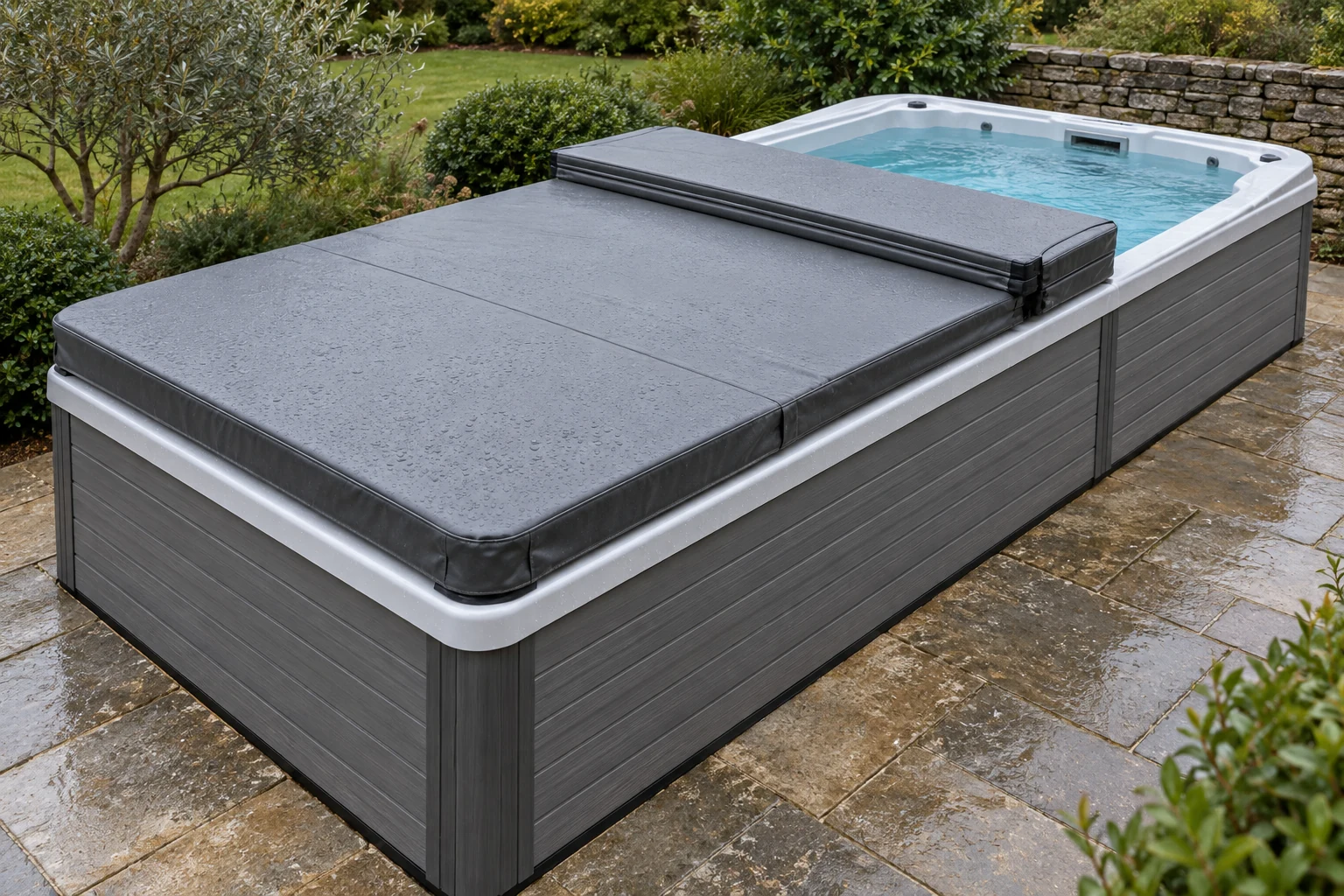
For temperature maintenance, record exposed surface area, water temperature, weather, cover use and uncovered hours. EPA’s Jump Into Pool Water Efficiency explains that evaporation removes heat and that covering the water reduces evaporation. Include the cover’s daily use in the heating brief, alongside the heater rating.
Can the heater and jets run together?
Check the operating-mode schedule as well as the supply rating. In the cited E-Series manual, the standard supply is 230 V, 60 A, single phase with GFCI protection. Its electrical note states that the heater turns off when the hydrotherapy jet pump turns on. The manual describes an 80 A conversion that permits both to run together.
That restriction concerns the hydrotherapy jet pump. The swim machine is identified separately in the equipment diagram. Record swim-current operation, hydrotherapy, circulation and heating as separate rows in the project’s mode schedule, and have the electrician apply the selected model’s instructions and local requirements.
Supply capacity and operating energy answer different questions. A breaker rating helps define the permitted installation; energy use comes from electrical input over time. For budgeting, sum each operating mode’s average input in kW multiplied by its hours of operation. Include heating interruptions and part-load operation instead of multiplying the service amperage by every hour in the month.
How much clear lane space does the current need?
Size the unobstructed swimming envelope before fixing steps, benches and wall shape. The vessel’s outside dimensions also need delivery and service space around them. For a current-equipped pool, the installation wall and the space in front of the outlet are part of the equipment selection.
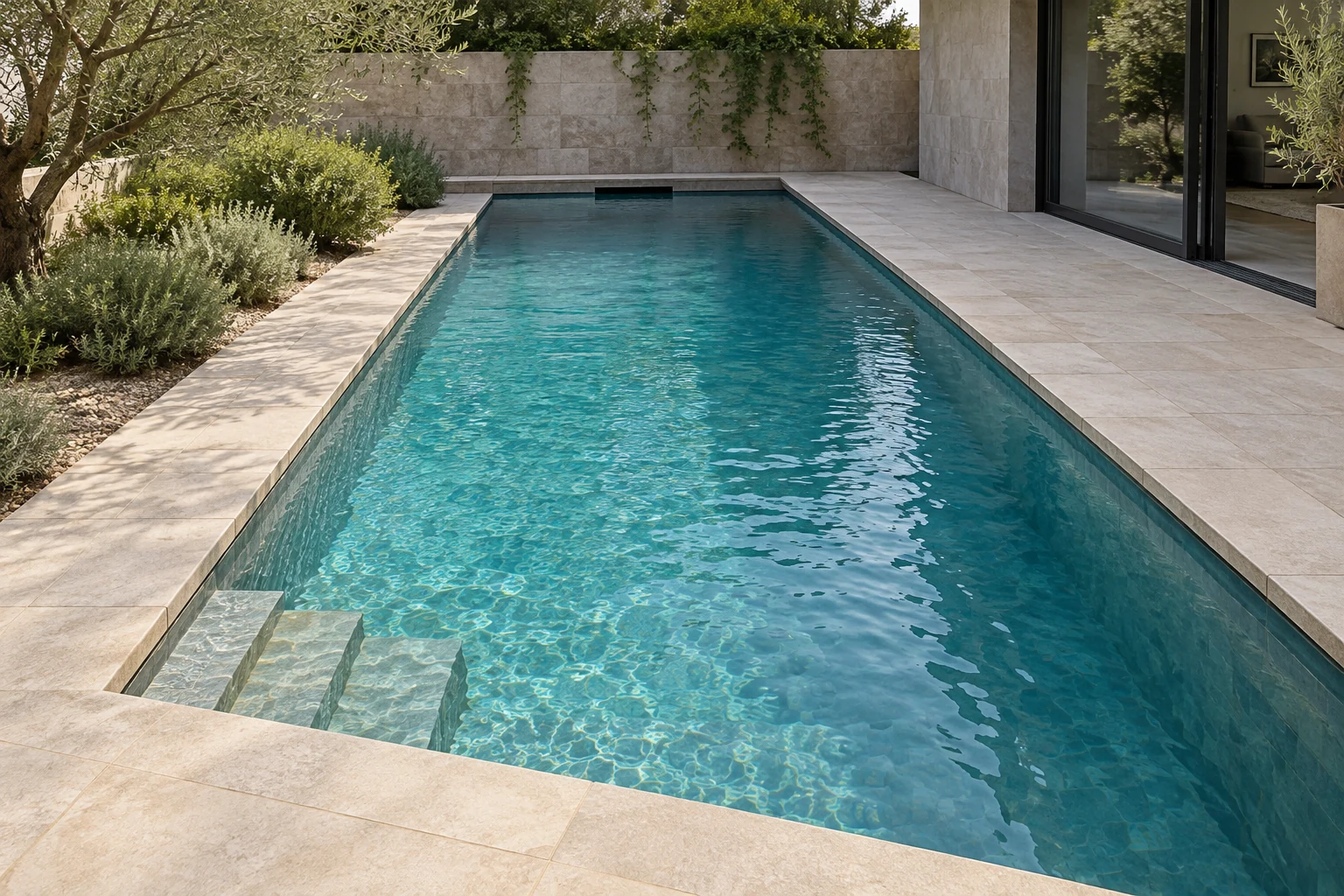
BADU’s builder specifications require an unobstructed 8 ft wide × 15 ft long × 3 ft deep swim envelope for BaduStream II, super-sport II and Imperial. Turbo Pro calls for 8 ft × 20 ft × 3 ft and a straight installation wall. Apply the envelope specified for the chosen unit, then position entry steps and seating around it.
If steps, seating or a curved wall intrude into the unit’s required envelope, revise the layout or the current-unit choice before committing to the shell. More pump power does not resolve a geometric obstruction.
Coordinate the lane, cover movement and equipment access in the pool and spa design brief so the shell and operating plan are resolved together.
Pre-construction comparison checklist
Bring these items to the design meeting for each candidate. The useful comparison is a complete operating arrangement that fits the site and intended swim session.
- Swimming brief: stationary swimming or travel laps, intended users, session length and usable swimming space.
- Current-unit data: exact model, current technology, adjustment range, flow-measurement boundary and required clear envelope.
- Hydraulic schematic: propulsion, hydrotherapy, filtration and heating duties; identify shared pumps, flow paths and specified bypasses.
- Component flow checks: pump operating point and the selected filter/heater’s permitted flow and pressure conditions.
- Heating brief: water volume, surface area, starting and target temperatures, weather exposure, cover type and daily uncovered hours.
- Electrical mode schedule: supply requirement, input power, which loads run together, and when heating pauses.
- Space and access plan: unobstructed lane, mounting wall, delivery route, service clearances and cover storage or travel.
For a hotel or other public-use project, add the occupancy and water-treatment requirements from the commercial spa filtration and turnover guide and the local authority’s requirements to that brief.
Frequently asked questions
Does a higher GPM rating mean a better swim current?
Judge the current at the swimmer’s position. Outlet width, flow distribution, adjustment and the clear swimming envelope affect the experience. First establish what the GPM figure measures, then compare the selected systems at the intended swimming setting.
Can a swim spa share a pump for heating and filtration?
Yes, some configurations use a therapy pump at low speed for filtration and heating; others use a dedicated circulation pump. The 2026 H2X manual describes both arrangements. Use the selected model’s hydraulic and operating instructions to identify the shared duty.
Is a smaller swim spa always cheaper to heat than a pool?
For the same temperature rise, less water requires less stored thermal energy. Continuing energy use also depends on exposed area, temperature, weather, cover hours and heater operation. Compare those inputs over the same season and usage schedule to judge running demand.
Technical references
- BADU SwimJet Planning Guide (2025), page 4, “Which BADU system is right for you?”; BADU planning page, “How They Work” and “Builder Specifications.”
- Master Spas, 2026 H2X Owner’s Manual, “Glossary of Swim Spa Terminology,” items 19, 22 and 24.
- Endless Pools, E-Series Fitness Systems Owner’s Manual, 305031.26 A (11/25), printed pages 5–6 and final “Fitness System Specifications” table (PDF page 32).
- Pentair, Clean & Clear Plus Cartridge Filter Installation and User’s Guide, printed page 12, “Recommended Flow Rates.”
- Pentair, MasterTemp Pool and Spa Heater Installation and User’s Guide, printed page 14, Table 1 and “Manual By-Pass.”
- U.S. EPA WaterSense, Jump Into Pool Water Efficiency (2022), “Evaporation,” “Cover Up” and “Cool Off.”