
Bromine vs Chlorine for a Hot Tub: pH Window, Sunlight, Ozone, and Safe Feeder Rules
Chlorine and bromine sanitize hot tubs at pH 7.0–7.8 and ≤104°F: CDC checks ≥3 ppm chlorine or bromine of 4–8 ppm, and feeders stay separate.
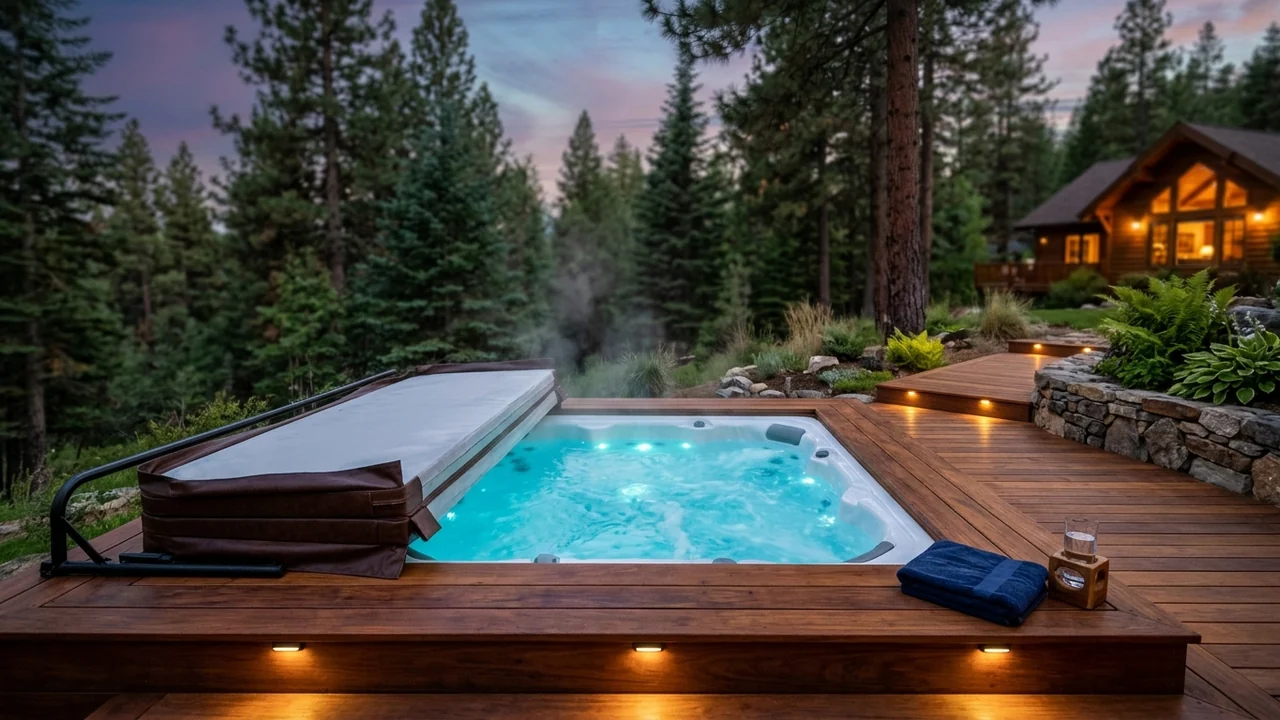
Chlorine and bromine are both EPA-registered halogen sanitizers that disinfect hot tub water by forming hypochlorous acid (HOCl) or hypobromous acid (HOBr) to kill bacteria; before entering a hot tub, CDC user guidance checks for water no warmer than 104°F (40°C), chlorine of at least 3 parts per million (ppm or mg/L) with a check with the operator or owner above 10ppm, bromine of 4–8 ppm with a check above 8ppm, and pH of 7.0–7.8.
CDC says a properly chlorinated hot tub has little odor and that a strong chemical smell indicates a problem, while Missouri's water-chemistry text says chloramines, not too much active chlorine, cause that odor and can irritate eyes and skin; a chlorine product and a bromine product never go into the same feeder or dilution bucket, because mixing pool chemicals can create high temperatures or release toxic gas.
Residential owners pair CDC's strip check with the EPA-registered product label, whereas public and hotel spas follow their jurisdiction's adopted pool code with qualified pool and spa maintenance oversight and coordinate circulation and treatment circuits across sunlight, pH drift, oxidizer routine, and ozone hardware.
What Are the Pros and Cons of Bromine vs Chlorine?
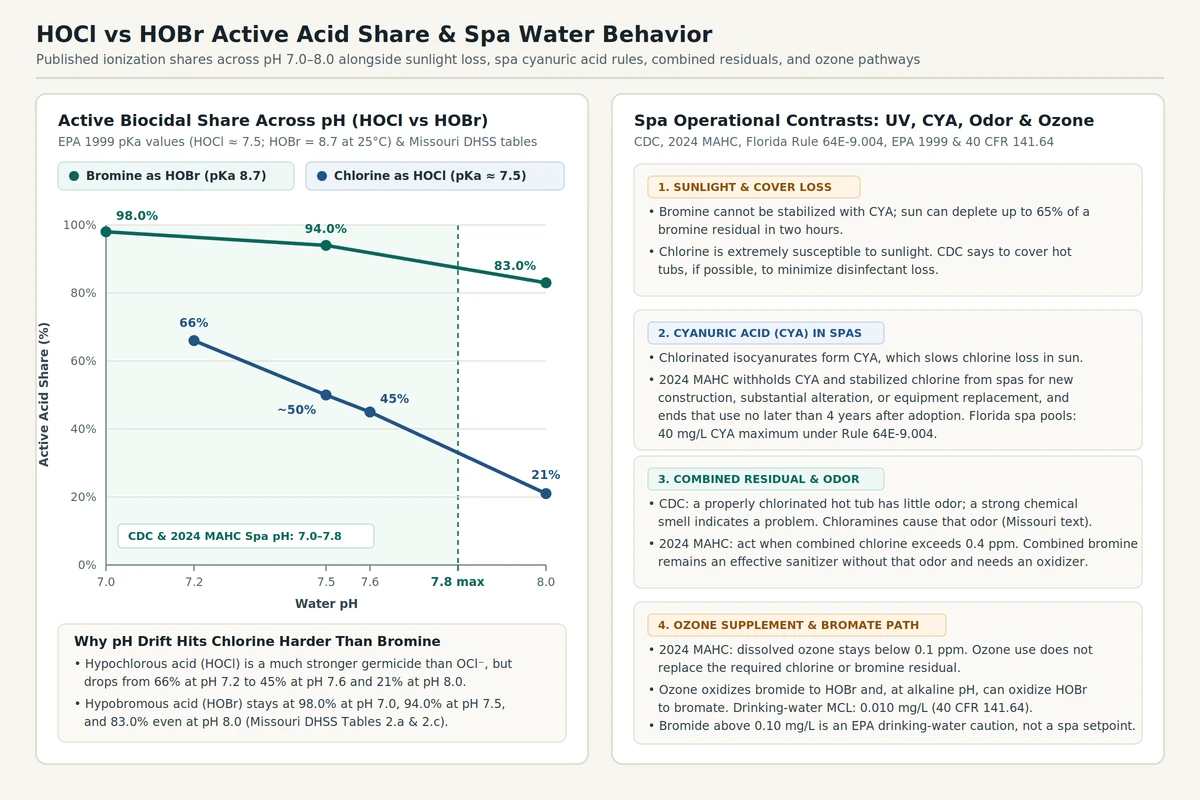
Chlorine acts as both a sanitizer and an oxidizer in spa water, whereas bromine holds a much higher un-ionized active share as pH rises toward 7.8 and forms combined bromamines that remain effective sanitizers without odor. EPA's water-disinfection manual (1999) lists hypochlorous acid (HOCl) with a pKa of about 7.5—no dissociation below pH 6.5, incomplete dissociation between pH 6.5 and 8.5 into HOCl and slower-acting hypochlorite ion (OCl⁻), and complete dissociation to OCl⁻ above pH 8.5—while hypobromous acid (HOBr) has a pKa of 8.7 at 25°C. In Missouri's public-health water-chemistry tables, active HOBr stands at 98.0% at pH 7.0, 94.0% at pH 7.5, and 83.0% at pH 8.0 (with 2.0%, 6.0%, and 17.0% hypobromite), while active HOCl falls from 66% at pH 7.2 (34% OCl⁻) to about 50% at pH 7.5, 45% at pH 7.6 (55% OCl⁻), and 21% at pH 8.0 (79% OCl⁻).
CDC says low water volumes combined with high temperatures and heavy bather loads make public hot tub operation challenging, and CDC and the MAHC (2024) keep spa water at or below 104°F (40°C): EPA's manual (1999) says effectiveness increases as temperature increases for all disinfectants, while warmer temperatures can raise chlorine demand and require a higher dosage to keep a residual. Under direct sun, chlorine is extremely susceptible to sunlight and needs regular monitoring, while bromine cannot be stabilized with cyanuric acid—as much as 65 percent of a bromine residual can be depleted by the sun in two hours—and Missouri's training text says many experts recommend bromine for indoor pools or spas only because sunlight leaves no reliable way to hold the residual.
Although cyanuric acid (also called stabilizer or conditioner) protects outdoor pool chlorine from sunlight, CDC's Model Aquatic Health Code (MAHC, 2024) bars cyanuric acid and stabilized chlorine in spas and therapy pools for new construction, substantial alteration, or disinfection-equipment replacement and phases them out within 4 years of adoption; as a separate state rule, Florida Rule 64E-9.004 sets a 100 mg/L pool cap, a 40 mg/L recommended maximum, and a 40 mg/L maximum in public spa pools, while keeping the hot tub covered minimizes loss for either halogen and bromine still requires a separate oxidizing chemical.
Scroll horizontally to see all columns →
| Factor | Chlorine | Bromine |
|---|---|---|
| Active acid & pKa | Hypochlorous acid (HOCl), pKa about 7.5; stronger germicide than slower OCl⁻ | Hypobromous acid (HOBr), pKa 8.7 at 25°C; the bromine compound forms HOBr and OBr⁻ when an oxidizer is present |
| Published active share by pH | 66% HOCl at pH 7.2; about 50% at pH 7.5; 45% at pH 7.6; 21% at pH 8.0 | 98.0% HOBr at pH 7.0; 94.0% at pH 7.5; 83.0% at pH 8.0 |
| Combined residual & odor | Chloramines cause chemical odor and eye or skin irritation; MAHC (2024) action above 0.4 ppm | Combined bromine remains an effective sanitizer and does not smell |
| Oxidation role | Acts as both a primary sanitizer and an oxidizer | Oxidizes poorly on its own and requires a separate oxidizing chemical |
| Sunlight & cyanuric acid (CYA) | UV-sensitive; MAHC (2024) withholds CYA from spas, while Florida Rule 64E-9.004 caps spa pools at 40 mg/L CYA | Cannot be stabilized with CYA; up to 65% of bromine residual can deplete in two hours of sun |
| Warm water & cover control | Effectiveness rises with temperature while warm water can raise chlorine demand; cover tub when idle | Effectiveness rises with temperature; keep tub covered when idle to minimize disinfectant loss |
Which Sanitizer Levels Do CDC and Public Spa Codes Set?
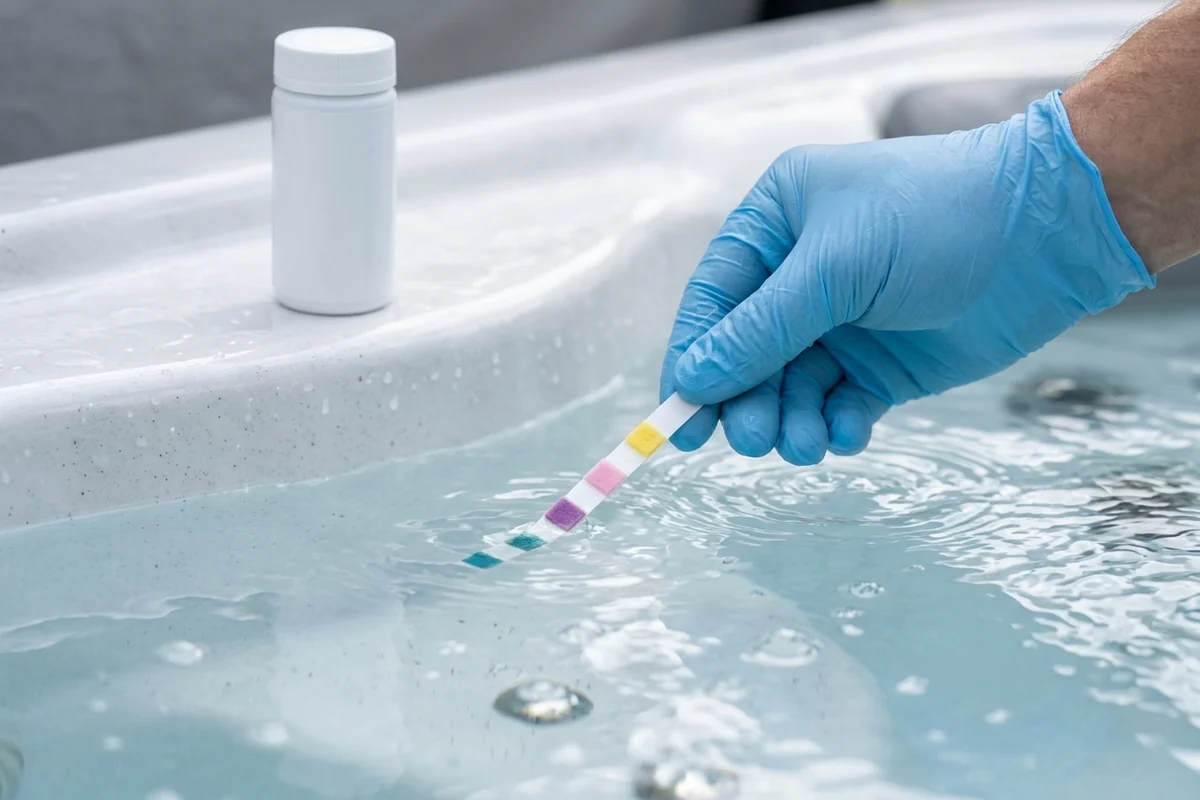
A home hot tub user relies on CDC's test-strip check and the EPA-registered product label, whereas a public, hotel, or apartment spa follows the pool code adopted by its local, state, tribal, or territorial authority; because low disinfectant levels allow Pseudomonas and Legionella to grow and spread and to cause skin and respiratory illnesses, CDC tells bathers to ask whether chlorine or bromine and pH are checked at least twice a day, and instructs public operators to test at least twice daily and hourly during heavy use.
Public codes keep distinct minimums, maxima, and hardware rules that cannot be merged into one national number: the MAHC (2024) requires at least 3.0 ppm DPD free chlorine in spas (not exceeding product-label limits) or 4.00 ppm bromine in spas (3.0 ppm in other aquatic venues, capped at 8.0 ppm while open to bathers) at pH 7.0 - 7.8 and ≤ 104°F (40°C), plus a 0.5-hour maximum allowable turnover for the ≥ 93°–104°F spa row detailed in our commercial hot tub code and filtration turnover guide. Florida's revised Rule 64E-9.004 sets 2 mg/L to 5 mg/L, inclusive, for free chlorine in spa-type pools, caps available bromine at 6 ppm across all pools and spas (1.5 mg/L to 6 mg/L in conventional pools and 3 mg/L to 6 mg/L in all other type pools), and requires immediate closure to patrons above those maxima; Missouri's lodging rule keeps at least 1.0 ppm free chlorine in the swimming pool and 3–5 ppm bromine in the spa at pH 7.2 to 7.8.
Scroll horizontally to see all columns →
| Authority | Chlorine | Bromine | pH & Testing |
|---|---|---|---|
| CDC Hot-Tub User Check | At least 3 ppm (mg/L); talk to operator or owner above 10ppm | Bromine of 4–8 ppm; talk to operator or owner above 8ppm | pH 7.0–7.8; water not above 104°F (40°C); ask if tested twice daily |
| CDC Public Operator Steps | Minimum 3 ppm free chlorine; stay within label upper limits | Minimum 4 ppm bromine; stay within label upper limits | pH 7.0-7.8; prevent water exceeding 104°F (40°C); test twice daily and hourly in heavy use |
| CDC MAHC (2024, Spas) | Minimum 3.0 ppm DPD free chlorine; ceiling per product label | Minimum 4.00 ppm in spas (3.0 ppm all venues); max 8.0 ppm open to bathers | pH 7.0 - 7.8; ≤ 104°F (40°C); act above 0.4 ppm combined chlorine; 0.5-hour maximum allowable turnover at ≥ 93°–104°F |
| Florida Rule 64E-9.004 Bulletin | 2 mg/L to 5 mg/L, inclusive, in spa-type pools | Max 6 ppm all pools and spas (1.5–6 mg/L conventional; 3–6 mg/L all other type pools) | pH 7.0 to 7.8; close the pool or spa immediately to patrons when chlorine or bromine is above those maxima |
| Missouri Lodging Rule | At least 1.0 ppm free chlorine throughout the swimming pool | 3–5 ppm bromine residual throughout the spa | Pool and spa pH maintained between 7.2 and 7.8 |
How Do Tablets, Granules, Salt Systems, and Feeders Differ?
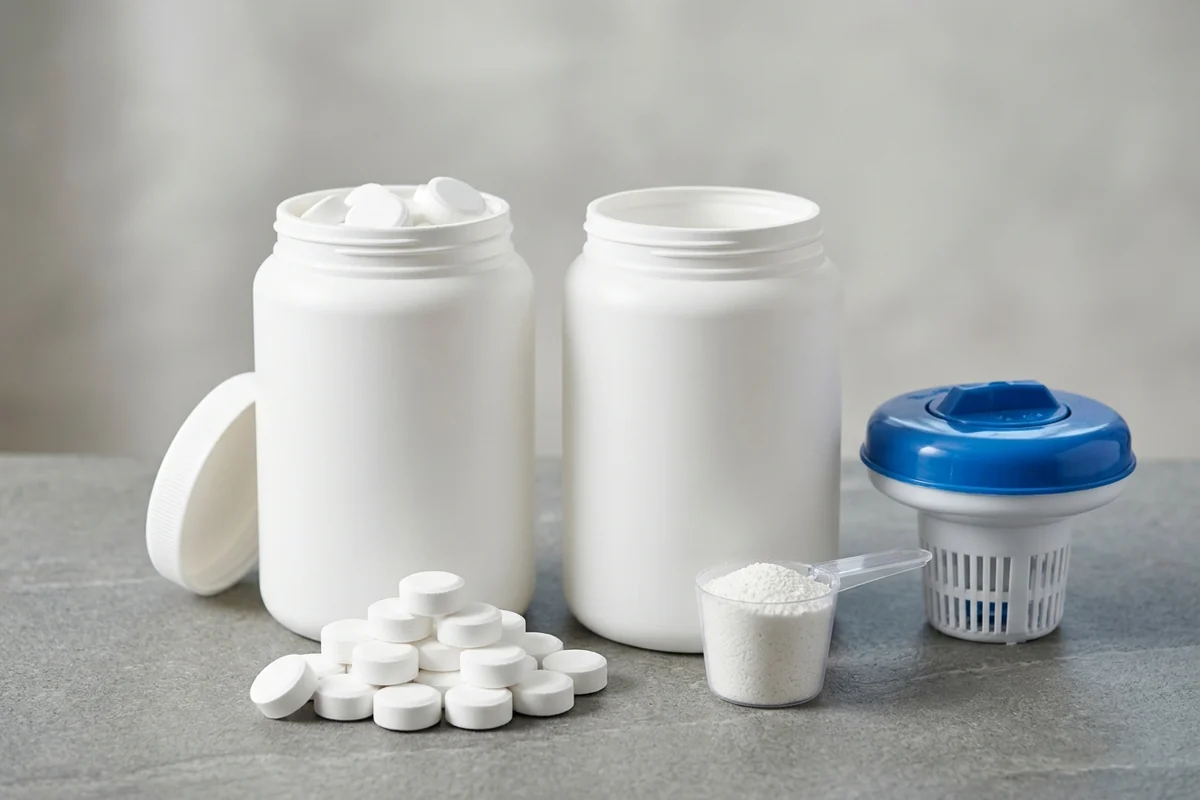
Under the MAHC (2024), all chemical-feed components must be dedicated to a single chemical and two or more chemicals must never be mixed in the same dilution water; gas, dry, and liquid chlorine all form HOCl and OCl⁻ in water, and EPA's manual (1999) notes that adding sodium hypochlorite solution or granular calcium hypochlorite to water yields hydroxyl ions that increase water pH. Bromine is sold either as a two-part bromide salt dissolved in water and activated by a separate oxidizer, or as a one-part organic halohydantoin stick or tablet—such as DBDMH or BCDMH, with a compound pH of 4.0-4.5—fed through an erosion feeder; although BCDMH combines bromine and chlorine inside one EPA-registered compound, the MAHC (2024) requires flow-through feeders to run only the exact formulation, brand, size, and shape specified by the feeder manufacturer.
Saltwater and brine electrolytic generators are not a separate halogen-free sanitizer class: the MAHC (2024) lists salt electrolytic chlorine generators and brine electrolytic chlorine or bromine generators with the primary disinfectants, EPA's drinking-water manual (1999) says dilute sodium hypochlorite under 1 percent can be generated on-site from salt brine, a chlorine generator manufactures chlorine from salt into the circulation water, and pool-grade salt shall be certified to NSF/ANSI 50 or NSF/ANSI 60 and/or EPA-registered and held in the manufacturer's salinity band, while MAHC treatment chemicals shall be certified to NSF/ANSI 50 or NSF/ANSI 60 with EPA FIFRA registration for disinfectants and used only according to the manufacturer's instructions. CDC's MMWR recommendations (2019) and chemical-safety guidance warn never to mix chlorine with acid, never to mix different or old and new pool chemicals—mixing calcium hypochlorite with dichlor or trichlor can cause explosions—to use appropriate personal protective equipment when handling chemicals, to add chemical to water only when a label directs predissolving, to keep children from handling any pool pesticide, and to store original manufacturer-labeled containers separately below 95°F/35°C in low humidity out of direct sun.
On automated builds, coordinate chemical feed with pool and spa equipment circuits by defining the cover-closed state separately for the circulation/filter pump, spa jet circuit, and decorative features using the installed equipment manuals—treating model-specific examples such as public IntelliCenter cover guide 523457 Revision C (August 2020, p. 8), which configures a chlorinator's covered-state behavior, as one model's setting rather than evidence that every cover controller provides an interlock.
Should You Use Bromine or Chlorine With an Ozonator?
An ozonator can run alongside either bromine or chlorine, because ozone is unstable and should be generated at the point of application, cannot create a residual, and is used together with chlorine or bromine. In the MAHC (2024), use of ozone does not modify any other water-quality requirements, and residual dissolved ozone in the aquatic venue water shall remain below 0.1 ppm (mg/L).
When bromide ion is present, ozone or free chlorine oxidizes bromide into active hypobromous acid, while under alkaline pH conditions ozone can oxidize hypobromous acid further to produce bromate ion—a pathway controlled in water treatment by ozonating at acidic pH where hypobromous acid dominates. Published numeric bromate limits govern drinking water rather than spa codes: 40 CFR 141.64 sets drinking-water maximum contaminant levels of 0.010 mg/L for bromate and 1.0 mg/L for chlorite with ozone-process control as best available technology, and EPA's drinking-water manual (1999) treats source-water bromide above 0.10 mg/L as a potable ozonation limit rather than a spa bromine setpoint.
Does Bromine or Chlorine Cause Less Hot Tub Skin Irritation?
Public-health and pesticide toxicology sources do not name either bromine or chlorine as gentler for sensitive skin; NPIC states that maintaining the proper level of these chemicals and proper water pH helps to kill bacteria and reduce irritation to swimmers. NPIC's acute-toxicity primary-skin row keeps each compound separate—listing sodium and calcium hypochlorite salts as corrosive, chlorinated isocyanurates as a mild irritant, halohydantoins as corrosive, and sodium bromide salt as low toxicity, so the low-toxicity salt entry does not apply to halohydantoin bromine tablets.
In hot tub water, CDC states that hot tub rash is caused by the germ Pseudomonas aeruginosa—which can grow and spread along with Legionella when disinfectant levels drop low—while a chlorine-like odor and eye or skin irritation come from chloramines rather than too much active chlorine.
Which Sanitizer Fits Your Hot Tub Setup and Feeder Checklist?
Match your hot tub sanitizer to sunlight exposure, pH drift, oxidizer routine, and ozone or salt hardware, then complete a dedicated-feeder and label checklist before dosing—remembering that product-specific maintenance schedules and EPA labels govern changeover without any universal drain formula or chemical mixing.
Scroll horizontally to see all columns →
| Setup | Operational Fit | Chemistry & Code Basis |
|---|---|---|
| Indoor or covered spa with upward pH drift | Bromine (two-part bromide + oxidizer or erosion-fed DBDMH/BCDMH) | Holds 94.0% active HOBr at pH 7.5 and 83.0% at pH 8.0; bromamines sanitize without odor; needs separate oxidizer |
| Uncovered outdoor spa in direct sunlight | Unstabilized chlorine with frequent testing and cover closed when idle | Up to 65% of bromine can deplete in two hours of sun; MAHC (2024) bars spa CYA (Florida caps spa CYA at 40 mg/L) |
| Single-product sanitizer plus oxidizer routine | Chlorine (EPA-registered spa liquid or granules, held within pH of 7.0–7.8) | Serves as both sanitizer and oxidizer; holds 66% HOCl at pH 7.2 vs 45% at pH 7.6; hypochlorites raise pH |
| Spa with ozonator or salt/brine generator | Either halogen maintained at full CDC or adopted code residual | Dissolved ozone stays below 0.1 ppm and ozone use does not replace the halogen residual; ozone oxidizes bromide to HOBr and can form bromate at alkaline pH; salt units make halogen |
Feeder & Label Checklist
- Confirm EPA FIFRA spa registration on the product label (plus NSF/ANSI 50 or 60 certification where required by code) and note the label's upper residual ceiling.
- Verify that no old or different chemical remains in the feeder, dedicate and clearly label every chemical-feed component for a single chemical, and load flow-through feeders only with the formulation, brand, size, and shape specified by the feeder manufacturer.
- Wear personal protective equipment, never mix chlorine and bromine, acid, old and new products, or calcium hypochlorite with dichlor/trichlor in the same feeder or dilution water, and add chemical to water only when the label directs predissolving.
- Store each sanitizer separately in its original manufacturer-labeled container, keep children from handling these pesticides, and keep the containers out of direct sunlight, in low humidity, and below 95°F/35°C.
- Test water before bathing to verify temperature is at or below 104°F (40°C), pH is 7.0–7.8, and sanitizer meets CDC's strip check (≥ 3 ppm chlorine or bromine of 4–8 ppm) or the venue's adopted public code.
Frequently Asked Questions
- What levels of chlorine or bromine should a hot tub have?
- For bathers checking water with test strips, CDC recommends at least 3 ppm chlorine (talk to the operator or owner above 10 ppm), 4–8 ppm bromine (talk to the operator or owner above 8 ppm), pH 7.0–7.8, and water no warmer than 104°F (40°C), while public venues enforce their adopted state or local code.
- Can you put bromine tablets in a chlorine feeder or mix both sanitizers?
- No—CDC, NPIC, and the MAHC (2024) forbid mixing pool chemicals, require every feeder component to be dedicated and labeled for one chemical, and restrict flow-through feeders to the exact formulation, brand, size, and shape specified by the feeder manufacturer.
- Does a saltwater or ozonator hot tub still need chlorine or bromine?
- Yes—a salt or brine generator manufactures chlorine (or chlorine/bromine) electrochemically in the circulation loop, and an ozonator holds no residual in the tub, so normal free chlorine or bromine residuals still apply.
Sources
- CDC — What You Can Do to Stay Healthy in Hot Tubs
- CDC — Preventing Hot Tub Rash
- CDC — Operating Public Pools, Hot Tubs, and Splash Pads
- CDC — Pool Chemical Safety
- CDC Morbidity and Mortality Weekly Report — Pool Chemical Injuries
- CDC — Model Aquatic Health Code (MAHC)
- Florida Department of Health — Public Pool and Spa Disinfection Bulletin
- Missouri Department of Health and Senior Services — Lodging Swimming Pools and Spas
- U.S. EPA — Alternative Disinfectants and Oxidants Guidance Manual
- Electronic Code of Federal Regulations — Disinfection Byproducts (40 CFR 141.64)
- National Pesticide Information Center (Oregon State University) — Pool Chemicals Fact Sheet
- Missouri DHSS — Swimming Pool Water Chemistry Training Booklet