
Cold Plunge and Contrast Therapy Beside a Spa
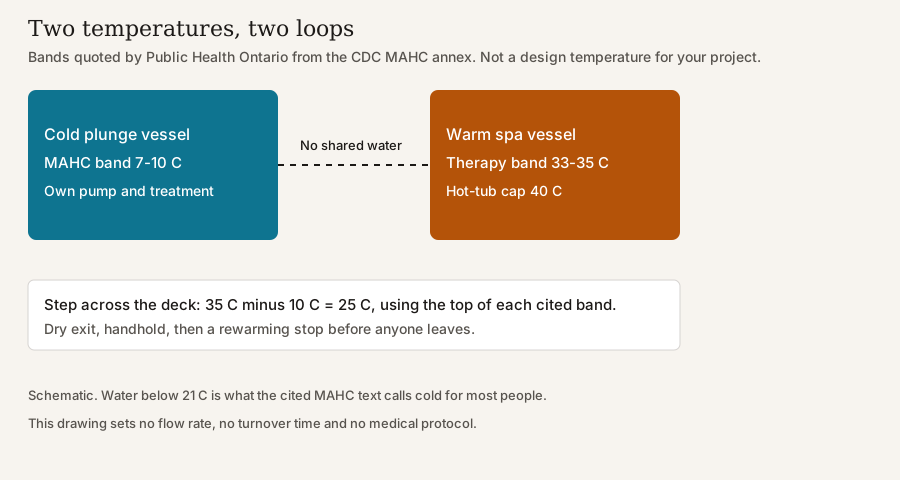
Putting a cold plunge on the same circulation loop as a hot spa wastes the heater and the chiller and puts bathers through a temperature step the water cannot hold at both ends. Public Health Ontario's 2024 cold-plunge FAQ, quoting the CDC Model Aquatic Health Code annex, puts cold-water plunge tanks generally at 7-10°C and therapy or rehab water at 33-35°C.
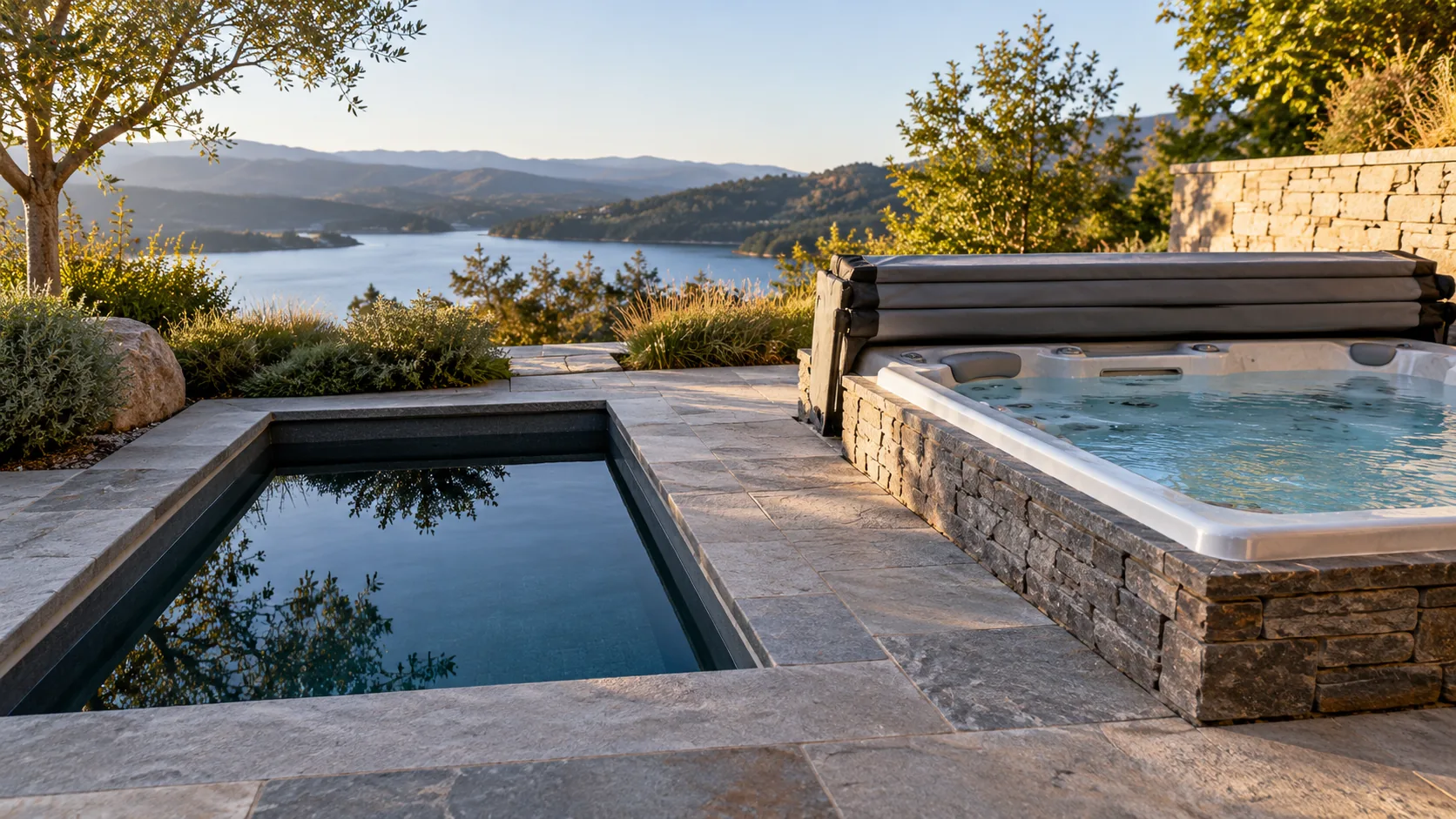
Keep the plunge and the warm spa as separate vessels with separate circulation. A single body of water cannot sit in both the 7-10°C plunge band and the 33-35°C therapy band quoted from the MAHC. The deck between them needs a controlled exit and a rewarming stop, because the same FAQ lists impaired coordination and falls among the outcomes of a sudden temperature change. This page is a layout and operations record for that pairing. It is not a medical protocol and it does not set an immersion time for any person.
Start from the pool and spa layout if the two vessels are not drawn yet. Heat, pipe route and whether water is shared or isolated already belong on that brief.
Which temperature bands are actually published?
Public Health Ontario's FAQ, current to the copy fetched on 20 October 2026, says there is no single definition of cold water. It reports that the MAHC annex treats water below 21°C as cold for most people, uncomfortable or painful enough to restrict normal activity. The FAQ's table of MAHC temperature guidance is:
| Aquatic use | Temperature band cited from the MAHC | Dominant failure mode and prevention |
|---|---|---|
| Cold-water plunge tank | 7-10°C | Cold shock on entry, including a gasp. Prevention: enter gradually, keep the face out until breathing settles, and supervise. The FAQ says cold shock can occur in water as warm as 10-15°C. |
| Therapy and rehab | 33-35°C | Using this band as if it were the plunge. Prevention: label the vessel. A therapy pool is not a cold plunge. |
| Recreational water | 28-30°C | Calling a swimming pool a plunge because it feels cool to one bather. Prevention: record the operating setpoint, not the complaint. |
| Hot tub | Maximum 40°C | Holding the spa at the cap and then stepping straight into 7°C water with no exit plan. Prevention: separate loops, a handhold, and a rewarming area before anyone leaves. |
Ontario plunge tanks are reported in that FAQ at 1-5°C, with some claims of 0°C. Those are reported operating points, not a target to copy. The MAHC band the FAQ cites for cold-water plunge tanks remains 7-10°C.
Rule of thumb: If the warm vessel is at the top of the therapy band (35°C) and the plunge is at the top of the cited plunge band (10°C), the step on the deck is 25°C. Do not erase that step by mixing the two waters.
Takeaway: Write the setpoint for each vessel from a cited band or from the project's own engineer. Do not average them.
Why the loops stay separate
Formula. Temperature step = warm-vessel temperature minus plunge temperature.
Worked example. Using the tops of the two MAHC bands in the table: 35°C minus 10°C = 25°C. Using the bottoms: 33°C minus 7°C = 26°C. Either way the deck crosses about 25°C. A shared pipe that tries to serve both setpoints fights itself: the heater and the chiller move the same water in opposite directions, and neither vessel holds its band.
The pool and spa layout brief already asks whether water is shared or isolated, and whether heating duties run together. A cold plunge is the sharp case of that question. Isolated water means its own pump, filter and treatment, not a tee off the spa return. The equipment-room guide is where the extra pump, the chiller and the access for both belong, before the shell is poured.
Contrast bathing, in the FAQ's summary of reported practice, is alternating a cold plunge and tepid water, each for about 1 to 5 minutes, or a single short immersion of about 30 seconds to 2 minutes for casual users. Athletes are reported using immersions up to 20 minutes. Those are reported patterns in the FAQ, not a session to prescribe. The FAQ also says serious hypothermia timing from long cold-water swimming is unlikely to match a 30-second to 2-minute plunge, and then lists the early risks anyway: cold shock in the first minutes, then muscle failure if exposure continues.
What the exit has to survive
The FAQ, citing the MAHC, lists immediate impaired coordination, loss of breathing control and, after core temperature falls, slowed heartbeat, hypothermia, muscle cramps and loss of consciousness. A separate literature note in the same FAQ says a gasp while the airway is under water can drown, and that about 150 mL of water in the lungs can be enough. Fall injuries on the way out are listed because muscle control drops.
The building response is ordinary and specific:
- A handhold at the exit, and a step that is still usable with wet feet.
- A dry path that does not cross the spa cover or a weir.
- A rewarming place, and a check that the person has rewarmed before leaving the site. The FAQ lists that check among operator actions.
- Supervision by someone who is not also in the plunge.
- Time limits written for the facility, not invented as a universal dose. The FAQ tells operators to consider time limits. It does not publish one number for every tank.
Pregnant bathers, people with pre-existing medical conditions, and young children are the groups the FAQ says should avoid extreme water temperatures, following the MAHC language it cites. Alcohol and some medicines are called out as changing cold tolerance. This journal does not screen health. The record should say who is allowed to use the plunge and who confirms that rule.
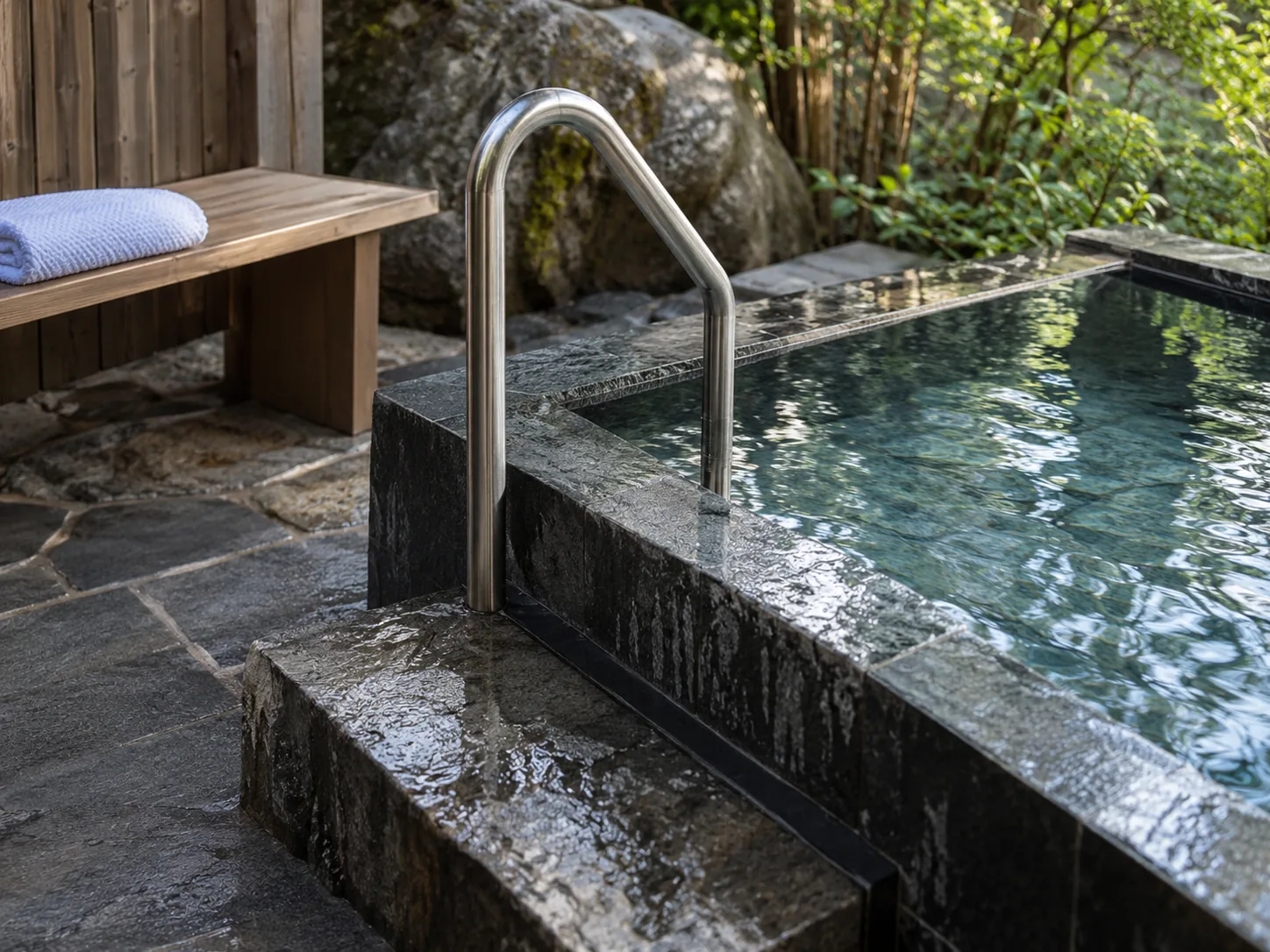
Takeaway: The temperature step is a deck problem and a supervision problem, not only a chiller problem.
What to leave blank until the project fills it
Turnover time is volume divided by flow. This page does not supply either number. A code turnover, a disinfectant residual at 7°C, and a chiller capacity are project calculations. Write them on the equipment brief when the volumes exist. Do not copy a swimming-pool turnover onto a plunge the size of a few seats.
| Record | What to enter | Leave blank until |
|---|---|---|
| Plunge setpoint and source | The operating temperature and the document that sets it | The engineer or the authority names it |
| Warm vessel setpoint | Spa or therapy vessel, with its own cap | The heater schedule exists |
| Water connection | Isolated, or a named shared mode | The hydraulic drawing says which |
| Exit and rewarming | Handhold, path, where people sit afterward | The deck plan shows them |
| Who may use it | The facility rule for pregnancy, children, known conditions | The operator writes the rule |
| Immersion limit | The facility's own limit | Someone adopts a number on purpose |
The raised spillover guide covers a warm spa that spills into a pool. That path is a different hydraulic problem from a cold plunge. Do not send plunge water over a weir into a swimming pool to "share" treatment.
Questions people ask before they draw the pair
Can the spa and the plunge share a pump if the valves are careful?
No, if the two setpoints are the bands above. Valves do not make one mass of water both 10°C and 35°C. Separate vessels and separate circulation are the layout that matches those bands.
Is 40°C a plunge temperature?
No. The FAQ's MAHC table caps hot tubs at 40°C. That is the warm end. The plunge band it cites is 7-10°C.
Does this page tell someone how long to stay in?
No. It records that casual immersions in the FAQ are described as about 30 seconds to 2 minutes, and that operators are told to consider a time limit. The limit for a given tank is an operating rule, set with medical and code advice, not a number from this journal.