
Pool Turnover Rate Calculator: Volume, Hours and Required Flow
Pool turnover rate in minutes equals Pool Gallons divided by flow rate in GPM, and turnover rate in hours equals turnover rate in minutes divided by 60; in a 25,000 gallon pool with a flowmeter reading of 70 GPM, the turnover rate is 357 minutes or 5.95 hours (approximately 6 hours).
Required flow rate in GPM equals Pool Gallons divided by Turnover in Minutes, where Turnover in Minutes equals Turnover in hours multiplied by 60 (6 hours = 360 minutes, 12 hours = 720 minutes), so a 25,000 gallon pool with a 6-hour turnover target requires 25,000 gallons divided by 360 minutes = 69 GPM (approximately 70 gallons per minute).
A 24,000-gallon pool with an 8-hour turnover goal requires 50 GPM calculated as 24,000 divided by (8 x 60), and running at a steady 50 GPM for 8 hours processes 24,000 gallons, or one equivalent pool volume, which does not mean every individual gallon passed through the filter exactly once.
Because swimming pool water is constantly mixing, one turnover filters approximately 63% of the water, two turnovers filter approximately 86%, and nearly four full turnovers are needed to filter 98% of the water, which is why running pumps 24/7 at low speeds is often superior.
Coordinate circulation pump schedules, filter media ratings, and pad manifolds in our pool and spa equipment hub, where U.S. EPA / DOE ENERGY STAR guidance notes that filtration only requires half the flow rate of running a pool cleaner, reducing pump speed by one-half allows the pump to use just one-eighth as much energy, and running your pool filter only 6 hours a day versus 24 hours will reduce your energy use by 75%.
Turnover & GPM arithmetic
Daily pump run time for a desired number of turnovers is calculated by multiplying pool volume by the number of daily turnovers and dividing by pump flow in gallons per hour (GPM x 60), giving typical run times at ~50 GPM for 1 turnover of ~3.3 hrs for 10,000 gallons, ~5 hrs for 15,000 gallons, ~6.7 hrs for 20,000 gallons, ~8.3 hrs for 25,000 gallons, and ~10 hrs for 30,000 gallons.
Rigid PVC pipe velocity
Suction branch/trunk velocity is capped at <= 6.0 ft/s (1.83 m/s) and pressure return velocity is capped at <= 8.0 ft/s using the pipe velocity equation v (ft/s) = (0.4085 x Q_GPM) / d_in2.
Equipment flow windows
Pentair MasterTemp heater Table 1 specifies minimum and maximum water flow rates of 20 GPM (76 LPM) to 120 GPM (454 LPM) for Models 175 and 200, 25 GPM (95 LPM) to 120 GPM for Model 250, 30 GPM (114 LPM) to 120 GPM for Model 300, and 40 GPM (152 LPM) to 120 GPM for Model 400, where a manual bypass should be installed and adjusted when water flow rate exceeds the maximum 120 GPM.
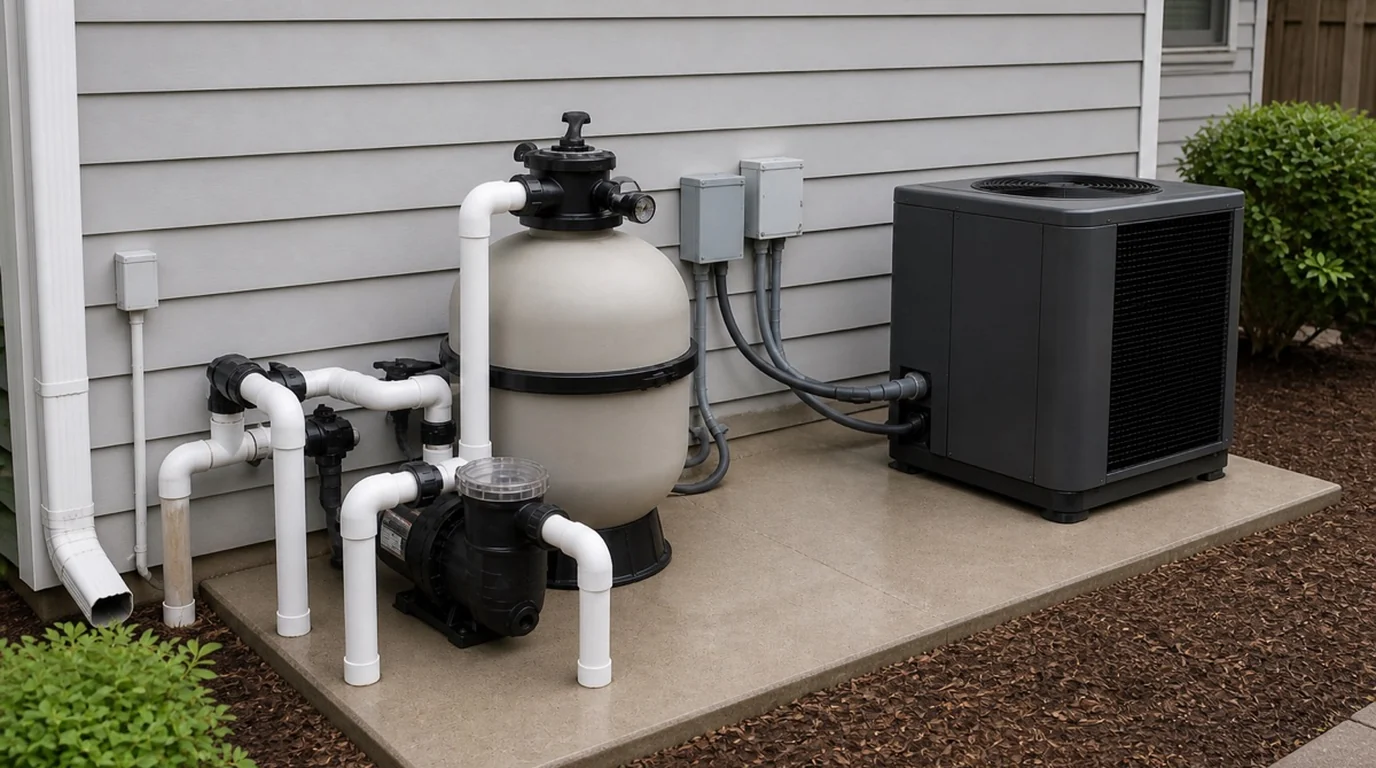
Pool turnover rate formulas: converting volume and turnover hours into GPM and GPH
Pool turnover rate in minutes equals Pool Gallons divided by flow rate in GPM, and turnover rate in hours equals turnover rate in minutes divided by 60, as illustrated by a 25,000 gallon pool at 70 GPM reaching a turnover of 357 minutes or 5.95 hours (approximately 6 hours).
When solving for target pump capacity, GPM equals Pool Gallons divided by Turnover in Minutes, where Turnover in Minutes equals Turnover in hours multiplied by 60 (6 hours = 360 minutes, 12 hours = 720 minutes), meaning a 25,000 gallon pool on a 6-hour turnover target requires 25,000 gallons divided by 360 minutes = 69 GPM (approximately 70 gallons per minute through the pump and filter).
For an 8-hour residential filtration target, a 24,000-gallon pool requires 50 GPM calculated as 24,000 divided by (8 x 60), where running at a steady 50 GPM for 8 hours processes 24,000 gallons, or one equivalent pool volume, rather than pushing every individual gallon through the filter exactly once.
Daily pump run time is determined by multiplying pool volume by the number of daily turnovers you want and dividing by pump flow in gallons per hour (GPM x 60), yielding typical 1-turnover run times at ~50 GPM of ~3.3 hrs for 10,000 gallons, ~5 hrs for 15,000 gallons, ~6.7 hrs for 20,000 gallons, ~8.3 hrs for 25,000 gallons, and ~10 hrs for 30,000 gallons.
In NIST conversion tables, cubic foot (ft3) to cubic meter (m3) has factor 2.831685 E-02, while U.S. gallon (gal) to cubic meter (m3) has factor 3.785412 E-03 and U.S. gallon (gal) to liter (L) has factor 3.785412 E+00.
Under the same NIST flow conversion tables, U.S. gallon per minute (gpm or gal/min) to cubic meter per second (m3/s) has factor 6.309020 E-05 and to liter per second (L/s) has factor 6.309020 E-02.
While residential pools size daily run hours from volume and flow arithmetic, commercial hot tubs follow the separate turnover schedule covered in our commercial hot tub code and filtration turnover guide.
Scroll horizontally to see all columns →
| Pool volume or conversion metric | Turnover time & flow formula benchmark | Runtime schedule or mixing behavior |
|---|---|---|
| Accelerated turnover target | For a 25,000 gallon pool on a 6-hour turnover target, 6 hours x 60 = 360 minutes (12 hours = 720 minutes) and 25,000 gallons divided by 360 minutes = 69 GPM (approximately 70 gallons per minute). | With a flowmeter reading of 70 GPM on a 25,000 gallon pool, 25,000 gallons divided by 70 GPM equals 357 minutes, and 357 minutes divided by 60 equals 5.95 hours (approximately 6 hours). |
| Residential turnover target | A 24,000-gallon pool with an 8-hour turnover goal requires 50 GPM calculated as 24,000 divided by (8 x 60), processing 24,000 gallons (one equivalent pool volume) in 8 hours. | Because pool water is constantly mixing, one turnover filters approximately 63% of the water, two turnovers filter approximately 86%, and nearly four full turnovers are needed to filter 98% of the water. |
| Benchmark runtime by pool volume | Multiplying pool volume by daily turnovers and dividing by GPH (GPM x 60) at ~50 GPM gives 1-turnover run times of ~3.3 hrs for 10,000 gallons, ~5 hrs for 15,000 gallons, and ~6.7 hrs for 20,000 gallons. | At the same ~50 GPM flow rate for 1 turnover, a 25,000 gallon pool runs ~8.3 hrs and a 30,000 gallon pool runs ~10 hrs. |

Rigid PVC pipe inside diameter, velocity limits, and friction head loss
Hydraulic sizing caps suction branch/trunk velocity at <= 6.0 ft/s (1.83 m/s) and pressure return velocity at <= 8.0 ft/s using the velocity equation v (ft/s) = (0.4085 x Q_GPM) / d_in2.
Schedule 40 PVC friction loss conversion notes state 1 ft (foot) = 0.3048 m, 1 gal (US)/min = 0.1337 ft3/min, and 1 psi/100 ft = 2.3 ftH2O/100 ft, and note that general thermoplastic pipe velocities should not exceed 5 feet per second.
Under ASTM D1785 and ASTM F441 Schedule 40 pipe dimension tables, nominal 1 1/2 inch PVC pipe has an outside diameter of 1.900 inches, a minimum wall thickness of 0.145 inches, and an inside diameter of 1.610 inches.
In Schedule 40 PVC pipe dimension tables, nominal 2 inch pipe has an outside diameter of 2.375 inches, a minimum wall thickness of 0.154 inches, and an inside diameter of 2.067 inches, while nominal 2 1/2 inch pipe has an outside diameter of 2.875 inches, a minimum wall thickness of 0.203 inches, and an inside diameter of 2.469 inches.
In Schedule 40 PVC pipe dimension tables, nominal 3 inch pipe has an outside diameter of 3.500 inches, a minimum wall thickness of 0.216 inches, and an inside diameter of 3.068 inches, while nominal 4 inch pipe has an outside diameter of 4.500 inches, a minimum wall thickness of 0.237 inches, and an inside diameter of 4.026 inches.
In PVC Pipes Schedule 40 - Friction Loss - 1 1/2 inch, volume flow of 30 gal/min (1800 gal/hr) produces 4.9 ft/sec velocity, 5.5 ft/100 ft friction head, and 2.4 psi/100 ft friction loss; 35 gal/min (2100 gal/hr) produces 5.7 ft/sec, 7.4 ft/100 ft, and 3.2 psi/100 ft; and 40 gal/min (2400 gal/hr) produces 6.5 ft/sec, 9.4 ft/100 ft, and 4.1 psi/100 ft.
Pushing 50 gal/min (3000 gal/hr) through a 1 1/2 inch Schedule 40 PVC line produces 8.1 ft/sec velocity, 14.3 ft/100 ft friction head, and 6.2 psi/100 ft friction loss, while 60 gal/min (3600 gal/hr) reaches 9.7 ft/sec, 20.0 ft/100 ft, and 8.7 psi/100 ft.
Stepping up to 2 inch Schedule 40 PVC reduces 50 gal/min (3000 gal/hr) to 4.9 ft/sec velocity, 4.2 ft/100 ft friction head, and 1.8 psi/100 ft friction loss, with 60 gal/min (3600 gal/hr) at 5.9 ft/sec, 5.8 ft/100 ft, and 2.5 psi/100 ft, and 70 gal/min (4200 gal/hr) at 6.8 ft/sec, 7.8 ft/100 ft, and 3.4 psi/100 ft.
When shared pool-and-spa suction headers switch between filtration and spillover modes detailed in our spillover spa hydraulic loop and check valves guide, note that in 2 inch Schedule 40 PVC, 80 gal/min (4800 gal/hr) produces 7.8 ft/sec velocity, 9.9 ft/100 ft friction head, and 4.3 psi/100 ft friction loss, 90 gal/min (5400 gal/hr) produces 8.8 ft/sec, 12.4 ft/100 ft, and 5.4 psi/100 ft, and 100 gal/min (6000 gal/hr) produces 9.8 ft/sec, 15.0 ft/100 ft, and 6.5 psi/100 ft.
Rigid PVC pipe dimensions, flow ceilings, and friction head loss matrix
Scroll horizontally to see all columns →
| Nominal pipe size & branch role | Suction and return flow ceiling | Velocity and friction head loss |
|---|---|---|
| Residential branch pipes | Using average Schedule 40 PVC inside diameters, 1.5 in pipe (d_in 1.590 in, area 1.986 sq in) is rated for 37 GPM max suction flow at <= 6.0 ft/s and 49 GPM max return flow at <= 8.0 ft/s, while 2.0 in pipe (d_in 2.047 in, area 3.291 sq in) is rated for 61 GPM suction and 82 GPM return. | In 2 inch Schedule 40 PVC, 50 gal/min (3000 gal/hr) produces 4.9 ft/sec and 4.2 ft/100 ft (1.8 psi/100 ft), 60 gal/min (3600 gal/hr) produces 5.9 ft/sec and 5.8 ft/100 ft (2.5 psi/100 ft), and 70 gal/min (4200 gal/hr) produces 6.8 ft/sec and 7.8 ft/100 ft (3.4 psi/100 ft). |
| Medium manifold header pipe | For 2.5 in Schedule 40 PVC pipe (average inside diameter 2.445 in, internal area 4.695 sq in), max suction flow at <= 6.0 ft/s is 87 GPM and max return flow at <= 8.0 ft/s is 117 GPM. | In 2 1/2 inch Schedule 40 PVC, 80 gal/min (4800 gal/hr) produces 5.5 ft/sec and 4.2 ft/100 ft (1.8 psi/100 ft), 90 gal/min (5400 gal/hr) produces 6.2 ft/sec and 5.2 ft/100 ft (2.3 psi/100 ft), 100 gal/min (6000 gal/hr) produces 6.8 ft/sec and 6.3 ft/100 ft (2.7 psi/100 ft), and 125 gal/min (7500 gal/hr) produces 8.6 ft/sec and 9.6 ft/100 ft (4.2 psi/100 ft). |
| Large trunk headers | For Schedule 40 PVC headers at <= 6.0 ft/s suction and <= 8.0 ft/s return, 3.0 in pipe (d_in 3.042 in, area 7.268 sq in) is rated for 135 GPM suction and 181 GPM return, and 4.0 in pipe (d_in 3.998 in, area 12.554 sq in) is rated for 234 GPM suction and 313 GPM return. | In 3 inch Schedule 40 PVC, 100 gal/min (6000 gal/hr) gives 4.4 ft/sec and 2.2 ft/100 ft (0.9 psi/100 ft), 125 gal/min (7500 gal/hr) gives 5.5 ft/sec and 3.3 ft/100 ft (1.4 psi/100 ft), 150 gal/min (9000 gal/hr) gives 6.6 ft/sec and 4.6 ft/100 ft (2.0 psi/100 ft), and 175 gal/min (10500 gal/hr) gives 7.7 ft/sec and 6.2 ft/100 ft (2.7 psi/100 ft). |
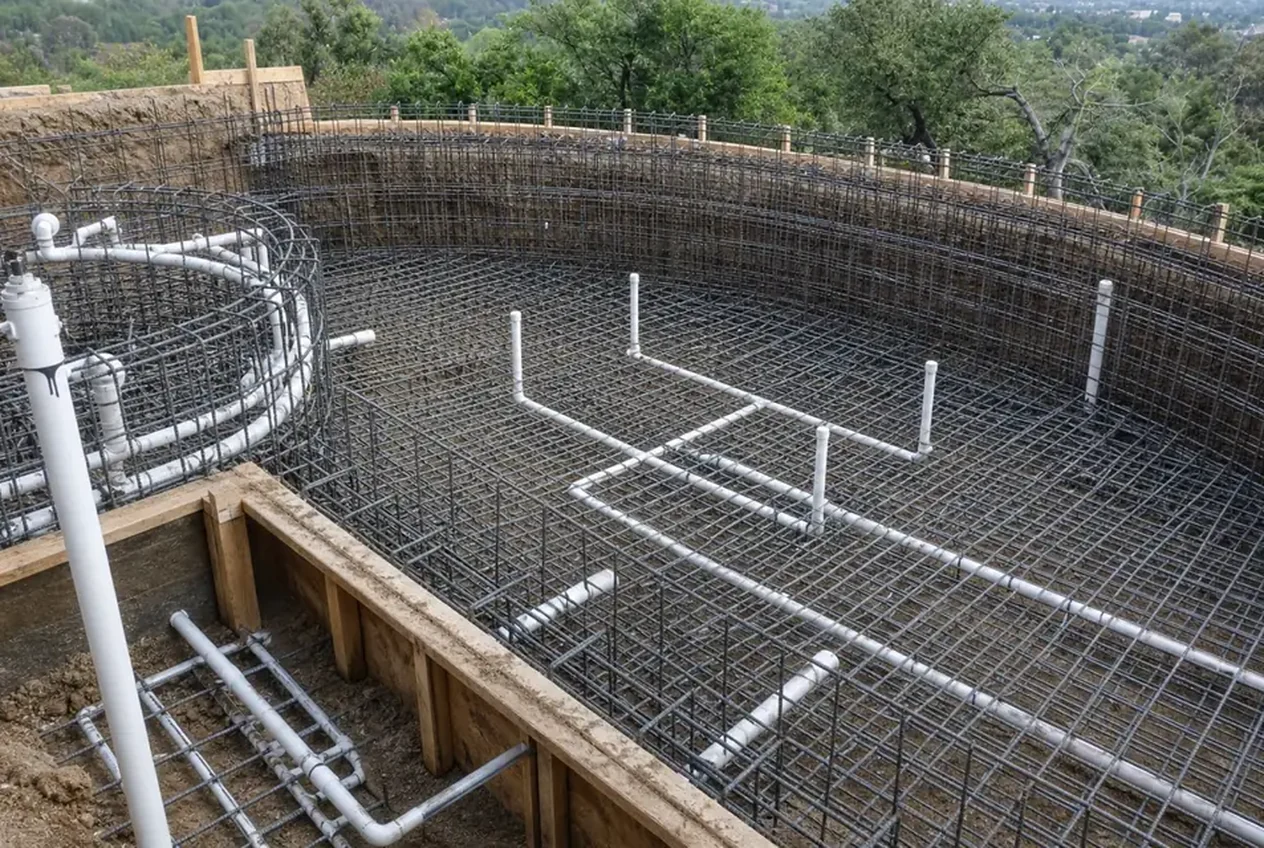
Variable-speed and variable-flow pump sizing: energy standards, affinity laws, and continuous schedules
Under federal energy conservation standard 10 CFR 431.465, single-phase self-priming pool filter pumps with hydraulic horsepower 0.711 hp <= hhp < 2.5 hp must achieve a minimum Weighted Energy Factor of WEF = -2.30 ln (hhp) + 6.59, while pumps with hhp < 0.711 hp must achieve WEF = 5.55 (for hhp <= 0.13 hp) or -1.30 ln (hhp) + 2.90 (for hhp above 0.13 hp).
The Pentair IntelliFlo3 VSF pump carries a Weighted Energy Factor (WEF) of 7.1 at THP 3.0 for 3 HP models and a WEF of 9.4 at THP 1.5 for 1.5 HP models.
Pentair IntelliFlo3 VSF Flow Programs can be set between 20-90 GPM on 1.5 HP models or 20-140 GPM on 3 HP models, and the pump automatically adjusts motor speed to maintain the programmed flow rate.
Technical specifications for Pentair IntelliFlo3 VSF 1.5 HP models list nominal input voltage 115/208-230 VAC, input current 12.0/6.4-5.9 Amps at 50 or 60 Hz, max input watts 1350 W, max shaft horsepower 1.5 HP, and a speed range of 400 - 4000 RPM.
Technical specifications for Pentair IntelliFlo3 VSF 3.0 HP models list nominal input voltage 208-230 VAC, input current 12.4-11.2 Amps, max input watts 2590 W, max shaft horsepower 3.0 HP, and a speed range of 450 - 3450 RPM.
Pentair IntelliFlo3 VSF union kit options include 1.5 inch or 2 inch plumbing on the 1.5HP pump (P/N 351157) and 2 inch or 2.5 inch plumbing (P/N 410028) or 3 inch plumbing sold separately (P/N 410029) on the 3HP pump.
The Pentair SuperFlo VST variable speed pump operates at speeds ranging between 450 and 3450 RPM within 115-230 Vrms at 50 or 60Hz, includes unionized fittings (1.5 inch and 2 inch), and is rated at WEF 9.1 and THP 2.2.
A PG&E study cited by ENERGY STAR determined that a robotic pool cleaner used only 197 kWh per year, whereas a cleaner powered by a filter pump used 1,675 kWh per year and a booster-pump-powered cleaner used 2,989 kWh per year.
When sizing dedicated jet pumps alongside filtration loops for custom shells in our custom inground hot tub planning and dimensions guide, Pentair IntelliFlo3 VSF installation rules state that suction line diameter should be the same or larger than the return line diameter and specify that valves, elbows or tees in the suction line should be no less than five times the suction pipe diameter from the pump inlet, so a 2-inch pipe requires 10 inches (25.4 cm) of straight run.
Matching turnover GPM to filters, gas heaters, salt chlorinators, and inline flowmeters
Pentair Clean & Clear Plus cartridge filter recommended flow rates and turnover capacities (6 Hours / 8 Hours / 12 Hours in gallons) are: CCP240 (240 Sq Ft, 56 in vertical clearance) = 90 GPM (32,400 / 43,200 / 64,800); CCP320 (320 Sq Ft, 62 in clearance) = 120 GPM (43,200 / 57,600 / 86,400); CCP420 (420 Sq Ft, 68 in clearance) = 150 GPM (54,000 / 72,000 / 108,000); and CCP520 (520 Sq Ft, 74 in clearance) = 150 GPM (54,000 / 72,000 / 108,000).
The maximum working pressure of the Pentair Clean & Clear Plus filter is 50 psi, and cartridges should be cleaned when pressure reads approximately 10 psi higher than the Original Starting Pressure or when significant reduction in flow is noticed.
Pentair Clean & Clear RP cartridge filters have a recommended residential flow rate of 0.5 GPM per sq ft and a commercial maximum of 0.375 GPM per sq ft: CNCRP 100 (P/N 160354, 100 sq ft) is rated for 100 GPM residential (6,000 GPH, 36,000 in 6 hour, 48,000 in 8 hour) and 38 GPM commercial (2,280 GPH, 13,680 in 6 hour, 18,240 in 8 hour); CNCRP 150 (P/N 160355, 150 sq ft) for 150 GPM residential (9,000 GPH, 54,000 in 6 hour, 72,000 in 8 hour) and 56 GPM commercial (3,360 GPH, 20,160 in 6 hour, 26,880 in 8 hour); and CNCRP 200 (P/N 160353, 200 sq ft) for 150 GPM residential and 75 GPM commercial (4,500 GPH, 27,000 in 6 hour, 36,000 in 8 hour).
Pentair Triton sand filter Table 1 filter area, flow rate, and daily turnover capacities (at 4 Turns / 3 Turns / 2.4 Turns / 2 Turns in gallons) are: TR40 (1.9 FT2) = 38 GPM (13,680 / 18,240 / 22,800 / 27,360); TR60 (3.1 FT2) = 63 GPM (22,680 / 30,240 / 37,800 / 45,360); TR100 (4.9 FT2, based on 15 GPM/FT2) = 74 GPM (26,640 / 35,520 / 44,400 / 53,280); TR100C / TR100C-3 (4.9 FT2) = 98 GPM (35,280 / 47,040 / 58,800 / 70,560); TR140 (7.1 FT2, based on 15 GPM/FT2) = 106 GPM (38,160 / 50,880 / 63,600 / 76,320); and TR140C / TR140C-3 (7.1 FT2) = 141 GPM (50,760 / 67,680 / 84,600 / 101,520).
Pentair Triton sand filter installation instructions recommend at least 2 in piping for the TR100 and TR140 models and at least 3 in piping for the TR100C-3 and TR140C-3 models to minimize pressure losses.
In Pentair THS Series high-rate sand filters, adequate backwash flow is approximately 15-20 GPM per square foot of filtration area, and each tank should be backwashed for at least 3 to 5 minutes or until waste water runs clear when filter pressure increases by 10 psi above clean filter pressure.
According to the California Urban Water Conservation Council (CUWCC) estimate reported in U.S. EPA WaterSense at Work Section 5.3, water evaporation, filter backwashing, and mineral buildup control account for 56, 23, and 21 percent of pool water use respectively across pools installed in California. The WaterSense Section 5.3 rule of thumb is that filter cleaning is necessary after filter pressure has increased by 5.0 to 10.0 pounds per square inch (psi) (35 to 70 Kilopascal [kPa]).
Downstream on the return header, the Hayward AquaRite S3 salt chlorination system must have at least a 12 inch (25cm) straight pipe run before (upstream) the flow switch, and if the switch is plumbed after the cell, the cell can be counted as the 12 inch (25cm) of straight pipe.
Blue-White Industries F-300 Pitot Tube Acrylic Flow Meters measure 5 - 2,200 GPM in SCH 40 PVC (or 30 - 1,800 LPM in PN 10) at up to 50 PSI (3.4 Bar) across pipe sizes of 1 inch, 1 1/4 inch, 1 1/2 inch, 2 inch, 2 1/2 inch, 3 inch, 4 inch, 6 inch, and 8 inch.
Pump, filter, heater, and inline flowmeter hydraulic operating windows
Scroll horizontally to see all columns →
| Equipment component & model family | Flow window or efficiency specification | Turnover capacity or straight-run rule |
|---|---|---|
| Variable-speed and variable-flow pumps | IntelliFlo3 VSF Flow Programs adjust between 20-90 GPM on 1.5 HP models or 20-140 GPM on 3 HP models to maintain the programmed flow rate. | Suction pipe diameter should be the same or larger than return pipe diameter with no less than five times the suction pipe diameter straight run (10 inches / 25.4 cm for a 2-inch pipe). |
| Pleated cartridge filtration tanks | Clean & Clear Plus models are rated for 90 GPM on CCP240 (240 Sq Ft), 120 GPM on CCP320 (320 Sq Ft), and 150 GPM on CCP420 (420 Sq Ft) and CCP520 (520 Sq Ft). | Clean & Clear Plus maximum working pressure is 50 psi, and cartridges should be cleaned when pressure reads approximately 10 psi higher than Original Starting Pressure. |
| High-rate sand filtration tanks | Triton sand filters are rated for 38 GPM on TR40 (1.9 FT2), 63 GPM on TR60 (3.1 FT2), 74 GPM on TR100 (4.9 FT2 at 15 GPM/FT2), 98 GPM on TR100C, 106 GPM on TR140 (7.1 FT2 at 15 GPM/FT2), and 141 GPM on TR140C. | THS Series high-rate sand filters require approximately 15-20 GPM per sq ft backwash flow for at least 3 to 5 minutes when pressure rises 10 psi above clean pressure. |
| Gas heater, salt chlorinator, and flowmeter | MasterTemp Table 1 sets minimum flow at 20 GPM (76 LPM) for Models 175 and 200, 25 GPM (95 LPM) for Model 250, 30 GPM (114 LPM) for Model 300, and 40 GPM (152 LPM) for Model 400, with 120 GPM (454 LPM) max. | Hayward AquaRite S3 must have at least a 12 inch (25cm) straight pipe run upstream of the flow switch, where the cell can be counted as the 12 inch (25cm) run if plumbed before the switch. |
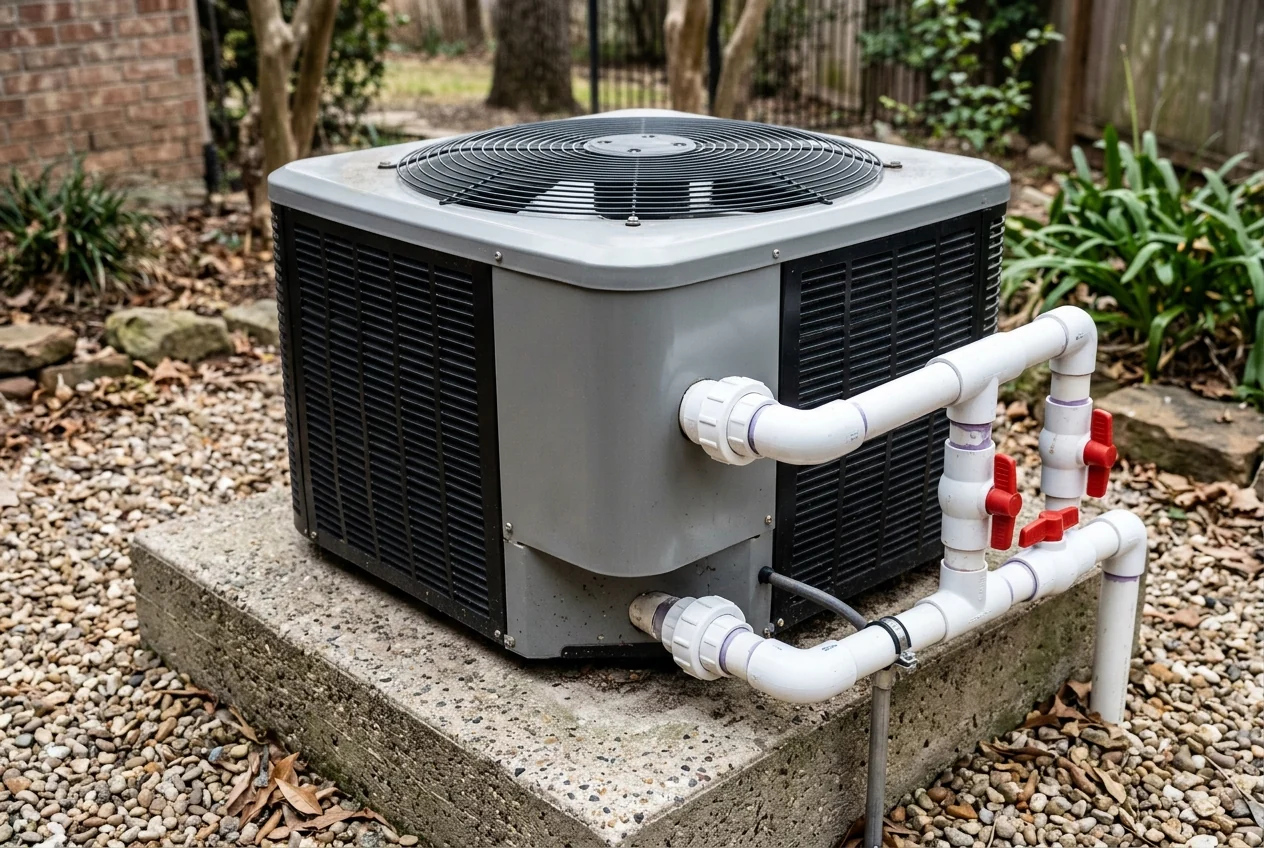
Step-by-step pool turnover rate and pump flow verification checklist
Before locking daily timer schedules on a variable-speed pump, remember that because swimming pool water is constantly mixing, one turnover filters approximately 63% of the water, two turnovers filter approximately 86%, and nearly four full turnovers are needed to filter 98% of the water.
- Calculate target turnover GPM from pool volume: Divide Pool Gallons by Turnover in Minutes (Turnover in hours x 60, where 6 hours = 360 minutes and 12 hours = 720 minutes), such as 25,000 gallons / 360 minutes = 69 GPM (approximately 70 gallons per minute).
- Verify Schedule 40 PVC pipe flow ceilings: Keep suction velocity <= 6.0 ft/s and return velocity <= 8.0 ft/s, corresponding to 37 GPM suction / 49 GPM return on 1.5 in pipe (d_in 1.590 in, area 1.986 sq in) and 61 GPM suction / 82 GPM return on 2.0 in pipe (d_in 2.047 in, area 3.291 sq in).
- Confirm pump suction straight-run clearance: Suction line diameter should be the same or larger than return line diameter, and valves, elbows, or tees in the suction line should be no less than five times the suction pipe diameter from the pump inlet (for example, a 2-inch pipe requires 10 inches or 25.4 cm of straight run).
- Read actual GPM on an inline pitot flowmeter: Verify running flow on a Blue-White F-300 Pitot Tube Acrylic Flow Meter rated for 5 - 2,200 GPM in SCH 40 PVC (30 - 1,800 LPM in PN 10) at up to 50 PSI (3.4 Bar) across 1 inch, 1 1/4 inch, 1 1/2 inch, 2 inch, 2 1/2 inch, 3 inch, 4 inch, 6 inch, and 8 inch pipe sizes.
- Check filter media design flow limits: Confirm peak pump GPM does not exceed Pentair Clean & Clear Plus ratings of 90 GPM (CCP240, 240 Sq Ft), 120 GPM (CCP320, 320 Sq Ft), or 150 GPM (CCP420 at 420 Sq Ft and CCP520 at 520 Sq Ft).
- Satisfy heater minimum and maximum flow limits: Maintain at least 20 GPM (76 LPM) on Pentair MasterTemp Models 175 and 200, 25 GPM (95 LPM) on Model 250, 30 GPM (114 LPM) on Model 300, and 40 GPM (152 LPM) on Model 400, where a manual bypass should be installed and adjusted when water flow rate exceeds the maximum 120 GPM (454 LPM).
- Service filters at the 5.0 to 10.0 psi pressure-rise threshold: Clean cartridges or backwash sand media once pressure rises by 5.0 to 10.0 psi (35 to 70 kPa) above clean starting pressure, noting that a CUWCC California estimate reported in WaterSense attributes 56, 23, and 21 percent of pool water use to evaporation, backwashing, and mineral control.
Frequently asked questions
How do you calculate pool turnover rate in hours and required pump GPM?
Pool turnover rate in minutes equals Pool Gallons divided by flow rate in GPM, and turnover rate in hours equals turnover rate in minutes divided by 60; in a 25,000 gallon pool with a flowmeter reading of 70 GPM, 25,000 divided by 70 equals 357 minutes, and 357 divided by 60 equals 5.95 hours (approximately 6 hours).
Does a full pool turnover filter every drop of water in the swimming pool?
Because swimming pool water is constantly mixing, one turnover filters approximately 63% of the water, two turnovers filter approximately 86%, and nearly four full turnovers are needed to filter 98% of the water, which is why running pumps 24/7 at low speeds is often superior.
What are the suction and return GPM flow ceilings for rigid PVC pool pipe sizes?
At a <= 6.0 ft/s suction ceiling and <= 8.0 ft/s return ceiling, 1.5 in Schedule 40 PVC (d_in 1.590 in, area 1.986 sq in) carries up to 37 GPM suction and 49 GPM return, while 2.0 in Schedule 40 PVC (d_in 2.047 in, area 3.291 sq in) carries up to 61 GPM suction and 82 GPM return.
How much electricity does lowering variable-speed pump RPM save during daily turnover filtration?
According to U.S. EPA / DOE ENERGY STAR pool pump guidance, filtration only requires half the flow rate of running a pool cleaner, reducing pump speed by one-half allows the pump to use just one-eighth as much energy, and running your pool filter only 6 hours a day versus 24 hours will reduce your energy use by 75%.
Technical references and engineering publications
- CivicLive Municipal Aquatics Education Bulletin, How to Calculate Your Pool Turnover Rate: Turnover Rate in Minutes = Pool Gallons / GPM and Turnover Rate in Hours = Turnover Rate in Minutes / 60 (25,000 gallons / 70 GPM = 357 minutes = 5.95 hours, or approximately 6 hours).
- National Institute of Standards and Technology (NIST), Guide to the SI Conversion Factors: cubic foot (ft3) to cubic meter (m3) factor is 2.831685 E-02, U.S. gallon (gal) to cubic meter (m3) factor is 3.785412 E-03, and U.S. gallon to liter (L) factor is 3.785412 E+00.
- U.S. Code of Federal Regulations, 10 CFR § 431.465 (Dedicated-Purpose Pool Pumps): single-phase self-priming pool filter pumps with 0.711 hp <= hhp < 2.5 hp require WEF = -2.30 ln (hhp) + 6.59, and hhp < 0.711 hp require WEF = 5.55 (hhp <= 0.13 hp) or -1.30 ln (hhp) + 2.90 (hhp above 0.13 hp).
- U.S. Environmental Protection Agency & Department of Energy, ENERGY STAR Pool Pumps Guidance: filtration requires half the flow rate of a pool cleaner, reducing pump speed by one-half allows the pump to use one-eighth as much energy, and running a pool filter 6 hours a day versus 24 hours reduces energy use by 75%.
- California Urban Water Conservation Council (CUWCC) estimate reported in U.S. EPA WaterSense at Work Section 5.3: water evaporation, filter backwashing, and mineral buildup control account for 56, 23, and 21 percent of pool water use respectively across California pools. WaterSense Section 5.3 rule of thumb: filter cleaning is needed after pressure increases by 5.0 to 10.0 psi (35 to 70 kPa).
- Pentair Water Pool and Spa, IntelliFlo3 VSF Variable Speed and Flow Pump Installation and User's Guide: rated at WEF 7.1 at THP 3.0 (3 HP models) and WEF 9.4 at THP 1.5 (1.5 HP models).
- Pentair Water Pool and Spa, SuperFlo VS / SuperFlo VST Variable Speed Pump Owner's Manual: operates from 450 to 3450 RPM within 115-230 Vrms at 50 or 60Hz with 1.5 inch and 2 inch unionized fittings, rated at WEF 9.1 and THP 2.2.
- Pentair Water Pool and Spa, Clean & Clear Plus Cartridge Filter Installation and User's Guide: recommended flow rates are 90 GPM for CCP240 (240 Sq Ft, 32,400 / 43,200 / 64,800 gal at 6 / 8 / 12 hr), 120 GPM for CCP320 (320 Sq Ft, 43,200 / 57,600 / 86,400 gal), and 150 GPM for CCP420 (420 Sq Ft) and CCP520 (520 Sq Ft, 54,000 / 72,000 / 108,000 gal).
- Pentair Water Pool and Spa, Triton II and Triton C High Capacity Sand Filter Manual: Table 1 rates TR40 (1.9 FT2) at 38 GPM, TR60 (3.1 FT2) at 63 GPM, TR100 (4.9 FT2 at 15 GPM/FT2) at 74 GPM, TR100C / TR100C-3 at 98 GPM, TR140 (7.1 FT2 at 15 GPM/FT2) at 106 GPM, and TR140C / TR140C-3 at 141 GPM.
- Pentair Water Pool and Spa, MasterTemp Pool and Spa Heater Installation and User's Guide: Table 1 sets maximum flow at 120 GPM (454 LPM) and minimum flow at 20 GPM (76 LPM) for Models 175 and 200, 25 GPM (95 LPM) for Model 250, 30 GPM (114 LPM) for Model 300, and 40 GPM (152 LPM) for Model 400.
- Blue-White Industries, F-300 Pitot Tube Acrylic Flow Meter Technical Specifications & Pool Flow Rate Calculator: measures 5 - 2,200 GPM in SCH 40 PVC (30 - 1,800 LPM in PN 10) at up to 50 PSI (3.4 Bar) across pipe sizes 1 inch, 1 1/4 inch, 1 1/2 inch, 2 inch, 2 1/2 inch, 3 inch, 4 inch, 6 inch, and 8 inch.