
Hot Tub Electrical Requirements: 120V vs 240V, Wire Gauge, and GFCI Rules
Full-size hot tubs require a dedicated 240V 50A or 60A GFCI circuit and 5 to 50 ft disconnect, while 120V spas use a dedicated GFCI outlet 6 ft away.
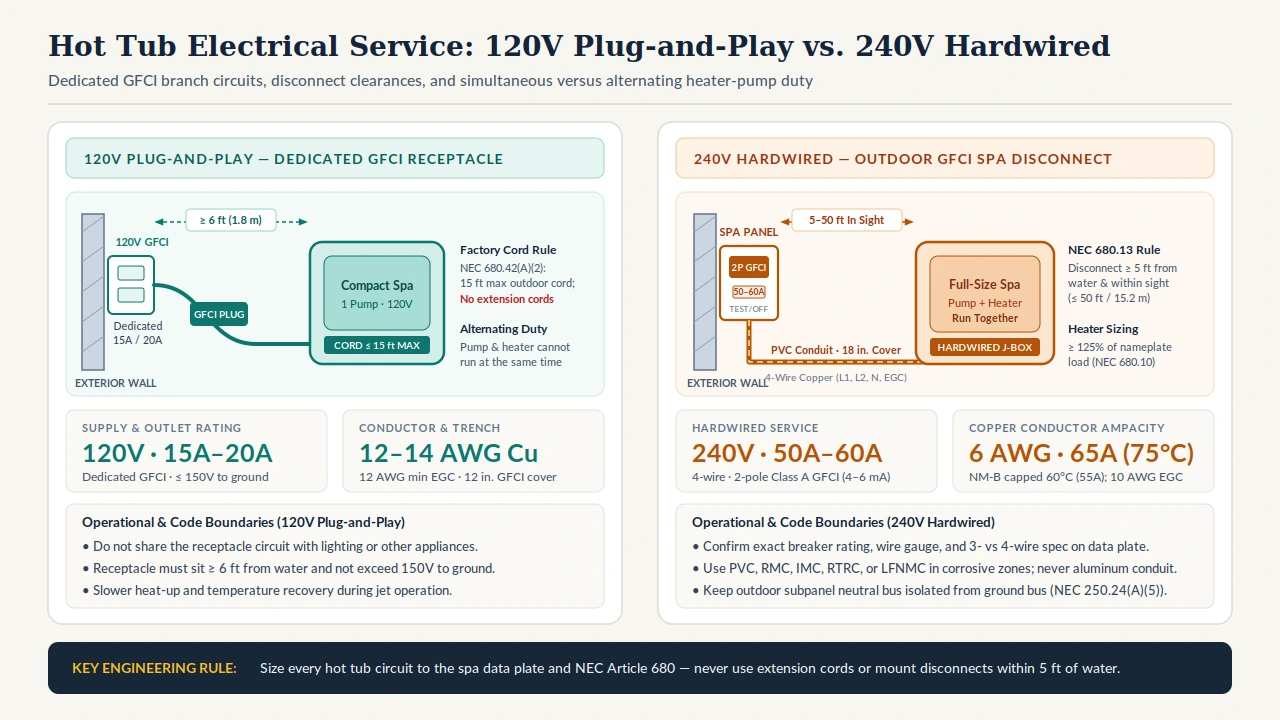
Most residential hot tubs require a dedicated 240-volt, 50-amp or 60-amp 4-wire hardwired circuit with Class A GFCI protection and a visible maintenance disconnect 5 to 50 feet away, whereas listed 120-volt plug-and-play spas plug into a dedicated grounding-type GFCI receptacle at least 6 feet from inside walls using a factory cord no longer than 15 feet.
Circuit sizing follows the spa nameplate load rating and whether pump and heater run together or alternate: under the Residential Code of New York State (RCNYS E4208.2 / NEC 680.10), electric spa water-heater circuits are sized to at least 125 percent of total nameplate load rating, while extension cords, disconnects within 5 feet of water, and miswired subpanel neutrals cause code failures or instant GFCI trips.
Coordinate feeder capacity, disconnect sightlines, and conduit routing early inside pool and spa equipment coordination alongside pool and spa safety planning before pouring a concrete pad or scheduling delivery.
Can You Plug a Hot Tub Into a Regular Household Outlet?
Only a listed 120-volt plug-and-play hot tub may connect to a receptacle, and it requires a dedicated, grounding-type, GFCI-protected 15-amp or 20-amp circuit rated no more than 150 volts to ground, located at least 6 feet (1829 mm) from inside spa walls with no shared appliances and no extension cord.
Multiple residential code provisions govern cord-and-plug spa outlets. Under RCNYS Section E4208.6 (NEC 680.43(A)(3)), receptacles providing power for a spa or hot tub shall not exceed 150 volts to ground and must be GFCI protected. Under Sections E4203.1.1 and E4203.1.2 (NEC 680.22(A)(2) and 680.22(A)(3)), both receptacles supplying water-pump motors or circulation and sanitation loads and other property receptacles must sit at least 6 feet (1829 mm) from inside walls of outdoor spas and hot tubs, be of the grounding type, and have GFCI protection. For outdoor packaged units, NEC 680.42(A)(2) permits cord-and-plug connection only when the listed spa is GFCI protected and its cord does not exceed 15 feet (4572 mm) in length.
Sharing an existing patio circuit or bridging distance with an extension cord violates both equipment listings and federal cord rules. Strong Spas instructs owners not to share a 120-volt spa outlet circuit with another appliance, verifies amperage rating on the branch circuit (15 amps maximum on 14 AWG copper or 20 amps maximum on 12 AWG copper per RCNYS Table E3705.5.3 / NEC 240.4(D)), and warns that using an extension cord voids the warranty and damages Durasport units equipped with a 15-foot factory cord and built-in GFCI. Likewise, federal flexible-cord rules in 29 CFR 1910.305(g)(1)(iv) prohibit using flexible cords and cables as a substitute for fixed structure wiring, running them through holes in walls, ceilings, floors, doorways, or windows, attaching them to building surfaces, concealing them behind walls, ceilings, or floors, or placing them in raceways unless specifically permitted.
What Voltage and Amperage Service Do Hot Tubs Need?
Most full-size hot tubs require a dedicated 240-volt, 50-amp or 60-amp 4-wire hardwired connection installed by a licensed electrician, whereas 120-volt plug-and-play models draw from a dedicated 15-amp or 20-amp circuit, are usually only available with one pump, and alternate pump and heater operation.
Nameplate load and listing instructions govern exact circuit ampacity rather than shell seating count. Under RCNYS Section E4208.2 (NEC 680.10), listed electric spa and hot tub water heaters must subdivide heating elements into loads not exceeding 48 amperes protected at not more than 60 amperes, and both branch-circuit conductor ampacity and overcurrent protective device ratings must be not less than 125 percent of the total nameplate load rating. Section E3403.3 (NEC 110.3(B)) requires listed electrical equipment to bear an approved agency label and be installed and used according to instructions included in the listing, labeling, or identification.
Because 120-volt models cannot run the pump and heater at the same time, heat-up and recovery time may take longer than on hardwired 240-volt units, as documented in Strong Spas' electrical guide. Larger 240-volt models hardwire into a junction box inside the spa access panel; Master Spas notes that most residential main panels have room for the 50-amp/240-volt service most spas require (though breaker cleanup may be needed) and advises directing a licensed electrician to the unit's electrical diagrams. When comparing portable spa hookups against built-in shells, coordinate concrete pads, benching, and access bays in our custom inground hot tub planning and dimensions guide.
Scroll horizontally to see all columns →
| Electrical Requirement | 120V Plug-and-Play Spa | 240V Hardwired Spa |
|---|---|---|
| Supply voltage and breaker | Dedicated 120V, 15A or 20A circuit (≤ 150V to ground) | Dedicated 240V, commonly 50A or 60A 4-wire circuit per manual |
| Heater sizing code rule | Installed per approved listing and nameplate instructions (NEC 110.3(B)) | Branch conductors and breaker ≥ 125% of nameplate load; heater elements ≤ 48A, protected ≤ 60A (NEC 680.10) |
| Pump and heater operation | Usually one pump; pump and heater alternate and heat-up or recovery takes longer | Hardwired larger-spa architecture without 120V single-pump alternating constraint |
| Connection method | Listed outdoor factory cord ≤ 15 feet (4572 mm) to grounding GFCI receptacle; no extension cord | Hardwired into junction box inside spa access panel via suitable conduit |
| GFCI device arrangement | Cord-connected GFCI plug with integral protection or dedicated GFCI outlet ≥ 6 feet (1829 mm) away | Two-pole Class A 5 mA (4–6 mA trip) GFCI breaker in readily accessible outdoor disconnect |
| General underground burial cover | 12 inches minimum for 120V GFCI-protected residential branch circuits ≤ 20A | 18 inches minimum for direct-burial nonmetallic raceways (6 inches for rigid/intermediate metal conduit) |
What Wire Gauge, Conduit, and Trench Depth Do Hardwired Spas Need?
Hardwired 240-volt hot tubs size copper conductors by breaker rating and terminal temperature limits—where 6 AWG copper is rated 55 amperes at 60°C or 65 amperes at 75°C—paired with an insulated copper equipment grounding conductor at least 10 AWG up to 60 amperes inside corrosion-resistant conduit.
Conductor temperature rules separate interior cable runs from individual insulated wires pulled through conduit. Under RCNYS Section E3705.4.1 (NEC 110.14(C)(1)(a)), unless equipment is marked otherwise, terminations on circuits rated 100 amperes or less (14 AWG through 1 AWG) limit allowable ampacity to the 60°C (140°F) column unless the equipment is listed and identified for higher-temperature conductors (or 75°C / 167°F for Design B, C, or D motors). Even though Type NM-B and NMC-B cable assemblies use 90°C (194°F) insulated conductors, Section E3705.4.4 caps their allowable ampacity at 60°C (140°F): in RCNYS Table E3705.1, 8 AWG copper carries 40A at 60°C (50A at 75°C; 55A at 90°C), 6 AWG copper carries 55A at 60°C (65A at 75°C; 75A at 90°C), and 4 AWG copper carries 70A at 60°C (85A at 75°C; 95A at 90°C). Small copper circuits follow Table E3705.5.3 (NEC 240.4(D)): 15A maximum for 14 AWG, 20A for 12 AWG, and 30A for 10 AWG.
Outdoor spa runs also enforce strict grounding, raceway, and trench-cover rules. Under RCNYS Section E4205.1 (NEC 680.7(A)), feeders and branch circuits in corrosive environments or wet locations must contain an insulated copper equipment grounding conductor (EGC) sized per Table E3908.13 (NEC Table 250.122: 14 AWG at 15A, 12 AWG at 20A, 10 AWG up to 60A, and 8 AWG up to 100A) and never smaller than 12 AWG. Under Section E4202.2 (NEC 680.14(A)), suitable wiring methods in corrosive spa environments are rigid metal conduit, intermediate metal conduit, rigid polyvinyl chloride conduit, reinforced thermosetting resin conduit, and liquidtight flexible nonmetallic conduit; aluminum conduit and tubing shall not be used. Under Table E3803.1 (NEC Table 300.5), minimum burial cover in general locations is 24 inches for direct-burial cables, 18 inches for direct-burial nonmetallic raceways without concrete encasement, 12 inches for 120-volt GFCI-protected residential branch circuits rated 20 amperes or less, and 6 inches for rigid or intermediate metal conduit; the Town of Walworth, NY pre-inspection checklist leaves trenches open in several spots to inspect 18-inch depth on 240-volt lines and 12-inch depth on 120-volt lines GFCI-protected before entering the ground.
Scroll horizontally to see all columns →
| Copper Size (AWG) | 60°C Allowable Ampacity | 75°C and 90°C Ratings (Conduit) | Circuit and Grounding Role |
|---|---|---|---|
| 14 AWG | 15A max overcurrent (Table E3705.5.3) | Capped at 15A overcurrent (NEC 240.4(D)) | General 15A dry circuit only; below 12 AWG wet-location EGC floor |
| 12 AWG | 20A max overcurrent (Table E3705.5.3) | Capped at 20A overcurrent (NEC 240.4(D)) | 120V 20A spa circuit; minimum insulated copper EGC in wet locations (E4205.1) |
| 10 AWG | 30A max overcurrent (Table E3705.5.3) | Capped at 30A overcurrent (NEC 240.4(D)) | Minimum copper EGC for spa circuits protected up to 60A (Table E3908.13) |
| 8 AWG | 40A (Types TW, UF, NM-B) | 50A at 75°C (THWN, XHHW); 55A at 90°C (THHN, THWN-2) | 40A circuit at 60°C or 50A at 75°C terminals; copper EGC up to 100A; solid copper bonding wire |
| 6 AWG | 55A (Types TW, UF, NM-B) | 65A at 75°C (THWN, XHHW); 75A at 90°C (THHN, THWN-2) | Common 50A circuit under 60°C NM-B cap; carries 65A at 75°C in conduit (covers 60A breaker) |
| 4 AWG | 70A (Types TW, UF, NM-B) | 85A at 75°C (THWN, XHHW); 95A at 90°C (THHN, THWN-2) | 70A at 60°C or 85A at 75°C; supports 60A circuits at 60°C termination limits |
What Rules Govern NEC Hot Tub Disconnect and Outlet Placement?
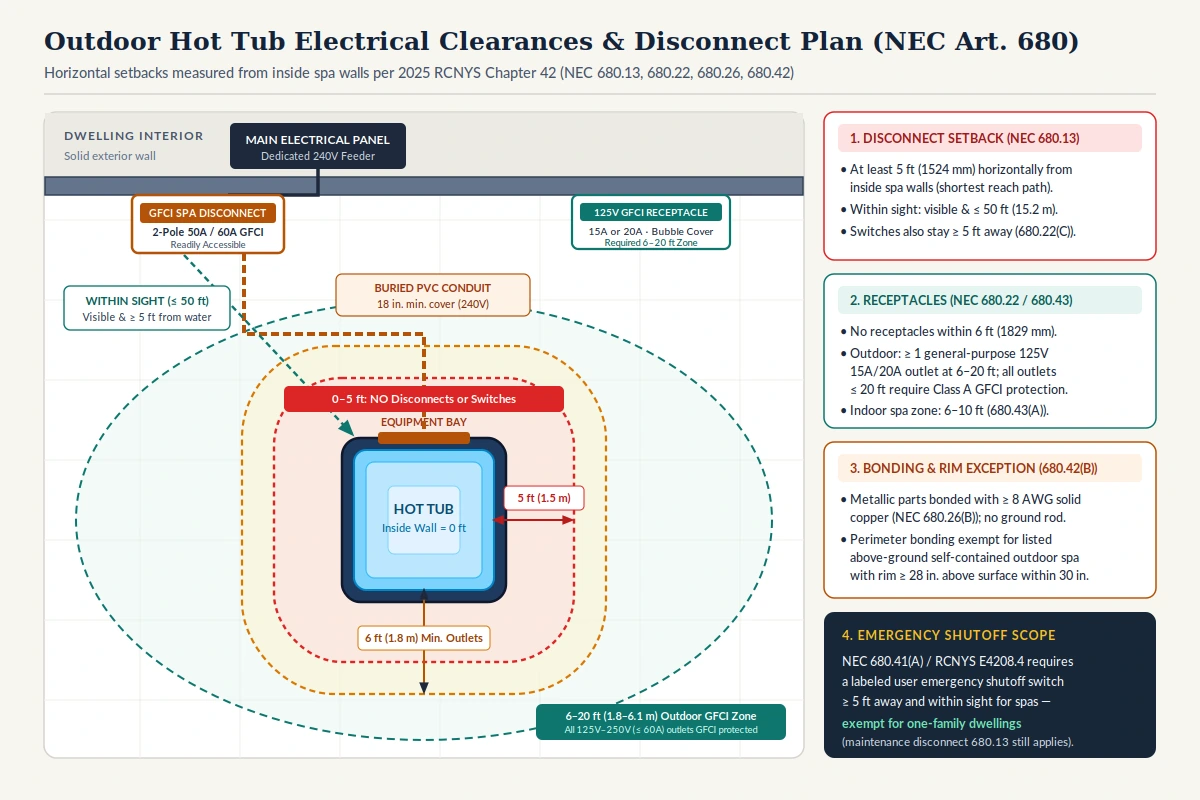
Under RCNYS Section E4203.3 (NEC 680.13), a hot tub maintenance disconnect simultaneously opening all ungrounded conductors must be readily accessible, within sight (visible and not more than 50 feet or 15.2 m away), and mounted at least 5 feet (1524 mm) horizontally from inside spa walls along the shortest reach path from the water's edge.
That dual boundary prevents a bather from touching an energized enclosure while standing in water while keeping shutoff access visible to technicians. RCNYS E4203.3 allows an exception to the 5-foot (1524 mm) horizontal distance only where a permanently installed barrier separates the disconnect from open water and creates a 5-foot (1524 mm) or greater reach path. Washington State Department of Labor and Industries WAC 296-46B-680 similarly mandates placing the maintenance disconnect and field-installed listed electrical equipment at least five feet from a hot tub, spa, or swim spa, requiring equipment within five feet to be listed or field evaluated as a package, requiring factory skid packs to sit more than five feet away, and specifying listed spa heaters, spa pumps, and environment-suitable panelboards, conduit, and wire. Under RCNYS E4203.2 (NEC 680.22(C) and 680.43(C)), switching devices must also stay at least 5 feet (1524 mm) horizontally from inside spa walls unless separated by a solid fence, wall, or permanent barrier giving at least a 5-foot reach distance, or listed for use within 5 feet.
Receptacle clearance zones differ between outdoor and indoor spas, and commercial emergency shutoff switches differ from residential maintenance disconnects. Under RCNYS E4203.1.3 and E4203.1.4 (NEC 680.22(A)(1), (4) and 680.21(C)), outdoor spas require at least one 125-volt, 15- or 20-ampere general-purpose receptacle placed between 6 feet (1829 mm) and 20 feet (6096 mm) from the inside wall and no higher than 6 feet 6 inches (1981 mm) above the grade or platform (with a bubble-style cover on municipal inspection checklists like Walworth's), and every 125-volt through 250-volt receptacle rated 60 amperes or less within 20 feet (6096 mm) must have Class A GFCI protection. For indoor spas, Section E4203.1.5 (NEC 680.43(A)(1)) keeps receptacles at least 6 feet (1829 mm) away and requires at least one 125-volt 15- or 20-ampere general-purpose receptacle between 6 feet (1829 mm) and 10 feet (3048 mm). Under Section E4208.4 (NEC 680.41(A)), a clearly labeled user emergency shutoff switch stopping recirculation and jet motors at least 5 feet (1524 mm) away and within sight does not apply to one-family dwellings; public and hotel installations cover that requirement in our commercial hot tub code and filtration turnover guide, while submerged luminaires fall under our LED underwater accent lighting and fiber optics guide.
Scroll horizontally to see all columns →
| Electrical Element | Required Clearance From Inside Wall | Governing Code and Condition |
|---|---|---|
| Maintenance disconnect | At least 5 feet (1524 mm) horizontally; within sight (visible and ≤ 50 feet / 15.2 m) | RCNYS E4203.3 / NEC 680.13; opens all ungrounded conductors simultaneously; WA WAC 296-46B-680 |
| Switching devices | At least 5 feet (1524 mm) horizontally | RCNYS E4203.2 / NEC 680.22(C) and 680.43(C); barrier giving ≥ 5-foot reach or listed switch exception |
| Outdoor convenience receptacle | 6 feet (1829 mm) to 20 feet (6096 mm); max 6 feet 6 inches (1981 mm) above grade | RCNYS E4203.1.3 / NEC 680.22(A)(1); 125V 15A or 20A general-purpose circuit with bubble-style cover |
| All outdoor receptacles ≤ 60A | None closer than 6 feet (1829 mm); Class A GFCI required within 20 feet (6096 mm) | RCNYS E4203.1.2 and E4203.1.4 / NEC 680.22(A)(3)–(4); covers 125V through 250V up to 60A |
| Indoor spa convenience receptacle | 6 feet (1829 mm) to 10 feet (3048 mm); none closer than 6 feet | RCNYS E4203.1.5 / NEC 680.43(A) and 680.43(A)(1); minimum one 125V 15A or 20A receptacle |
| User emergency shutoff switch | At least 5 feet (1524 mm), readily accessible and within sight | RCNYS E4208.4 / NEC 680.41(A); stops recirculation and jet motors; does not apply to one-family dwellings |
How Do Plug-and-Play GFCI Rules and Bonding Exceptions Differ?
Under RCNYS Section E4208.1 (NEC 680.44(A)), a listed self-contained spa or packaged assembly marked as providing integral GFCI protection for all internal electrical parts does not require additional external ground-fault protection, and qualifying above-ground outdoor spas with rims at least 28 inches high are exempt from perimeter-surface equipotential bonding.
The integral-GFCI provision explains why factory 120-volt plug-and-play spas ship with a cord-connected GFCI attachment plug. While Section E4208.1 (NEC 680.44) generally mandates GFCI protection for outlets supplying self-contained, packaged, or field-assembled spas, NEC 680.44(A) exempts units marked to indicate integral GFCI protection covering all internal electrical parts—pumps, air blowers, heaters, lights, controls, sanitizer generators, and wiring. OSHA explains that a cord-connected GFCI attachment plug protects both the cord and attached equipment, carries test and reset buttons, and includes a no-voltage release device that disconnects power to the load if any supply conductor opens.
Equipotential bonding is distinct from equipment grounding and carries specific residential above-ground exemptions. Under RCNYS Section E4204.2 (NEC 680.26(B)), metallic spa parts are bonded together with insulated, covered, or bare solid copper conductors not smaller than 8 AWG (or brass or corrosion-resistant rigid metal conduit) to reduce voltage gradients; that 8 AWG or larger bonding conductor is not required to extend to remote panelboards, service equipment, or electrodes. Town of Walworth pre-inspection criteria reinforce that factory metal bonding uses #8 solid copper wire with no ground rods, while on-ground tubs requiring perimeter equipotential bonding run #8 solid copper 18 to 24 inches from the tub edge and 4 to 6 inches deep bonded to the pump lug. However, under NEC 680.26(B)(2), 680.42(B), and 680.43 Exception No. 2 as codified in RCNYS, perimeter-surface equipotential bonding is not required when a listed self-contained above-ground outdoor spa (not restricted to indoor-only use) is installed on or above grade per manufacturer instructions with its top rim at least 28 inches (711 mm) above all perimeter surfaces within 30 inches (762 mm) horizontally—ignoring nonconductive external steps—and perimeter bonding likewise does not apply to a listed indoor self-contained spa above a finished floor.
What Wiring Mistakes Trip a Hot Tub GFCI Breaker Immediately?
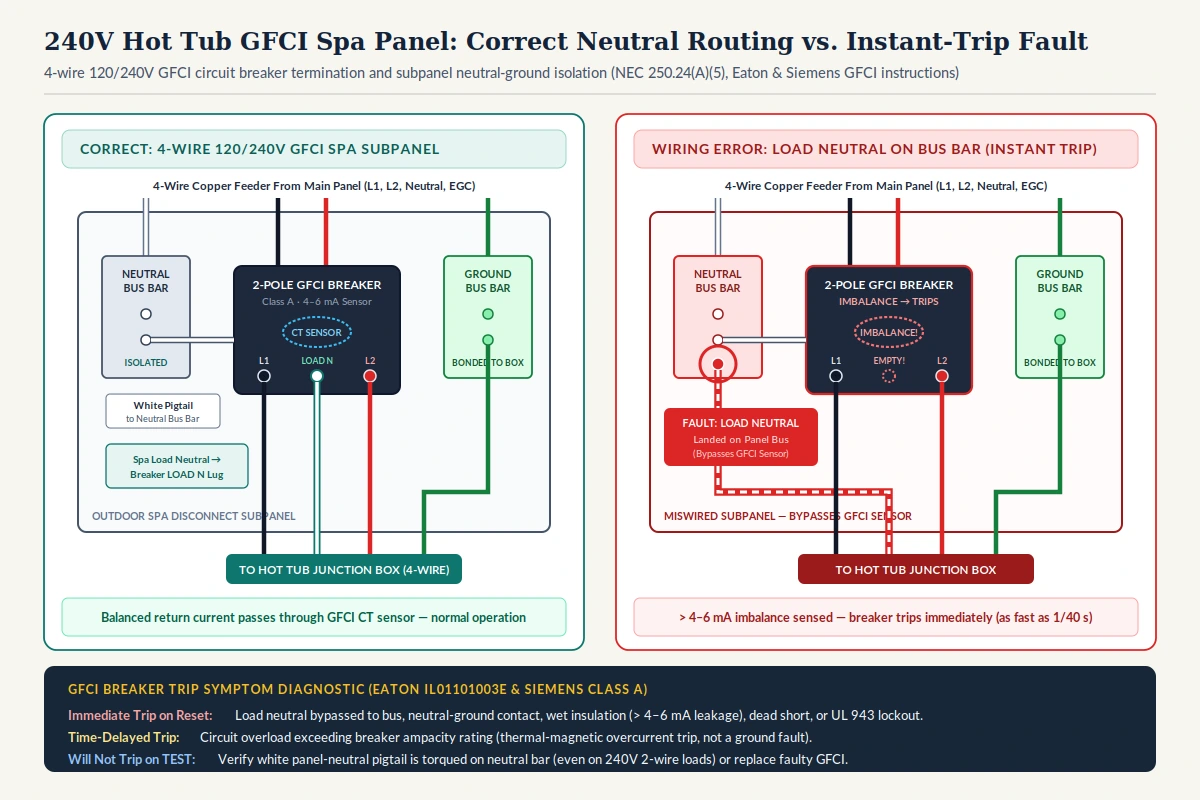
Class A GFCI breakers compare outgoing and returning conductor currents and trip in as little as 1/40 of a second when imbalance exceeds 4 to 6 milliamperes, so landing a 4-wire spa's load neutral on the subpanel neutral bus bar instead of the breaker's Load Neutral terminal causes an instant trip.
Personnel-protection sensitivity explains why GFCI breakers cannot be swapped for arc-fault or equipment-protection devices. The U.S. Office of Congressional Workplace Rights (OCWR) reports that as little as 10 milliamperes across the chest can trigger irregular heartbeat and possible death, whereas Class A GFCIs interrupt fault current at roughly 4 mA to 6 mA. OSHA notes that a GFCI shuts off power in as little as 1/40 of a second at about 5 milliamperes—protecting against ground-fault shock, fires, overheating, and wire-insulation destruction, though not against line-to-line or hot-to-neutral contact—and CPSC Publication 099 confirms that a circuit-breaker GFCI protects against both ground faults and circuit overloads across the branch circuit. Municipal checklists such as Walworth's specifically check for a ground-fault GFCI rather than an arc-fault AFCI breaker.
Miswiring a 4-wire spa subpanel's load neutral or bonding neutral to ground on the load side triggers immediate breaker trips. Eaton's Type CH and Type BR GFCI instructional leaflet directs connecting the protected circuit's white load neutral wire to the breaker connector marked Load Neutral and torquing the lug screw per the breaker side markings (noting load neutral is optional only on pure 208-volt and 240-volt systems with no load neutral). Siemens' Class A 5 mA GFCI breaker datasheet (covering 1-pole 15–30A and 2-pole 15–60A breakers for spas and hot tubs) adds that the breaker's white line-neutral pigtail must connect to the panel neutral for the device to function even when the circuit requires no load neutral. Meanwhile, RCNYS Section E3908.7 (NEC 250.24(A)(5)) forbids connecting a grounded neutral conductor to noncurrent-carrying metal parts, equipment grounding conductors, or ground on the load side of the service disconnect, and Eaton cautions that single-pole GFCIs cannot protect shared-neutral circuits (a two-pole GFCI is used for shared-neutral or 240 VAC two-wire circuits without a load neutral). Mechanical enclosures or indoor plant vaults housing subpanels also require drainage and access clearance covered in our equipment vault location, soundproofing, and ventilation guide.
Step-by-step isolation separates wiring errors from spa faults and breaker end-of-life. Under Eaton's troubleshooting procedure, if an immediate trip clears when all appliance loads are disconnected, the cause lies in the spa: leakage exceeding 4–6 mA nominal (30 mA nominal for equipment-protection devices), an interchanged or touching neutral and ground wire, or a dead short tripping the overcurrent mechanism. If the breaker still trips with the spa disconnected, disconnecting Load Power isolates defective insulation or wet conductors in premise wiring, and disconnecting Load Neutral isolates a grounded neutral wire. Both Eaton and Siemens highlight UL 943 Self Test and Lockout on personnel-protection GFCI breakers (marked by a white test-button label on Eaton units, versus an orange label on equipment-protection units without self-test): if internal sensing fails, the breaker trips itself and refuses to relatch so the unit is replaced. By contrast, a trip occurring after a time delay signals circuit overload, and a test button that will not trip points to an unattached white pigtail on the neutral bar; CPSC Publication 099 instructs testing every GFCI after installation, at least once a month (UL suggests every 30 days), after a power failure, and per manufacturer instructions.
Scroll horizontally to see all columns →
| Observed Symptom | Primary Wiring or Fault Cause | Diagnostic Isolation Step |
|---|---|---|
| Trips immediately on reset (clears when spa disconnected) | Spa ground leakage > 4–6 mA nominal, interchanged/touching neutral and ground, or dead short | Disconnect spa loads and reset; inspect appliance wiring, neutral-ground isolation, and shorted components |
| Trips immediately with spa disconnected (clears with Load Power removed) | Excessive leakage in premise wiring from defective insulation or wet conductors | Disconnect Load Power wires from GFCI breaker and reset to isolate conduit or feeder insulation faults |
| Trips immediately with Load Power removed (clears with Load Neutral removed) | Grounded load neutral or load-side neutral-to-ground bond violating NEC 250.24(A)(5) | Disconnect Load Neutral wire and reset; verify isolated neutral bar in outdoor subpanel |
| Still refuses to relatch with loads removed and pigtail attached | UL 943 Self Test and Lockout detected compromised GFCI sensing circuitry (white personnel label) | Confirm white test-button label (personnel GFCI) and replace locked-out breaker |
| Trips after a time delay under load | Circuit overload tripping thermal-magnetic overcurrent element rather than ground fault | Compare running current against breaker rating and 125% nameplate requirement; reduce overload |
| Will not trip when TEST button is pressed | White line-neutral pigtail disconnected from panel neutral bar or failed GFCI | Verify white pigtail is secured on panel neutral bar (required even without load neutral) or replace GFCI |
Pre-Delivery Electrician Handover Checklist
- Verify the spa nameplate voltage (120V or 240V), total load rating, and whether the circuit uses 4-wire 120/240V service or a 240 VAC two-wire circuit without a load neutral, sizing branch conductors and overcurrent protection to at least 125 percent of nameplate load with electric heating loads subdivided to 48 amperes or less and protected at 60 amperes or less (NEC 680.10 / RCNYS E4208.2).
- Confirm main-panel breaker capacity for a dedicated two-pole Class A 5 mA (4–6 mA) GFCI feeder—not an AFCI breaker—and match copper gauge to terminal temperature markings (60°C cap on Type NM-B versus 75°C individual conductors in conduit) plus an insulated copper EGC sized per Table E3908.13 (minimum 10 AWG up to 60A, never smaller than 12 AWG).
- Mark the outdoor maintenance disconnect at least 5 feet (1524 mm) horizontally from inside spa walls along the shortest reach path and visible within 50 feet (15.2 m), keep switching devices at least 5 feet away, and place a 125-volt 15A or 20A GFCI convenience receptacle with a bubble-style cover 6 to 20 feet away with all receptacles within 20 feet GFCI protected.
- Leave underground trenches open for inspection at required cover: 18 inches for direct-burial 240-volt nonmetallic raceways, 12 inches for 120-volt GFCI-protected circuits rated 20A or less, or 6 inches for rigid/intermediate metal conduit, using suitable corrosive-environment raceways and excluding aluminum conduit.
- Inside the outdoor spa subpanel, keep the neutral bar isolated from the ground bar (NEC 250.24(A)(5)), connect the GFCI breaker white pigtail to the panel neutral bar and any 4-wire spa load neutral to the breaker Load Neutral lug, verify the 28-inch rim / 30-inch perimeter bonding exception or #8 solid copper bonding with no ground rods, and test the GFCI after installation, monthly, and after power failures.
Frequently Asked Questions
- Does a 240-volt hot tub require a 50-amp or 60-amp GFCI breaker?
- Many 240-volt hot tubs use a 50-amp or 60-amp 4-wire dedicated service, and the exact rating comes from the spa's nameplate and listing instructions (NEC 110.3(B)): under RCNYS Section E4208.2 (NEC 680.10), electric spa water-heater conductors and overcurrent protection must be sized to at least 125 percent of the total nameplate load rating with heating elements subdivided to 48 amperes or less and protected at no more than 60 amperes.
- Can you use Type NM-B cable for an outdoor hot tub circuit?
- Type NM-B cable is capped at 60°C (140°F) ampacity under RCNYS Section E3705.4.4 (limiting 6 AWG copper to 55 amperes instead of 65 amperes at 75°C), and outdoor wet or corrosive spa wiring must instead use an insulated copper equipment grounding conductor (minimum 12 AWG, 10 AWG up to 60A) inside an approved corrosive-environment raceway such as rigid polyvinyl chloride conduit, rigid metal conduit, intermediate metal conduit, reinforced thermosetting resin conduit, or liquidtight flexible nonmetallic conduit.
- How far must the hot tub disconnect be from the water?
- Under RCNYS Section E4203.3 (NEC 680.13) and Washington WAC 296-46B-680, the maintenance disconnect must sit at least 5 feet (1524 mm) horizontally from inside spa walls along the shortest reach path from the water's edge (unless separated by a permanently installed barrier providing a 5-foot reach path) and remain readily accessible and within sight, meaning visible and not more than 50 feet (15.2 m) away.
- Does an above-ground portable hot tub need perimeter equipotential bonding or a ground rod?
- Under NEC 680.26(B)(2) and 680.42(B) as codified in RCNYS, perimeter-surface equipotential bonding is not required for a listed above-ground self-contained outdoor spa installed on or above grade per manufacturer instructions if its top rim is at least 28 inches (711 mm) above all perimeter surfaces within 30 inches (762 mm) horizontally (ignoring nonconductive external steps); solid copper 8 AWG bonding conductors do not extend to remote panels or electrodes, and municipal checklists such as Walworth's explicitly note no ground rods.
- When should a hot tub GFCI breaker be tested?
- CPSC Publication 099 recommends testing every GFCI after installation, at least once a month, after a power failure, and according to the manufacturer's instructions (UL likewise suggests testing every 30 days); modern UL 943 personnel-protection GFCI breakers also include Self Test and Lockout that trips and prevents relatching if internal sensing circuitry malfunctions.
Sources
- New York State Department of State — Residential Code of New York State
- Washington State Department of Labor & Industries — Electrical Safety Standards (WAC 296-46B-680)
- Town of Walworth, NY — Hot Tub Pre-Inspection Checklist
- U.S. OSHA — Construction eTool: Ground-Fault Circuit Interrupters (GFCI)
- U.S. Consumer Product Safety Commission — Ground-Fault Circuit Interrupters Fact Sheet
- U.S. Office of Congressional Workplace Rights — Ground-Fault Circuit Interrupters Fast Facts
- Legal Information Institute (Cornell Law School) — 29 CFR 1910.305, Wiring Methods and Flexible Cords