
Natural Stone Spa Coping: Travertine vs Granite vs Bluestone
Coping that etches, stains, flakes or feels harsh at the water’s edge is expensive to replace once the spa is tiled and filled. There is no single best coping stone for a hot tub: the defensible choice is a specific stone, colour and finish, in a specific edge profile, with evidence for the water, sun and climate at your spa edge. This comparison is based on published stone-industry guidance, not our own tests, and ends with the documents to request before you approve a sample.
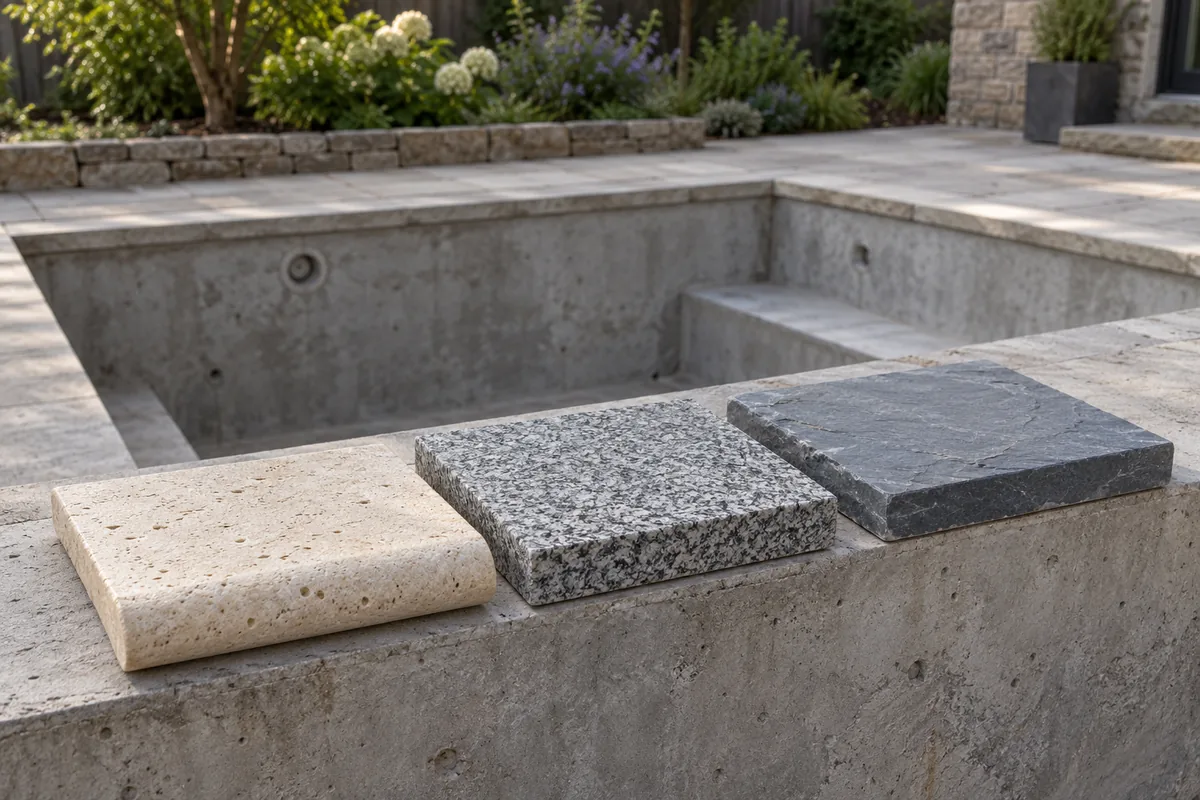
Quick comparison: what each stone name does and does not tell you
Travertine is a limestone that reacts to mild acids; granite has a long record as exterior paving for abrasion and weathering; “bluestone” is a trade name whose rock type depends on where it was quarried. None of those facts approves a particular product for your spa. Use the table to separate what an industry source supports from what your supplier still has to prove.
Scroll horizontally to see all columns →
| Stone | Supported by industry sources | Ask the supplier to prove |
|---|---|---|
| Travertine | A calcium carbonate limestone; vulnerable to alteration by mild acids. Absorption varies widely across the limestone group. | Fill type, finish, frost resistance where relevant, salt and water-treatment behaviour of the exact stone. |
| Granite | Long use as exterior cladding and paving, with strength, abrasion resistance and weathering durability. | Colour and finish for sun and wet use, staining minerals, and compatibility with your water treatment. |
| Bluestone | In Pennsylvania and New York, a fine-grained sandstone; elsewhere the name is used for limestone or basalt. | Geological name and quarry first, then the same evidence as any other stone for that rock type. |
Make the coping decision after the overall pool and spa layout fixes where the spa sits, which edges people sit on and which edges face the pool or deck. The same stone can perform differently on a sunny, salt-splashed raised edge and a shaded deck-level edge.
Takeaway: Compare named samples with evidence, not three stone names.
Map where the coping sits in the water exposure
Spa coping is usually wetted from below and from above, not submerged. Stone Federation Great Britain’s pool guidance describes four zones: underwater; capillary rise just above the waterline, where water and dissolved salts are drawn up through the stone; splash, with random wetting and drying; and peripheral, where the surrounding deck can feed water and salts into the construction. Salts concentrate and can precipitate where water evaporates.

That is why the questions for a raised spa wall or a spillover into a pool differ from those for a deck-level edge: more faces are wetted, and the stone may be exposed on two sides. Record the inputs below before asking for samples.
Scroll horizontally to see all columns →
| Input | Where to get it | Why it changes the choice |
|---|---|---|
| Edge type | Section drawing: deck-level, raised wall, spillover, pool-facing | Sets which faces are wet and which zone they sit in |
| Water treatment | Equipment designer: chlorine, salt chlorination, bromine, pH adjustment | Chemicals and dissolved salts may react with the stone |
| Climate | Local freeze–thaw exposure | Exterior stone must show frost resistance where the climate requires it |
| Sun and colour | Site orientation and shade | Darker surfaces absorb more radiation |
| Cover and waterline | Cover supplier drawing and tile layout | Profile and overhang must suit cover travel and the tile line |
Ask the pool and spa equipment designer to name the sanitising method and, if the spa has an automatic cover, get the cover supplier’s edge detail before choosing a profile.
Takeaway: Describe the exposure first; the stone evidence you need follows from it.
Confirm the actual rock before comparing performance
Ask every supplier for the same identity record: geological name, trade name, quarry and country of origin. Stone Federation notes that classification in the UK and Europe follows BS EN 12440, with petrographic examination to BS EN 12407 where the correct geological name is in doubt. You do not need to specify those standards to use the principle: a trade name is not enough to transfer test data.
This matters most for bluestone. The Natural Stone Institute’s Use Natural Stone programme describes Pennsylvania and New York bluestone as a fine-grained sandstone that comes in grey-blue, green, brown and lilac tones, while noting that Virginia has a limestone sold as bluestone and that in Australia the name means basalt. Absorption, acid sensitivity and heat behaviour quoted for one cannot be borrowed for another.
Stone Federation also gives an initial suitability table for stone in pool floors and walls: granite is rated A (usable in all situations), limestone A to D depending on the variety, and sandstone E (likely to be difficult in these circumstances). It states that the table is initial guidance only and does not remove the need to assess each project. Treat it as a reason to ask harder questions of a sandstone or soft limestone, not as a ranking of coping products.
Common mistake: accepting test data quoted for “bluestone” or “travertine” in general. Data transfers only to the same rock, quarry and finish.
Takeaway: Get the geological name and quarry in writing before any performance claim.
Will it get too hot in the sun? Separate colour, exposure and conductivity
Claims that travertine “stays cool” are not material constants. The evidence-backed variable is colour: Stone Federation notes that black surfaces absorb more light and radiation than white ones and suffer more from heating in sunny periods. Orientation, shade, finish and how long the stone sits in direct sun all add to that.
Thermal conductivity is a different property. The Natural Stone Institute defines the k-value as the rate at which heat moves through a solid material; a higher k conducts more. Its reference table lists granite values from 1.73 to 3.98 W/mK, a spread of more than two times under one stone name, and gives no travertine or bluestone row. Conductivity also says nothing directly about how hot a surface becomes in the sun. Do not accept a temperature ranking built on it.
A practical comparison is to leave the actual candidate samples side by side in the same sun at the spa location and compare them by observation. This is a screening step for preference, not a burn-safety test; do not test hot stone with bare skin. Heat that matters to the spa’s energy use is a separate question from how warm the coping feels.
Takeaway: Choose colour and finish for the exposure, and compare real samples on site.
Salt, chlorine, acids and sealers: the evidence to request
No natural stone is chlorine resistant or salt proof as a class. Stone Federation states that pool water treatments are usually chemically based and may react with stone, so specialist advice and testing are needed. It also points out that all pool water carries dissolved salts, from treatment chemicals and from the top-up water itself, not only in a salt-chlorinated pool. Where that water dries on or in the stone, salts can stain and damage it; the corresponding laboratory test is salt crystallisation to BS EN 12370.
Discoloration is a separate risk. Some stones contain iron-bearing minerals that can produce rust-like stains, and some limestones can show organic discoloration; Stone Federation mentions partial immersion tests in alkaline water to check the latter. So “resists alkalis” also needs evidence for the specific stone rather than an assumption either way.
Cleaning products can bring acids to the coping. The Natural Stone Institute warns that lemon, vinegar and other acids can dull or etch calcareous stones such as travertine, and that many rust removers contain hydrofluoric acid, which attacks all stones including granite. It recommends neutral cleaners and, for outdoor pool and hot tub areas, flushing with clear water. Keep the stone-specific care instructions with your spa maintenance records.
Sealers do not close these questions. NSI explains that stone “sealers” are impregnators that make stone more stain resistant, not stain proof, and that many stones do not need them. Stone Federation advises specialist advice before using any treatment outside, and asks sealant manufacturers to confirm compatibility with the pool environment. A sealer can also change appearance; approve it on a sample.
Common mistake: treating a sealer as the answer to salt or staining. An impregnator makes stone more stain resistant, not stain proof; ask for evidence on the stone itself first.
Scroll horizontally to see all columns →
| Request | From | What it answers |
|---|---|---|
| Stone identity record | Stone supplier | Which rock, quarry and finish the data applies to |
| Water-treatment compatibility | Supplier or specialist, with your treatment named | Whether the stone and fill tolerate your chemistry |
| Salt crystallisation result | Stone supplier test report | Behaviour where pool water dries |
| Frost resistance (cold climates) | Stone supplier test report | Exterior durability in freeze–thaw cycles |
| Treatment and sealant data | Treatment and sealant manufacturers | Suitability outdoors at a pool, maintenance and appearance |
| Care instructions | Stone supplier | Cleaners to use and to avoid |
Coping is only one layer of the edge. If the spa interior is tiled, the waterproofing and tile system needs its own compatibility record up to the coping.
Takeaway: Name your water treatment and ask for evidence on the exact stone, fill and treatment.
Bullnose, square or drop-face edge
Fabricator catalogues, such as the one listed in the sources, show these as separate profiles. A bullnose has a rounded front edge; a square profile has a flat front face and a squared top edge; a drop-face profile carries a vertical face down past the top of the wall, so the coping looks thicker from the water. The modern drop edge is an appearance and detailing choice, not a waterfall or overflow detail.

Compare edges on three separate fields: the top finish people sit and walk on, the contact edge where hands and backs meet the stone, and the vertical face below. None of the profile names is a safety rating. A rounded edge changes how the arris feels; it does not establish wet slip resistance or prevent injury.
Raised spas and pool-facing walls often need a corner piece or a coping finished on two faces. Ask for a dimensioned section and a corner sample from the fabricator before production. The Natural Stone Institute’s travertine selection notes call for moldings and drips to stay consistent in profile along their full length, which is a fair acceptance test for any coping. Also confirm the profile with the cover supplier and the spillway detail where water is meant to leave the spa.
Takeaway: Choose the profile for appearance and contact, then approve its section and corners.
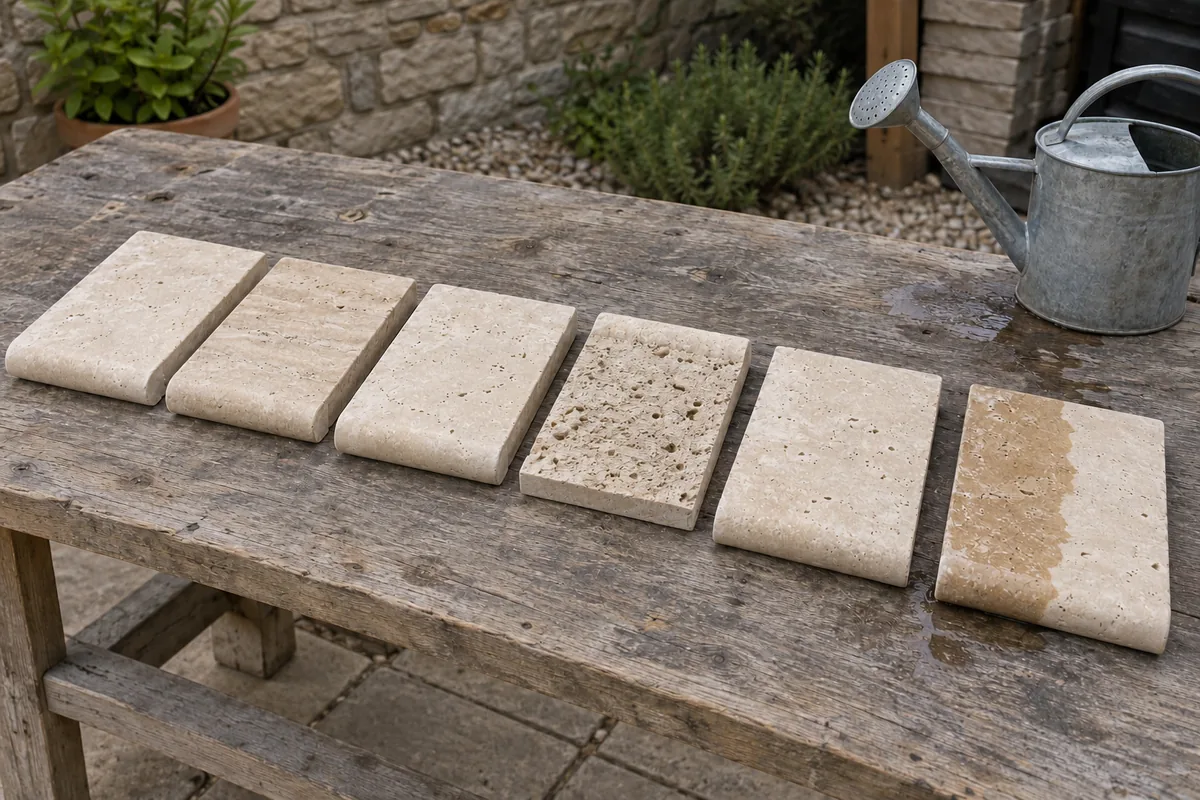
Approve a wet sample and a range of pieces
Slip resistance has to be evaluated, not assumed from a finish name. Stone Federation’s UK guidance recommends a minimum pendulum test value of PTV 40 (BS EN 14231, using the rubber slider for barefoot areas) for swimming pool environments, and notes that sloping surfaces need a correction. That is an industry recommendation in the UK, not a universal legal threshold, but it shows what a useful report looks like: a named test, on the same finish, in the condition you will install, including any treatment.
Then look at more than one piece. NSI’s travertine selection notes say holes are not the quality issue, solid structure and finish work are; the back of a piece shows what the face looked like before it was filled and honed; and stone varies even within one quarry. Ask for a range of samples and, for a large order, pieces mixed from all pallets.
Common mistake: approving coping from one dry showroom sample. Look at a range of pieces, their backs and a wet surface in the finish and treatment you will install.
Scroll horizontally to see all columns →
| Check | Record | Accept when |
|---|---|---|
| Range of pieces | Photos of the full sample set | Colour, pores and fill match the agreed range |
| Backs and fill | Back of several pieces, fill colour | Solid structure; fill appearance agreed |
| Edge and corner | Profile along the length, corner sample | Consistent profile; no unagreed sharp arris |
| Wet surface | Test report for the finish and treatment | Report matches what will be installed |
| Treated appearance | Sample with and without treatment | Colour change accepted in writing |
Keep the record with the wider pool and spa safety review; a coping sample does not replace barrier, suction or local inspection requirements.
Takeaway: Approve a wet-tested finish and a representative range, in writing.
What the coping choice does not settle
Several decisions belong to the project designer and installer, not to the stone name. Stone Federation lists frost resistance where the climate requires it, flexural strength for the location and loads, thermal movement and, where relevant, thermal shock. Joints and sealants must accommodate movement without staining or attacking the stone. Waterproofing below the coping, the bond beam and the joint layout are separate details; record who is responsible for each in the in-ground spa design checklist.
For a hotel or shared facility, involve the team responsible for commercial pool and spa design, because traffic, cleaning regimes and local requirements change the evidence needed. This guide does not give coping thickness, overhang, joint width or slope, and it does not diagnose damage from photographs.
When this guide does not apply
It is written for natural stone coping on an in-ground or raised built spa. It does not cover portable or freestanding hot tubs; porcelain, concrete or composite coping, which need their own manufacturer data rather than the stone evidence above; or approval of the project itself, which stays with your designer, installer and local inspection.
Takeaway: Assign each interface to a named party before the coping is ordered.
Frequently asked questions
Is honed travertine a good coping for a saltwater spa?
It can be considered, but the stone name alone does not answer the question. Travertine is a calcium carbonate limestone, and pool water deposits salts wherever it dries on the stone. Ask the supplier for the exact stone, fill and finish, and for salt crystallisation and water-treatment compatibility evidence that matches your system.
Will sealing travertine coping make it slippery?
A treatment can change how the surface behaves, so do not rely on an unsealed sample. Ask for a wet slip-resistance result on the same finish in the condition you will install, including any impregnator, and confirm the treatment with its manufacturer for an outdoor pool environment.
Does tumbled travertine coping need resealing?
There is no universal interval. Many stones do not need sealing at all, and an impregnator makes stone more stain resistant, not stain proof. Follow the treatment manufacturer’s maintenance instructions and keep them with the spa handover documents.
Does bluestone coping get hot in the sun?
It can. Darker surfaces absorb more radiation than light ones and heat more in sunny periods, so a dark bluestone on an unshaded edge can get hotter than a lighter stone in the same sun. How hot depends on colour, finish, exposure and which bluestone it is: the name covers sandstone, limestone and basalt in different regions. Compare the actual samples side by side in the same sun at the site rather than relying on a published temperature claim.
Can sharp coping edges be smoothed after installation?
Possibly, but whether an installed edge can be reworked depends on a stone fabricator or mason inspecting the pieces in place. Reworking an edge changes the profile and can expose the stone differently, and a treated surface may need attention afterwards. On new work, agree the edge on a sample before fabrication so the issue does not arise on site.
Why is travertine coping crumbling?
It may be linked to salt crystallisation, frost or acidic cleaners, but the actual cause has to be confirmed by inspecting the stone on site; a photograph cannot diagnose it. Record the stone identity, finish, fill, the water-treatment system, the climate and where on the coping the damage occurs, then have the supplier or a qualified stone specialist inspect it.
Takeaway: Most answers come back to one step: name the exact stone, finish and treatment, then check them on a sample.
Method and sources
Reviewed October 2026. This is an editorial comparison based on published stone-industry guidance. It reports no product test, temperature measurement or project approval, and recommends no supplier. Owner questions from community threads shaped the FAQ; their answers are not used as evidence. Our editorial policy explains how we separate sources from interpretation.
- Stone Federation Great Britain, Natural Stone – Swimming Pools (Version 1, September 2024) — pool zones, water treatment, salt, discoloration, slip, frost, thermal properties and sealants; UK industry guidance.
- Natural Stone Institute: Travertine, Limestone, and Dolomitic Limestone; Granite — material identity and exterior use.
- Natural Stone Institute: R-value technical bulletin — k-value definition and reference table; not product data.
- Natural Stone Institute: Stone care; Travertine Selection: Good, Better, Best — cleaners, sealers, samples and profile consistency.
- Use Natural Stone: Bluestone, a versatile American sandstone (Karin Kirk, May 2018) — regional meanings of “bluestone” and finishes.
- SAI Stone, Curved Pool catalogue — page 2, coping profile names only; no product is recommended.
- Owner questions: travertine for salt pools (2026); bluestone in the sun (2024); sharp edges (2026); crumbling coping (2024). Question discovery only.
Takeaway: Cite these documents by name when you ask a supplier for evidence; they frame the questions, not the answers for your product.
Next step
Take the exposure inputs, the evidence list and the sample record to your designer and stone supplier, and approve the coping only when each line has an answer. Centaur Spa Journal is an independent editorial resource; we do not sell stone or build spas. Continue with in-ground spa design to place the coping decision within the full layout, seating and cover plan.
Takeaway: Bring the three tables from this page to the next design review.