
Pool Plaster Types: Marble, Quartz and Pebble on a Spa Shell
In the Pentair MasterTemp manual, the heater comes factory set at 78°F for the pool mode and 100°F for the spa mode, with adjustable thermostat setpoints from 65°F to 104°F.
The National Plasterers Council classifies cementitious interior finishes into three categories: group 1 Traditional Plaster, group 2 Quartz, and group 3 Exposed Aggregate: Pebble/Glass Bead, noting that many finishes incorporate pozzolans or polymers.
When white cement hydrates, it forms calcium silicate hydrate (CSH) and calcium alumino-silicate hydrate (CASH) binders alongside soluble calcium hydroxide (CH), which makes up approximately 24% to 27% of fully-hydrated white cement.
In the Interfacial Transition Zone (ITZ) around lights and PVC pipes, the cement binder contains significant amounts of calcium hydroxide and has a higher water / cement ratio and greater porosity.
In our inground spa design hub, Laticrete Design Manual Section 5.4 distinguishes non-tiled pool finishes including white portland cement and fine marble dust (Marcite or Marbleite), quartz based plasters, and small river pebbles, referencing DS 386.2.
Traditional White Marble Plaster (Pool Brite)
According to the Pool Brite Safety Data Sheet, the mixture contains 30-60 percent by weight Calcium Carbonate (471-34-1) and 15-60 percent by weight Portland Cement (65997-15-1), with 0.01-6.5 percent copper phthalocyanine (147-14-8) and Pigment Blue 29 (57455-37-5).
Polymer-Modified Quartz (Diamond Brite)
According to the Diamond Brite Safety Data Sheet, the mixture contains 20-80 percent by weight Quartz (14808-60-7) and 15-60 percent by weight Portland Cement (65997-15-1), with 0.01-6.5 percent copper phthalocyanine (147-14-8) and Pigment Blue 29 (57455-37-5).
Exposed Natural River Pebble (River Rok)
In the River Rok datasheet, each 80 lb. bag covers approximately 18 - 22 sq. ft. to a minimum thickness of 3/8 inch - 1/2 inch with 1 1/2 to 2 gallons (5.7 to 7.6 L) of water, using Water Washing With Brushes as the only approved exposure technique.
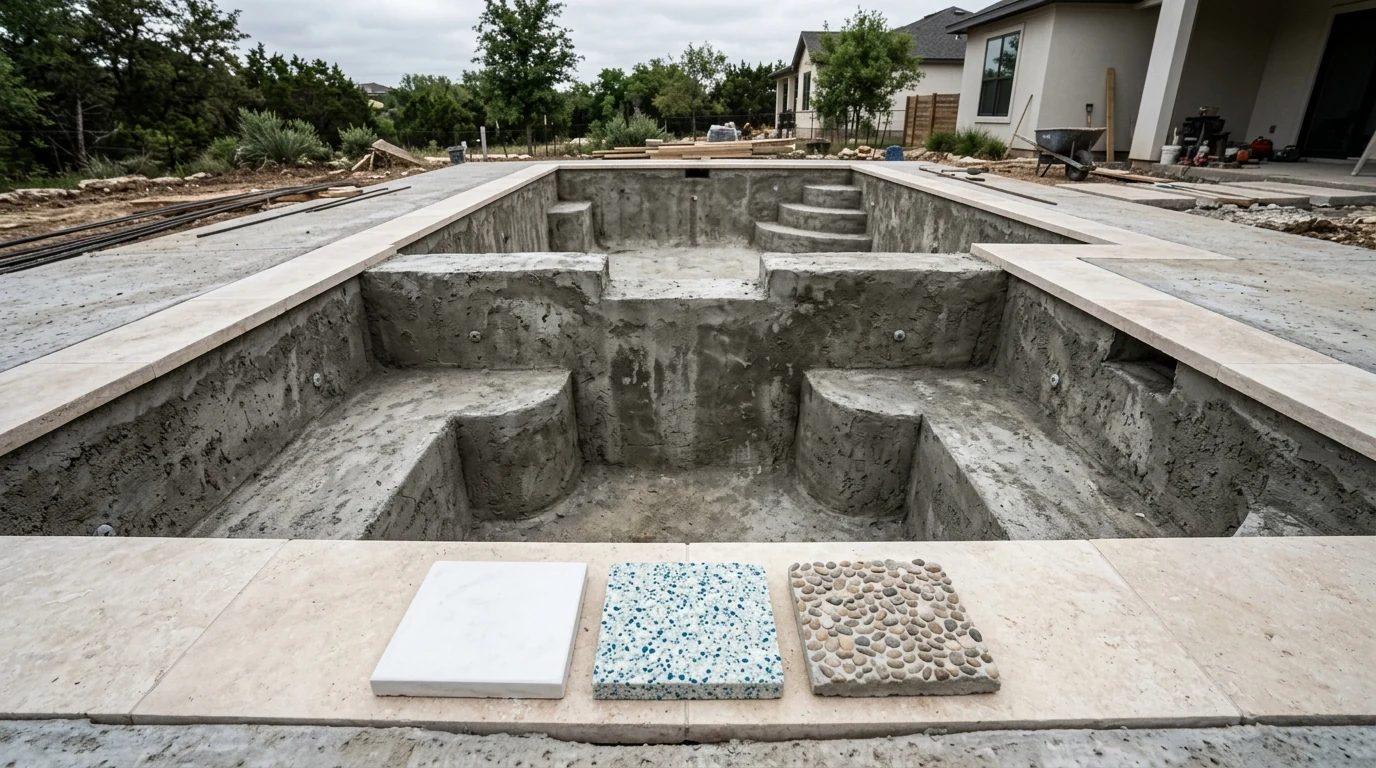
Pool plaster vs pebble and quartz: laboratory and field specification matrix
In the Diamond Brite Installation Manual, marble-based finishes deteriorate due to the weak, soluble nature of marble aggregate and fine cement paste, whereas quartz aggregate is completely insoluble even in highly corrosive acid and polymer modification increases cement hardness.
Scroll horizontally to see all columns →
| Specification parameter | White Marble Plaster (Pool Brite) | Polymer-Modified Quartz (Diamond Brite) | Exposed River Pebble (River Rok) |
|---|---|---|---|
| Primary aggregate and binder composition | Calcium Carbonate (471-34-1) is 30-60 percent by weight and Portland Cement (65997-15-1) is 15-60 percent by weight, with 0.01-6.5 percent 147-14-8 and Pigment Blue 29 (57455-37-5). | Quartz (14808-60-7) is 20-80 percent by weight and Portland Cement (65997-15-1) is 15-60 percent by weight, with 0.01-6.5 percent 147-14-8 and Pigment Blue 29 (57455-37-5). | Laticrete Design Manual Section 5.4 classifies non-tiled pool finishes into white portland cement and fine marble dust (Marcite or Marbleite), quartz based plasters, and small river pebbles (referencing DS 386.2). |
| Bag weight, coverage and mixing water | Manufactured in batches of 4,000 to 20,000 lbs (1,800 to 9,000 kg), each 80 lb. bag covers 22 - 25 sq. ft. at 3/8 inch - 1/2 inch thickness, has a shelf life up to one year, and mixes for 5 to 10 minutes with 2 to 2.5 gallons of water. | Each 80 lb. bag of Diamond Brite covers approximately 22 - 25 sq. ft. to a minimum thickness of 3/8 inch - 1/2 inch and mixes with 1 1/2 to 2 gallons (5.7 to 7.6 L) of clean potable water. | Each 80 lb. bag of River Rok covers approximately 18 - 22 sq. ft. to a minimum thickness of 3/8 inch - 1/2 inch and mixes with 1 1/2 to 2 gallons (5.7 to 7.6 L) of water, with Water Washing With Brushes as the only approved exposure technique. |
| Compressive strength, shrinkage and adhesion | The Technical Data section of the Pool Brite datasheet states that to date, no specifications have been industry approved. | ASTM C 109 compressive strength is 2950 psi at 24 hours, 5750 psi at 7 days, 5970 psi at 14 days, and 6640 psi at 28 days, with ANSI 118.7 flexural strength of 720 psi at 28 days, shrinkage of 0.027 at 1 Day and 0.091 at 7 Day, and adhesion of 0.80 N/mm2 at 28 day and 1.40 N/mm2 after NaCl 60°C cycling. | ASTM C 109 compressive strength is 2690 psi at 24 hours, 5350 psi at 7 days, 5540 psi at 14 days, and 6310 psi at 28 days, with shrinkage of 0.037 at 1 day and 0.099 at 7 days, adhesion of 0.75 N/mm2 at 28 days and 1.30 N/mm2 after NaCl 60°C cycling, and ASTM C 1028 slip resistance of SR > 0.86 and SR > 0.73. |
| Surface smoothness and dry slip resistance | Interior Finish Tolerances state that a hard-troweled finish should be no rougher than very fine sandpaper (of 220 grit or finer), like the smoothness of an eggshell, while avoiding overly smooth finishes on steps or benches to prevent slipping. | Under ASTM C 1028-07, Diamond Brite dry slip resistance is 0.86 lbf for Marlin Blue (Rough Finish) and 0.73 lbf for Oyster Quartz, Blue Quartz, and Aqua Quartz (Smoother Finish). | Under ASTM C 1028, River Rok dry slip resistance is SR > 0.86 and SR > 0.73, while ASTM C 109 compressive strength reaches 2690 psi at 24 hours, 5350 psi at 7 days, 5540 psi at 14 days, and 6310 psi at 28 days (with 1 day shrinkage 0.037, 7 days 0.099, and adhesion of 0.75 N/mm2 at 28 days and 1.30 N/mm2 after NaCl 60°C cycling). |
| Packaging weight and manufacturer term | Pool Brite is packaged in a multi-ply heavy duty lined bag of net weight 80 lb. (36 kg) and is warranted for a period of one year from the date of manufacture. | Diamond Brite comes in a bag of net weight 80 lb. (36 kg) with a standard warranty of one year from the date of manufacture, and customers may acquire an extended 5-year commercial or 10-year residential warranty. | Commercial-compliant River Rok colors AQUA REEF, SERENE SEAS, IMPERIAL WHITE, and SAPPHIRE BAY record Munsell values of 8.5, 8, 8.6, and 7.5, exceeding the Model Aquatic Health Code (MAHC) threshold of greater than 6.5. |
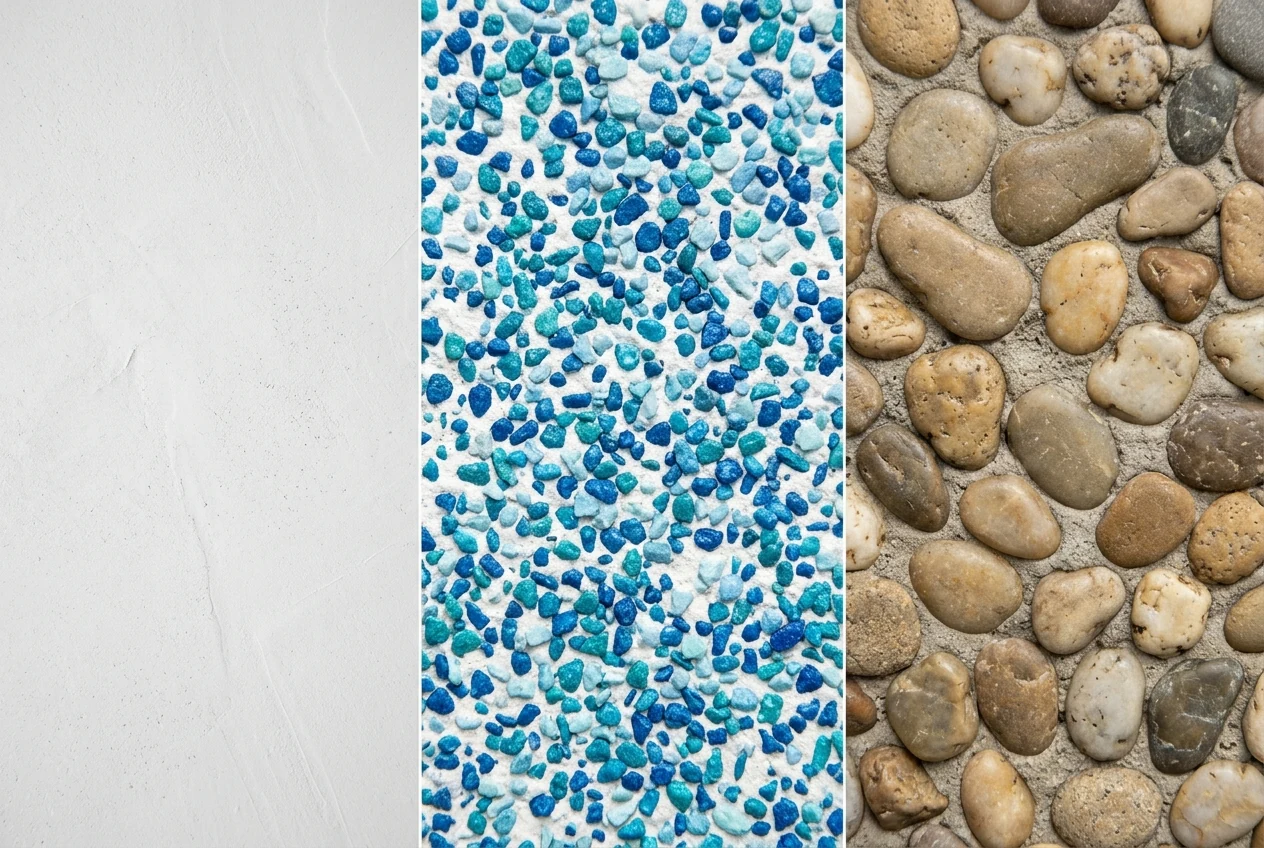
How heated spa water and negative saturation index attack the cement matrix
Hydrated white cement forms calcium silicate hydrate (CSH) and calcium alumino-silicate hydrate (CASH) alongside soluble calcium hydroxide (CH), and CH makes up approximately 24% to 27% of fully-hydrated white cement.
The Interfacial Transition Zone (ITZ) around lights and PVC pipes contains significant amounts of calcium hydroxide and exhibits a higher water / cement ratio and greater porosity.
Per the NPC Technical Bulletin (citing ANSI/APSP balanced ranges), unbalanced water can dissolve components of the cement/aggregate matrix, resulting in leaching where etched areas appear around aggregate particles, tile inserts, and other interfaces.
Low calcium hardness, low carbonate alkalinity, and/or low pH attack the ITZ, and continued leaching can cause complete dissolution of the cement paste over time in those regions of the coating.
In the King Technology Langelier Saturation Index chart, Saturation Index = pH + TF + CF + AF - 12.1, where the Temperature Factor (TF) rises from 0.0 at 32°F, 0.1 at 37°F, 0.2 at 46°F, 0.3 at 53°F, 0.4 at 60°F, and 0.5 at 66°F to 0.6 at 76°F, 0.7 at 84°F, 0.8 at 94°F, 0.9 at 105°F, and 1.0 at 128°F.
In the same Langelier lookup chart, Calcium Hardness (CF) and Total Alkalinity (AF) factors at readings of 75, 100, 150, 200, 300, 400, and 800 are CF 1.5 / AF 1.9 at 75, CF 1.6 / AF 2.0 at 100, CF 1.8 / AF 2.2 at 150, CF 1.9 / AF 2.3 at 200, CF 2.1 / AF 2.5 at 300, CF 2.2 / AF 2.6 at 400, and CF 2.5 / AF 2.9 at 800.
While APSP acknowledges an acceptable Saturation Index range of -0.3 to +0.5 and states the ideal range is 0.0 to +0.5, the NPC further refines the ideal range to 0.0 to +0.3.
In Laticrete Design Manual Section 11 (Source: ANSI/APSP-11 2009), the formula with cyanuric acid is SI = pH + TF + CF + AF - CYA Factor - 12.1, where 12.1 is a constant applied for Total Dissolved Solids between 0 and 1,000 ppm and -0.3 to +0.5 indicates balanced water.
The National Plasterers Council notes that elevated cyanuric acid levels (CYA) will impact the carbonate alkalinity measurement, that only carbonate or adjusted alkalinity can be used to calculate the Saturation Index, and that higher salt levels can make the water more aggressive.
Under Water Chemistry rules, carbonate alkalinity is calculated by subtracting approximately 1/3 of the CYA (in ppm) from the total alkalinity (in ppm), avoiding a false indication that the water is balanced when it is in a corrosive condition.
When a heated spa shares circulation with a cooler pool through our spillover spa hydraulic loop and check valves guide, Pentair's MasterTemp manual warns that if pH is too low (over acid), item 2 is etching of the plaster alongside brown, blue, green, or almost black stains from corroded metal fixtures, and pH must not be tested when chlorine residual is 3.0 ppm or higher or bromine residual is 6.0 ppm or higher.
Water chemistry operating boundaries across industry manuals
Scroll horizontally to see all columns →
| Water chemistry parameter | Plasterers council target and dosing rule | Heater manual and post-curing boundary |
|---|---|---|
| Acidity and sanitizer boundaries | Under Water Chemistry guidelines, pH should be kept within the range of 7.2 - 7.8; at a pH below 7.2 the water is considered aggressive, and a pH above 7.8 is considered scaling. | Pentair MasterTemp Table 9 lists minimum, ideal, and maximum levels for Free Chlorine at 1.0, 2.0-4.0, and 5.0 ppm, Combined Chlorine at None, None, and 0.2 ppm, Bromine at 2.0, 4-6, and 10.0 ppm, and pH at 7.2, 7.4-7.6, and 7.8. |
| Carbonate alkalinity and buffering | Carbonate alkalinity is kept at 80 - 120 ppm, where 1.5 pounds of Sodium Bicarbonate raises 10,000 gallons of pool water by 10 ppm, about 2 pounds of dry acid lowers it by 10 ppm, and no acid is added if pH is less than 7.2. | The Pentair MasterTemp water chemistry table sets Total Alkalinity (Buffering) at 60 minimum, 80-100 ideal, and 180 ppm maximum, Salt at 2000, 3200, and 5000 ppm, TDS at 1,500 ppm > TDS at startup, and Calcium Hardness at 150, 200-400, and 500-1,000 ppm. |
| Calcium hardness and fill water | Calcium hardness is kept at 200 - 400 ppm because low calcium hardness causes deterioration of the interior finish and tile grout, and one pound of calcium chloride increases 10,000 gallons of water by 10 ppm. | Initial fill water should be above 200 ppm calcium hardness (or above 150 ppm calcium hardness for some high-performance finishes) so soft water does not leach calcium hydroxide from the upper surface and weaken the cement binder. |
| Dissolved solids, stabilizer and test cadence | Total Dissolved Solids (TDS) should not exceed 1500 ppm above the source water TDS (or 1500 ppm above the source water TDS plus the added salt), and Cyanuric Acid should be kept at 30 - 50 ppm. | After 28 days, LSI is maintained between 0.0 and +0.3, Chlorine at 1 to 3 PPM (noting above 4.0 ppm may cause corrosion), pH 7.4 to 7.6, Alkalinity 80 to 120 PPM, Calcium Hardness 200 to 400 PPM, Cyanuric Acid 50 to 80 PPM, TDS 300 to 1800 PPM, and Salt 2500 to 3500 PPM. |
Aggregate exposure methods, thickness tolerances, and commercial light reflectance
In the Diamond Brite Technical Information Sheet, crews must have one workman for every 300 square feet to properly expose Diamond Brite, and the exposure time is limited to approximately one hour.
Diamond Brite details four exposure options: Water Washing With Brushes, Acid Washing with a 25% solution of Muriatic Acid, Wet Acid Wash for 3 days, and Powerwash Exposure using 8 to 10 inches of water, 100% muriatic acid for 1-2 minutes, and a 2500 PSI pressure washer with a 45-degree nozzle held 12 to 18 inches away with 20% overlap.
For River Rok natural pebble finishes, each 80 lb. bag covers approximately 18 - 22 sq. ft. to a minimum thickness of 3/8 inch - 1/2 inch using 1 1/2 to 2 gallons (5.7 to 7.6 L) of water, and Water Washing With Brushes is the only approved exposure technique.
Per the Diamond Brite Technical Information Sheet, many building and health departments require commercial finishes to have a dry Lightness level (CIE L value) of 80.0 or greater and a wet Luminous Reflectance Value (CIE Y value) of 50.0 or greater (measured using ASTM D 4086, ASTM E1477, and ASTM E 1347) to reflect more than 50 percent of visible light.
In the Diamond Brite reflectance table, finishes meeting code 454.1.2.4, 15A NCAC 18A .2514, and the Model Aquatic Health Code (MAHC) threshold of greater than 6.5 include COMMERCIAL WHITE at CIE L 88.28, CIE Y 65.67, wet reflectance 81, and Munsell 9, while ONYX records 44.54, 7.71, 39, and Munsell 2.
Under the ASTM E903 standard test method for total solar reflectance (TSR) from 200 nanometers to 2500 nanometers, River Rok percentage readings are 9.6 for Emerald Black, 40.1 for Lucayan Blue, 66.6 for Imperial White, and 42.5 for Granite.
Pre-plaster substrate preparation, fixture beveling, and waterproof membrane handoff
Under SGM Pool Brite installation rules, crews must undercut existing plaster 2 inches below the tile line to a depth of 3/8 inch, verify that concrete shells have cured at least 28 days, and let SGM Bond Kote cure for at least 6 hours before plastering within 3-5 days.
Under Interior Finish Tolerances, a cementitious coating should have an average minimum thickness of 3/8 inch and an average maximum thickness of 3/4 inch, beveling up to adjoining materials greater than 3/4 inch and beveling down to plumbing, lighting, or adjoining materials that are less than 3/8 inch.
During placement, hot or dry shells trigger check or shrinkage cracking and delamination, so all materials and affected areas must stay above 50°F (10°C) and below 100°F (38°C) for 24 hrs. prior and 72 hrs. after placement while troweling to a final thickness of one-half inch (1/2 inch) (10 mm-12 mm).
When Calcium Chloride is used as an accelerator in Pool Brite, it must be fully dissolved in water and no more than 2% by weight of cement (about 1/2 lb. per bag) can be used, because overuse may cause discoloration.
When Diamond Brite is applied to exposed areas above water, water curing of exposed areas for 7 to 28 days will lessen the occurrence of shrinkage cracking, and blisters due to air trapped during troweling must be eliminated because they will fill with water and may delaminate during freezing temperatures.
For full-tile or glass-mosaic waterproofing assemblies detailed in our waterproof membrane systems under glass mosaic tile guide, Laticrete Design Manual Section 5.4 separates Non-Tiled Pool Finish Types (white portland cement and fine marble dust known as Marcite or Marbleite, quartz based plasters, and small river pebbles) and directs specifiers to DS 386.2 when cementitious waterproofing is installed under plaster.
Before scheduling plaster crews on a new concrete vessel, review our gunite and shotcrete shell thickness and rebar schedules guide to confirm that concrete shells have cured at least 28 days, existing plaster at tile lines is undercut 2 inches to a depth of 3/8 inch, and SGM Bond Kote cures at least 6 hours before plastering within 3-5 days.
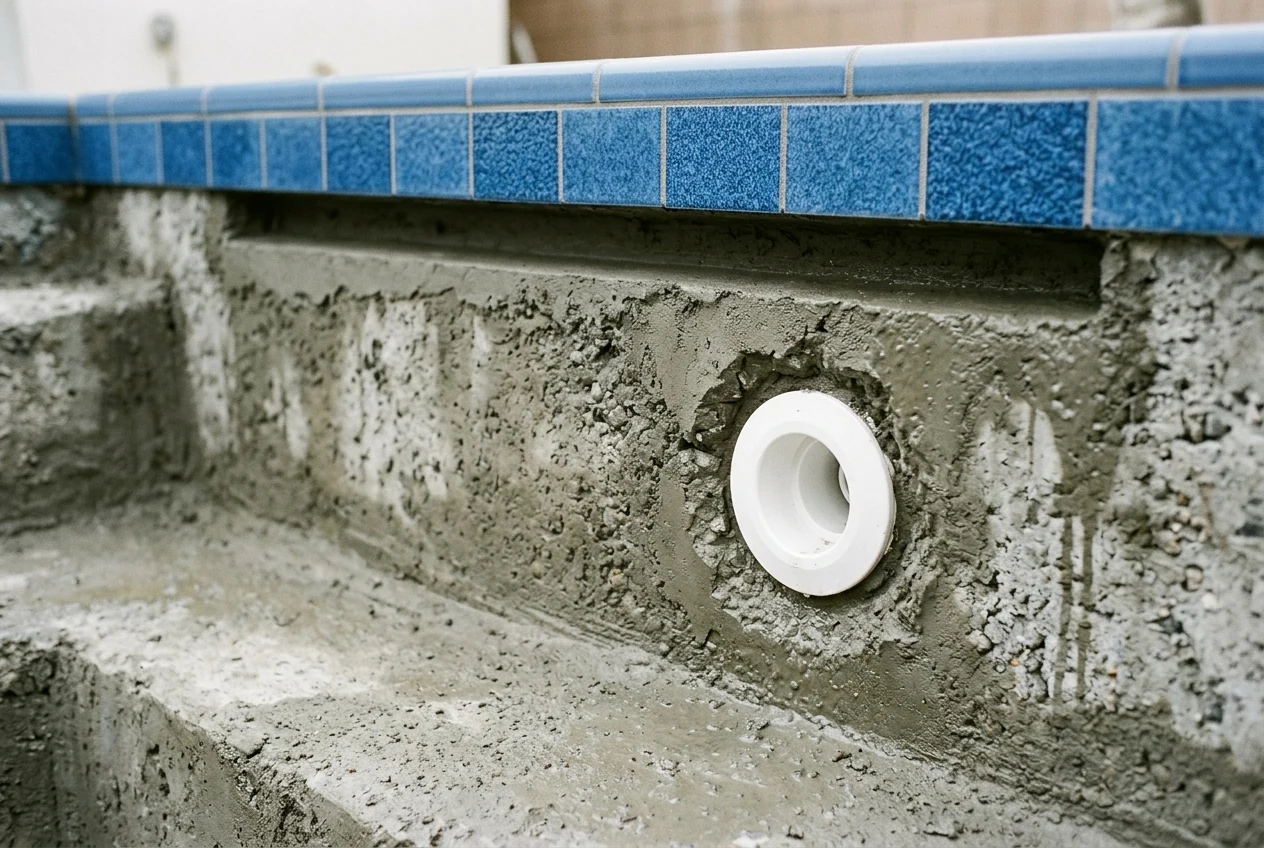
Thirty-day startup water chemistry, brushing protocol, and visual acceptance
During the first thirty days (30) of initial startup, pH and alkalinity must be monitored and adjusted (if applicable) every three (3) to five (5) days and other chemicals monitored and adjusted (if applicable) every seven (7) to ten (10) days: First Day sets pH to 7.2 - 7.6, alkalinity to 80 - 120 PPM, and calcium hardness to a minimum of 125 PPM for 3 days (then 200-400 PPM); Second Day adjusts pH to 7.4 - 7.6 and total alkalinity to 80-120 PPM and does not add chlorine; Third Day adds 1.0 - 3.0 PPM chlorine and 30 - 60 PPM stabilizer.
Startup rules require owners to brush the pool walls and floor daily for the first two (2) weeks, do not vacuum the pool with a wheeled vacuum for 14 days, and do not install an automatic pool cleaner for 28 days.
For ongoing maintenance, the National Plasterers Council specifies testing one to two times a week for pH, total alkalinity, and chlorine, and once a month for calcium hardness, stabilizer (cyanuric acid), and TDS.
Under Interior Finish Tolerances, the pool should be full of clean water (ideally in a chemically balanced condition) for visual inspection, which should be conducted in the morning, the afternoon, or on a cloudy day, and should not be made at night.
Interior Finish Tolerances also explain that normal color variation (normal mottling) arises from differences in moisture content and the rate of cement hydration, and normal mottling or shade variation is not considered a failure or defect.
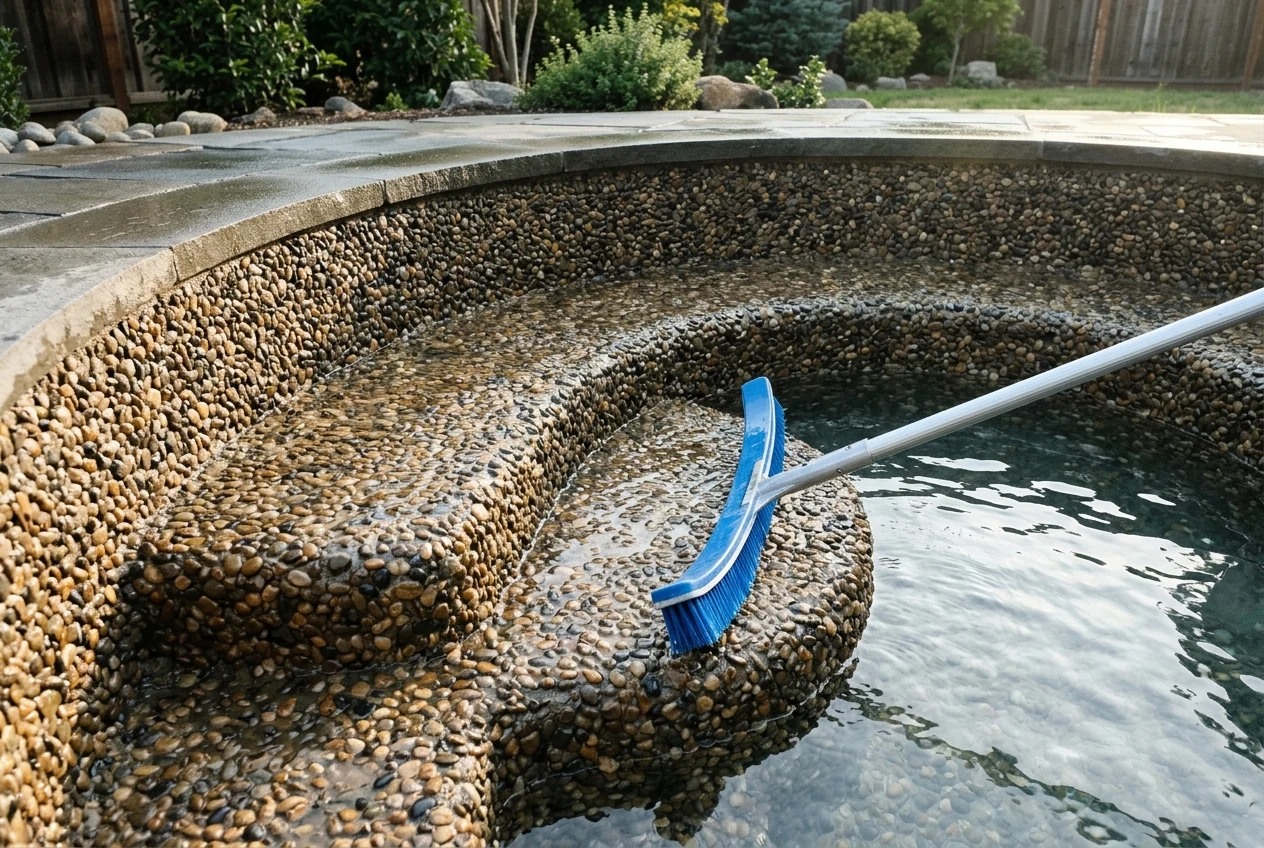
Pre-plaster and startup verification checklist
In the Pentair MasterTemp manual, spa water temperatures should never exceed 104°F (40°C), a temperature of 100°F (38°C) is considered safe for a healthy adult, soaking above 102°F (39°C) is hazardous during pregnancy, and thermostats may err by as much as 4°F (2.2°C).
- 28-day concrete cure and 2-inch tile undercut: Verify under SGM Pool Brite rules that concrete shells cured at least 28 days, existing plaster is undercut 2 inches below the tile line to a depth of 3/8 inch, and SGM Bond Kote cures at least 6 hours before plastering within 3-5 days.
- 50°F to 100°F ambient and substrate window: Confirm that all materials and affected areas stay above 50°F (10°C) and below 100°F (38°C) for 24 hrs. prior and 72 hrs. after placement to prevent check or shrinkage cracking and delamination at a final thickness of 1/2 inch (10 mm-12 mm).
- 3/8-inch to 3/4-inch thickness and fixture bevels: Check under Interior Finish Tolerances that the coating maintains an average minimum thickness of 3/8 inch and an average maximum thickness of 3/4 inch, beveling up to materials greater than 3/4 inch and beveling down to fittings less than 3/8 inch.
- Fill-water calcium hardness minimum: Verify that initial fill water is above 200 ppm calcium hardness (or above 150 ppm calcium hardness for some high-performance finishes) so soft water does not leach calcium hydroxide from the upper surface and weaken the cement binder.
- 14-day wheeled vacuum and 28-day cleaner hold: Enforce the curing rule to brush the pool walls and floor daily for the first two (2) weeks, prohibit wheeled vacuums for 14 days, and prohibit automatic pool cleaners for 28 days.
- One-third CYA carbonate alkalinity adjustment: Apply the rule of subtracting approximately 1/3 of the CYA (in ppm) from the total alkalinity (in ppm) to arrive at carbonate alkalinity, avoiding a false indication that water is balanced when it is in a corrosive condition.
- After 28 days LSI 0.0 to +0.3 equilibrium: Maintain the schedule after 28 days with LSI between 0.0 and +0.3, Chlorine 1 to 3 PPM (noting above 4.0 ppm may cause corrosion), pH 7.4 to 7.6, Alkalinity 80 to 120 PPM, Calcium Hardness 200 to 400 PPM, Cyanuric Acid 50 to 80 PPM, TDS 300 to 1800 PPM, and Salt 2500 to 3500 PPM.
Frequently asked questions
Why does white marble plaster etch faster than quartz or river pebble in a heated spa?
In the Diamond Brite Installation Manual, marble-based finishes deteriorate due to the weak, soluble nature of the marble aggregate and fine cement paste, whereas quartz aggregate, unlike marble, is completely insoluble even in the presence of highly corrosive acid and polymer modification reinforces the binder.
What is the only manufacturer-approved exposure method for River Rok natural pebble finishes?
According to the River Rok Technical Information Sheet, each 80 lb. bag covers approximately 18 - 22 sq. ft. to a minimum thickness of 3/8 inch - 1/2 inch mixed with 1 1/2 to 2 gallons (5.7 to 7.6 L) of water, and Water Washing With Brushes is the only approved exposure technique.
How do you adjust total alkalinity for cyanuric acid when calculating the Saturation Index?
Under National Plasterers Council Water Chemistry guidelines, carbonate alkalinity is determined by subtracting approximately 1/3 of the CYA (in ppm) from the total alkalinity (in ppm), preventing a false indication that the water is balanced when it is actually in a corrosive condition.
When can wheeled vacuums and automatic pool cleaners be used on a newly plastered spa or pool?
Under the Pool Brite startup protocol, you must brush the pool walls and floor daily for the first two (2) weeks, do not vacuum the pool with a wheeled vacuum for 14 days, and do not install an automatic pool cleaner for 28 days.
Technical references and cited standards
- National Plasterers Council Technical Bulletin on Chemical Etching: calcium silicate hydrate (CSH) and calcium alumino-silicate hydrate (CASH) binders form alongside soluble calcium hydroxide (CH), which makes up approximately 24% to 27% of fully-hydrated white cement.
- National Plasterers Council Interior Finish Tolerances: a cementitious coating should have an average minimum thickness of 3/8 inch and an average maximum thickness of 3/4 inch, beveling up to materials greater than 3/4 inch and beveling down to fixtures less than 3/8 inch.
- National Plasterers Council Pool Water Chemistry Effects & Prevention: carbonate alkalinity is calculated by subtracting approximately 1/3 of the CYA (in ppm) from the total alkalinity (in ppm) to avoid a false indication that the water is balanced in a corrosive condition.
- National Plasterers Council Avoiding Soft Water or Water with Low Calcium Hardness: fill water should be above 200 ppm calcium hardness (above 150 ppm calcium hardness for some high-performance finishes) so it does not leach calcium hydroxide from the upper surface and weaken the cement binder.
- Pentair Water Pool and Spa MasterTemp Pool and Spa Heater Installation and User's Guide: the heater comes factory set at 78°F for the pool mode and 100°F for the spa mode, with thermostat setpoints from a minimum temperature of 65°F to a maximum of 104°F.
- Pool Brite Safety Data Sheet: Calcium Carbonate (471-34-1) is 30-60 percent by weight and Portland Cement (65997-15-1) is 15-60 percent by weight, with 0.01-6.5 percent 147-14-8 and Pigment Blue 29 (57455-37-5).
- Diamond Brite Technical Information Sheet: ASTM C 109 compressive strength reaches 2950 psi at 24 hours, 5750 psi at 7 days, 5970 psi at 14 days, and 6640 psi at 28 days, with ANSI 118.7 flexural strength of 720 psi at 28 days, shrinkage of 0.027 at 1 Day and 0.091 at 7 Day, and adhesion of 0.80 N/mm2 at 28 day and 1.40 N/mm2 after NaCl 60°C cycling.
- Diamond Brite Installation Manual: quartz aggregate, unlike marble, is completely insoluble even in the presence of highly corrosive acid, and polymer modification counteracts the weak, soluble nature of marble aggregate and fine cement paste.
- River Rok Technical Information Sheet: ASTM C 109 compressive strength is 2690 psi at 24 hours, 5350 psi at 7 days, 5540 psi at 14 days, and 6310 psi at 28 days, with shrinkage of 0.037 at 1 day and 0.099 at 7 days, adhesion of 0.75 N/mm2 at 28 days and 1.30 N/mm2 after NaCl 60°C cycling, and ASTM C 1028 slip resistance of SR > 0.86 and SR > 0.73.
- King Technology Langelier Saturation Index Chart: Saturation Index = pH + TF + CF + AF - 12.1, with Temperature Factor (TF) values of 0.0 at 32°F, 0.1 at 37°F, 0.2 at 46°F, 0.3 at 53°F, 0.4 at 60°F, 0.5 at 66°F, 0.6 at 76°F, 0.7 at 84°F, 0.8 at 94°F, 0.9 at 105°F, and 1.0 at 128°F.
- Laticrete Pool, Spa & Fountain Technical Design Manual Section 11 (Source: ANSI/APSP-11 2009): SI = pH + TF + CF + AF - CYA Factor - 12.1, where 12.1 is a constant applied for Total Dissolved Solids between 0 and 1,000 ppm and -0.3 to +0.5 indicates balanced water.