
Steam Room vs Dry Sauna: Heat Transfer, Humidity Strain, and Room Envelope Construction
Finnish dry saunas run at 80–100°C and 10–20% humidity with wood walls above dew point, while 40–50°C steam rooms at 100% humidity require full waterproofing, sloped ceilings, and drains.
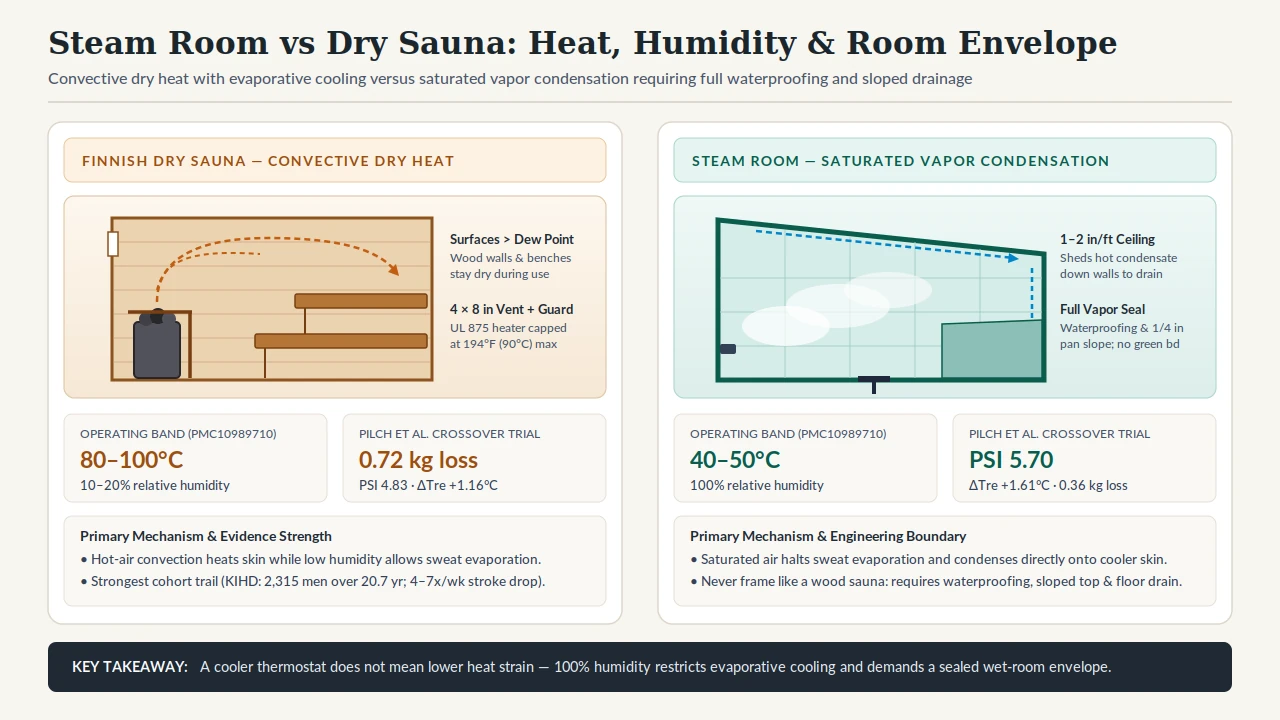
A Finnish dry sauna operates at 80–100°C with 10–20% relative humidity and transfers heat through hot-air convection so sweat can evaporate, whereas a steam room runs at 40–50°C with 100% relative humidity, blocking sweat evaporation as vapor condenses onto cooler skin and requiring a continuous waterproof vapor barrier, sloped ceiling, and floor drain.
Because saturated moisture prevents evaporative cooling, a cooler steam enclosure can place heavier core-temperature and cardiovascular strain on bathers than a much hotter dry cabin, while driving continuous liquid condensation against every wall and ceiling surface.
Coordinate thermal room selection early in pool and spa design alongside thermal energy and heating management, because framing a steam room with breathable dry-sauna wood-cabin details causes trapped cavity moisture and hot ceiling condensate dripping onto occupants.
What Are the Main Pros and Cons of a Steam Room vs Dry Sauna?
Dry saunas deliver higher ambient heat (80–100°C at 10–20% relative humidity) with greater sweat evaporation and better subjective heat tolerance, whereas steam rooms operate at lower air temperatures (40–50°C at 100% relative humidity) yet impose higher core-temperature and heart-rate strain while requiring full wet-room waterproofing.
Heat-transfer physics explains why the thermostat reading alone misleads buyers. In a Finnish dry sauna, heat transfer occurs primarily through convection from hot air to the skin while low humidity allows sweat to vaporize off the body. In a steam bath, high air humidity impedes sweat evaporation and slows body heat removal; whenever skin temperature sits below the ambient dew point, water vapor condenses directly as liquid onto the skin surface, adding heat load and raising cardiovascular strain.
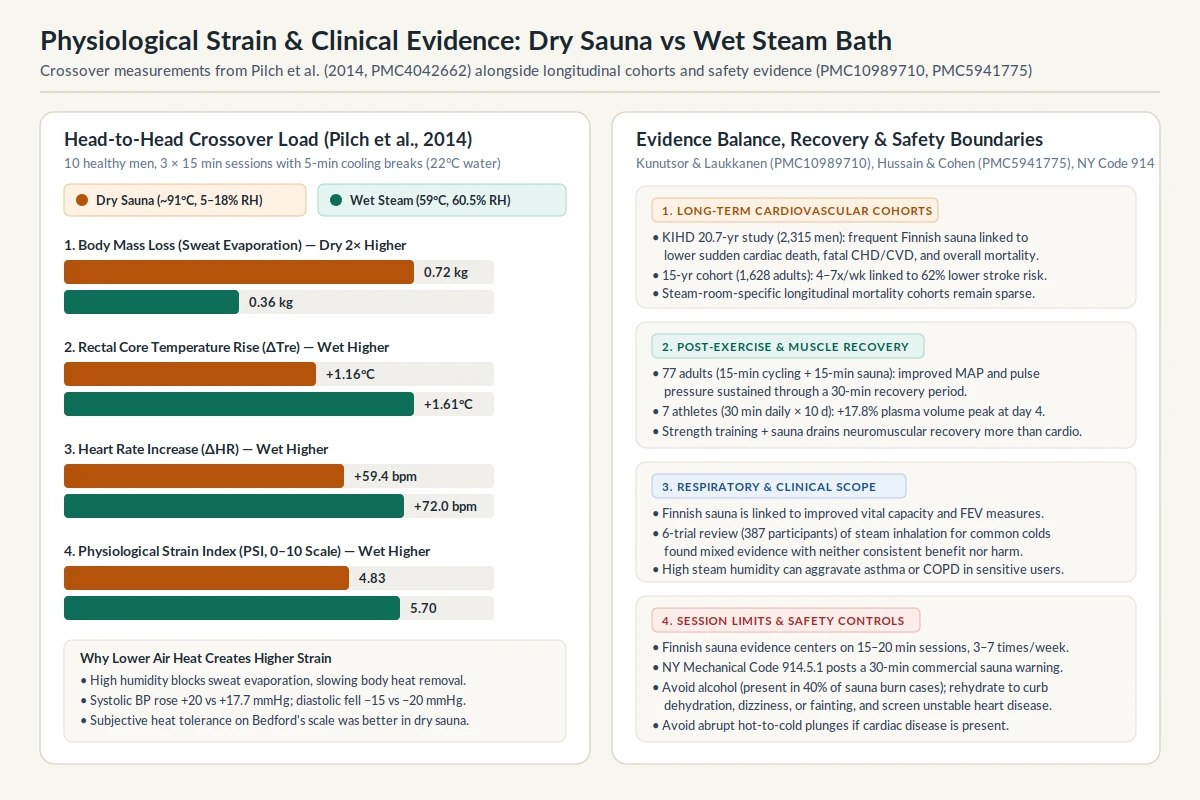
In a crossover study by Pilch et al. comparing a ~91°C dry sauna (5–18% humidity) against a 59°C wet steam bath (60.5% humidity), average body mass loss from sweating was twice as high after the dry sauna (0.72 kg versus 0.36 kg, p<0.01). Yet the cooler humid bath drove a larger rectal temperature increase (+1.61°C versus +1.16°C, p<0.01), a steeper heart-rate rise (+72 versus +59.4 beats per minute, p<0.01), a deeper diastolic blood-pressure drop (-20 versus -15 mmHg, p<0.01), and a higher Physiological Strain Index (5.70 versus 4.83). Systolic blood pressure rose slightly more in dry heat (+20 versus +17.7 mmHg), and men rated subjective heat tolerance better in the high-temperature, low-humidity dry sauna than in the lower-temperature, high-humidity bath.
Scroll horizontally to see all columns →
| Parameter | Finnish Dry Sauna | Steam Room (Wet Steam Bath) |
|---|---|---|
| Published air temperature | 80–100°C (Kunutsor & Laukkanen review) | 40–50°C (Hamman/steam room table) |
| Relative humidity | 10–20% dry air | 100% saturated water vapor |
| Primary heat mechanism | Hot-air convection to skin; sweat evaporates | Vapor condensation onto cooler skin; sweat evaporation blocked |
| Sweat body-mass loss (Pilch et al.) | 0.72 kg at ~91°C and 5–18% humidity | 0.36 kg at 59°C and 60.5% humidity (half of dry loss) |
| Rectal temperature rise (Pilch et al.) | +1.16°C (p<0.01) | +1.61°C (p<0.01) |
| Heart rate & BP response (Pilch et al.) | +59.4 beats/min; SBP +20 mmHg; DBP -15 mmHg | +72 beats/min; SBP +17.7 mmHg; DBP -20 mmHg |
| Strain index & subjective tolerance | PSI 4.83; better heat tolerance on Bedford scale | PSI 5.70; lower subjective heat tolerance |
How Do Health and Recovery Benefits Compare Between the Two?
Traditional Finnish dry sauna has the strongest long-term human evidence, linking frequent bathing to lower cardiovascular mortality, stroke risk, and improved lung-function parameters, whereas steam-room-specific clinical trials are sparse and systematic reviewers state there is insufficient evidence to prescribe a specific sauna type for specific clinical conditions.
In the 20.7-year Kuopio Ischemic Heart Disease (KIHD) longitudinal evaluation of 2,315 Finnish men, higher frequency and duration of Finnish sauna sessions were associated with reduced risk of sudden cardiac death (SCD), fatal coronary heart disease (CHD), fatal cardiovascular disease (CVD), and overall mortality. In a separate 15-year KIHD cohort of 1,628 men and women, bathing 4–7 times per week versus once weekly was associated with a 62% lower risk of stroke. Finnish sauna bathing has also been associated with improved vital capacity, ventilation, and forced expiratory volume.
By contrast, direct clinical evidence for steam inhalation and steam baths is far narrower. In a review of six trials across five publications totaling 387 participants examining heated water vapor (steam) inhalation for the common cold, the evidence was mixed and showed neither consistent benefits nor harms. Hussain and Cohen likewise emphasized that their systematic review did not cover steam sauna interventions and concluded that current evidence remains insufficient to recommend specific sauna types for specific clinical conditions.
Which Works Better After a Workout for Muscle Recovery?
Published post-exercise heat research centers on Finnish dry sauna rather than steam rooms, showing acute vascular recovery and plasma-volume expansion after aerobic sessions, while warning that intense strength training followed by sauna is more draining on neuromuscular performance than pairing aerobic exercise with a sauna.
In an intervention with 77 adults carrying at least one cardiovascular risk factor, completing a 15-minute cycling bout followed by a 15-minute sauna session produced favorable shifts in mean arterial pressure (MAP), pulse pressure, and augmentation index that persisted across a 30-minute recovery period. In a small athlete trial (n = 7), 30 minutes of daily postexercise Finnish sauna bathing over ten days produced a peak +17.8% plasma volume expansion after 4 days (90% CI: 7.4–29.3%).
Training modality still governs recovery timing. Intense strength training followed by a sauna session places a heavier drain on neuromuscular performance than aerobic endurance exercise followed by a sauna, and no comparative clinical data establish steam rooms as superior to dry heat for post-workout muscle recovery.
How Long Can You Safely Stay in a Steam Room vs a Dry Sauna?
Overall Finnish sauna evidence centers on 3–7 sessions per week lasting approximately 15–20 minutes, while New York Mechanical Code Section 914.5.1 posts a 30-minute maximum warning on commercial saunas; in a steam room, blocked sweat evaporation and faster core-temperature rise make prolonged sessions prone to overheating and steam burns.
Because saturated humidity prevents evaporative cooling, steam baths carry distinct respiratory and thermal hazards alongside cardiovascular load. High humidity in steam baths can aggravate asthma or COPD, and prolonged sessions increase the risk of steam burns and overheating. In any passive heat room, prolonged immersion without fluid replacement creates dehydration risks that can lead to dizziness or fainting.
Alcohol sharply elevates burn and cardiovascular danger: a seven-year retrospective study found that 26% of burn cases were linked to sauna sessions through hot stove or steam contact, with alcohol playing a role in 40% of those incidents. Individuals with recent myocardial infarction, severe aortic stenosis, uncontrolled hypertension, or severe valvular disease are advised to exercise caution or avoid saunas due to blood pressure (BP) fluctuations.
If a Facility Has Both, Which Should You Use First?
Because current clinical evidence does not mandate a single universal sequence between dry sauna and steam room, thermal-load physiology favors starting with the dry sauna—where evaporative cooling and subjective heat tolerance are higher—before optionally finishing with a brief humid session after rehydrating.
In Pilch et al.'s direct comparison, men tolerated the ~91°C dry sauna better on the Bedford scale and recorded a lower Physiological Strain Index (4.83 versus 5.70) despite doubling sweat body-mass loss (0.72 kg versus 0.36 kg). Entering a high-humidity steam bath first raises rectal temperature faster (+1.61°C versus +1.16°C) and drives a higher heart-rate jump (+72 versus +59.4 beats per minute), leaving less thermal headroom if you move straight into a second hot room without cooling and replacing fluids.
When a wellness suite also includes cold water, keep transitions measured rather than abrupt. Profound physiological shifts between heat exposure and cold immersion can trigger rapid hemodynamic changes and arrhythmia risk in people with preexisting cardiac disease; plan separate cold-plunge circulation, deck handholds, and rewarming space using our cold plunge and contrast-therapy integration guide.
What Does Installing a Dry Sauna vs a Steam Room at Home Require?
Installing a home dry sauna requires wood lining above dew point, a UL 875 heater capped at 194°F (90°C), a 1-hour timer, and a 4 inch by 8 inch ventilation opening, whereas a steam room requires waterproofing, a vapor barrier, a 1 to 2 inch per foot sloped ceiling, and a sloped floor drain pan.
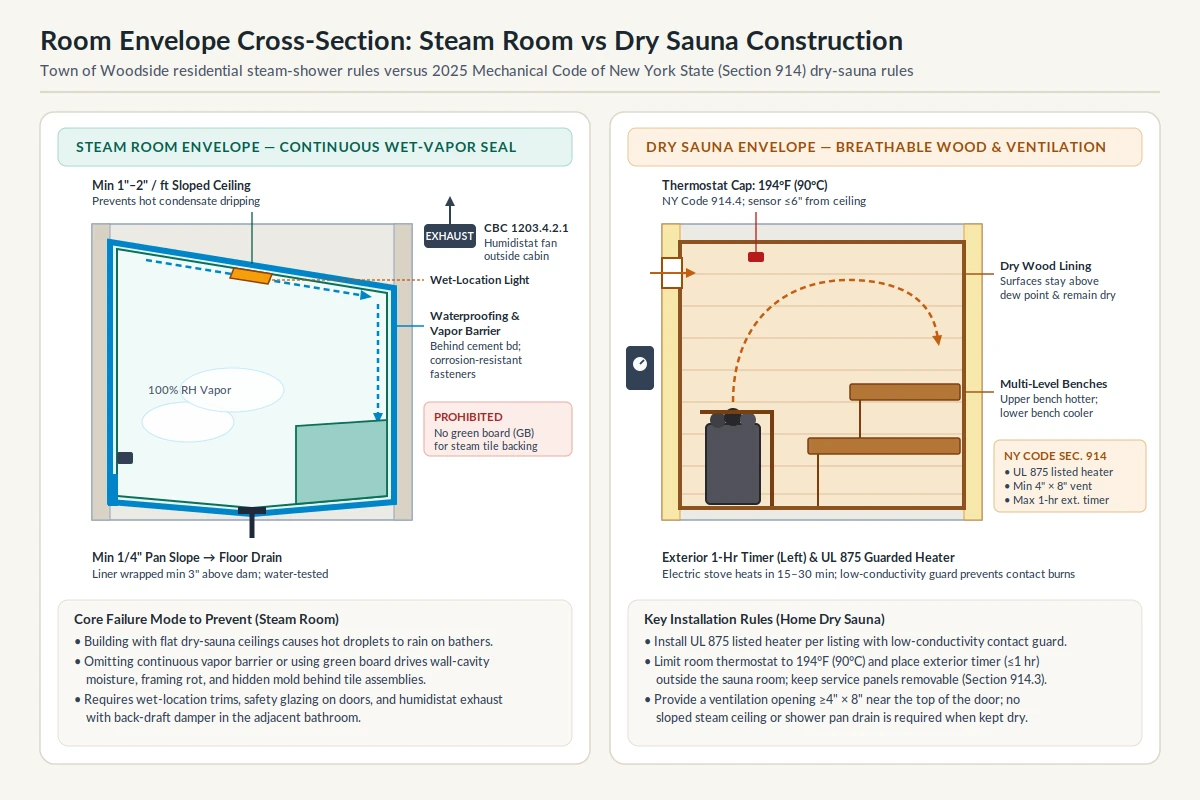
Dew-point physics drives the entire architectural split. In a typical Finnish dry sauna, the air, wood walls, and multi-level benches remain above the dew point and stay dry during use, and a modern electric stove usually heats the cabin in 15–30 minutes. Under the Mechanical Code of New York State, Section 914.2 requires sauna heaters to be listed and labeled to UL 875 and installed per their listing, Section 914.4 requires a thermostat limiting room temperature to 194°F (90°C), Section 914.4.1 caps main-burner timers at 1 hour, and Section 914.5 requires a ventilation opening of at least 4 inches by 8 inches into the sauna room.
A steam room cannot share those dry-cabin framing details. Town of Woodside residential bathroom requirements specify minimum sloped ceilings of 1 inch to 2 inches per foot in steam showers so overhead condensate sheets down the walls instead of dripping hot droplets onto occupants, an approved waterproofing system across walls and ceilings, a vapor barrier between concrete board and framing with corrosion-resistant fasteners, and an explicit prohibition on green board (GB) for steam-shower tile backing. Floor pan liners must slope at least ¼ inch to the drain and wrap at least 3 inches up the wall, wet-location light fixtures must be listed for wet locations with water-resistant trims, and adjacent bathroom mechanical ventilation per CBC 1203.4.2.1 must be separately switched with a humidistat. Coordinate membrane assemblies with our waterproof membrane systems under glass mosaic tile guide and verify space allocation on the pool and spa design hub.
Scroll horizontally to see all columns →
| Building System | Home Dry Sauna (NY Sauna Heater Code) | Home Steam Room (Woodside Steam-Shower Rules) |
|---|---|---|
| Interior surface physics | Wood walls and benches stay above dew point and dry | Continuous liquid condensation at 100% humidity |
| Ceiling geometry | Flat insulated wood ceiling permitted | Minimum sloped ceiling of 1 inch to 2 inches per foot |
| Substrate & vapor seal | Insulated framed wood lining; no wet-pan substrate | Approved waterproofing on walls and ceiling; vapor barrier behind concrete board; green board (GB) prohibited |
| Floor & drainage | Dry floor; no shower pan slope required | Plastic liner or underlayment sloped minimum ¼ inch to drain, wrapped minimum 3 inches up wall |
| Heat source & safety cap | UL 875 listed heater (Section 914.2), thermostat cap 194°F (90°C) (Section 914.4), max 1-hour timer (Section 914.4.1); electric stove heats in 15–30 minutes | Dedicated steam supply with wet-location listed light fixtures and water-resistant trims |
| Ventilation | Minimum 4 inch by 8 inch ventilation opening into sauna room (Section 914.5) | Separately switched mechanical bathroom ventilation with humidistat (CBC 1203.4.2.1) |
Thermal Room Envelope & Rough-In Checklist
- Confirm which thermal modality the room serves before framing: never apply dry-sauna flat ceilings or unsealed wood framing to a steam enclosure.
- For a steam room, pitch the ceiling 1 inch to 2 inches per foot, install an approved waterproofing system on walls and ceiling, place a vapor barrier behind concrete board with corrosion-resistant fasteners, and exclude green board (GB).
- Slope steam-room pan liners at least ¼ inch to the drain, wrap liners at least 3 inches up the wall, specify wet-location listed light fixtures with water-resistant trims, and wire a separately switched humidistat exhaust fan (CBC 1203.4.2.1) outside the cabin.
- For a dry sauna, verify a UL 875 listed heater (Section 914.2), thermostat limit at 194°F (90°C) (Section 914.4), maximum 1-hour timer (Section 914.4.1), and a ventilation opening of at least 4 inches by 8 inches (Section 914.5).
- Confirm local building, mechanical, and electrical code editions with your permitting authority before ordering heaters, steam generators, or waterproofing membranes.
Frequently Asked Questions
- Which gets hotter, a steam room or a dry sauna?
- A Finnish dry sauna runs much hotter in air temperature at 80–100°C with 10–20% relative humidity, whereas a steam room runs at 40–50°C with 100% relative humidity; however, blocked sweat evaporation in high humidity caused a larger rectal temperature rise (+1.61°C vs +1.16°C) and higher Physiological Strain Index (5.70 vs 4.83) in Pilch et al.'s crossover trial.
- Do you sweat more in a dry sauna or a steam room?
- In Pilch et al.'s head-to-head comparison (~91°C dry sauna at 5–18% humidity versus 59°C wet steam bath at 60.5% humidity), sweat-driven body mass loss was twice as high after the dry sauna (0.72 kg versus 0.36 kg) because dry air allows sweat to evaporate rather than pooling on the skin.
- Does a steam room cure a common cold or clear asthma?
- No—a review of six trials totaling 387 participants found mixed evidence for inhaling heated water vapor (steam) to treat the common cold with neither consistent benefit nor harm, and high humidity in steam baths can aggravate respiratory conditions such as asthma or COPD.
- Why does a steam room need a sloped ceiling when a dry sauna does not?
- In a dry sauna, walls and ceilings remain above the dew point and stay dry, whereas a 100%-humidity steam room condenses liquid water overhead; residential steam-shower codes such as Woodside's require a minimum 1 to 2 inch per foot ceiling slope plus continuous waterproofing so condensate runs down walls to the drain instead of dripping hot water onto bathers.
- How long should a session last in a dry sauna or steam room?
- Published Finnish sauna evidence centers on approximately 15–20 minutes per session (3–7 times per week), and New York Mechanical Code Section 914.5.1 posts a 30-minute maximum warning on commercial saunas; in a steam room, shorter cautious exposure and prompt rehydration are critical because high humidity accelerates overheating and dehydration risks.
Sources
- Pilch et al., Biology of Sport — Comparison of Physiological Reactions and Physiological Strain in Dry and Steam Heat Saunas
- PubMed Central — Temperature and Humidity Independently Influence Thermoregulatory Responses During Finnish Sauna Bathing
- Kunutsor & Laukkanen, PubMed Central — Passive Heat Therapy: A Narrative Review With a Focus on Finnish Sauna
- Hussain & Cohen, PubMed Central — Clinical Effects of Regular Dry Sauna Bathing: A Systematic Review
- Town of Woodside Building Division — Residential Bathrooms and Steam Shower Requirements
- New York State Department of State — Mechanical Code of New York State: Sauna Heaters
- Wikipedia — Sauna