
Luxury Spa Heating Efficiency and Thermal Management Guide
Under 10 CFR § 430.32(k)(1), gas-fired pool heaters manufactured on and after April 16, 2013 and before May 30, 2028 shall have a thermal efficiency of not less than 82%.
While the current federal efficiency baseline for gas-fired pool heaters is 82%, the most efficient gas-fired heaters on the market achieve an efficiency of 95%, representing 13% savings.
Under 10 CFR Part 430 Appendix P, coefficient of performance (COP) as applied to heat pump pool heaters means the ratio of heat output in kW to the total power input in kW.
ENERGY STAR notes that portable spas are more energy efficient than in-the-ground spas because they are better insulated and usually have covers, with a typical portable spa heater raising water 10 degrees in about 8 hours while, if you use your spa once a week, lowering the temperature three degrees when not in use saves approximately 5–10% of your spa heating costs and running hydrotherapy jets mixes air and water that cools the water quickly.
Coordinate heater selection, pump curves, and cover interlocks with our pool energy efficiency hub where ENERGY STAR data shows that reducing circulation pump speed by one-half allows the pump to use one-eighth as much energy, running a filter 6 hours a day versus 24 hours reduces energy use by 75%, ENERGY STAR certified pool pumps are third-party certified to use 70 percent less energy than conventional single-speed pumps, and certified in-ground pool pumps use 20% less energy than standard pool pumps.
Gas heater vs heat pump
In Trouble Free Pool's Gas and Heat Pump Cost Calculator, heat pump COP defaults to 5.0 as a reasonable average while most gas heaters are around 83% efficiency.
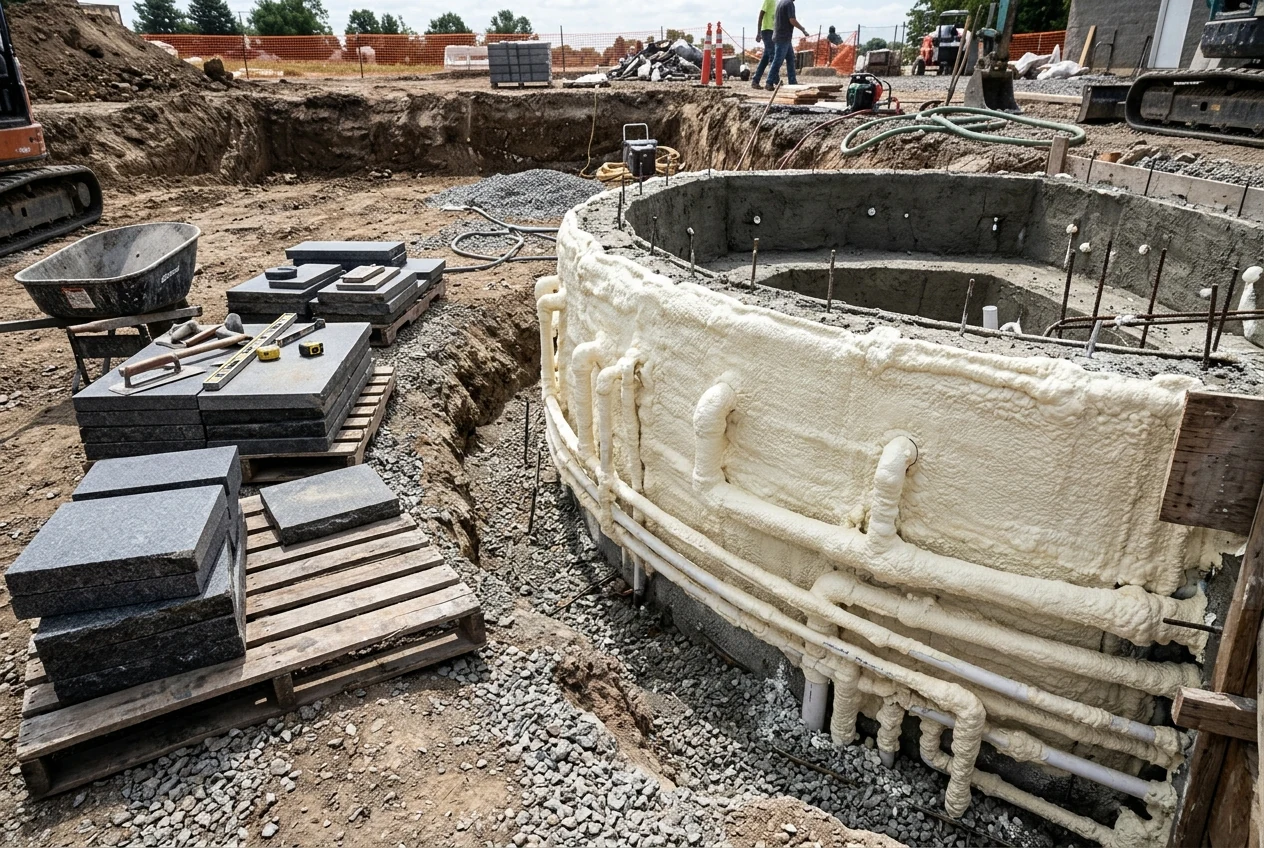
Closed-cell spray foam shell
Closed-cell sprayed polyurethane foam has a higher R-value than open-cell—typically between R-6 and R-7 per 25 mm of thickness—and its low moisture permeability rarely requires an additional vapor retarder.
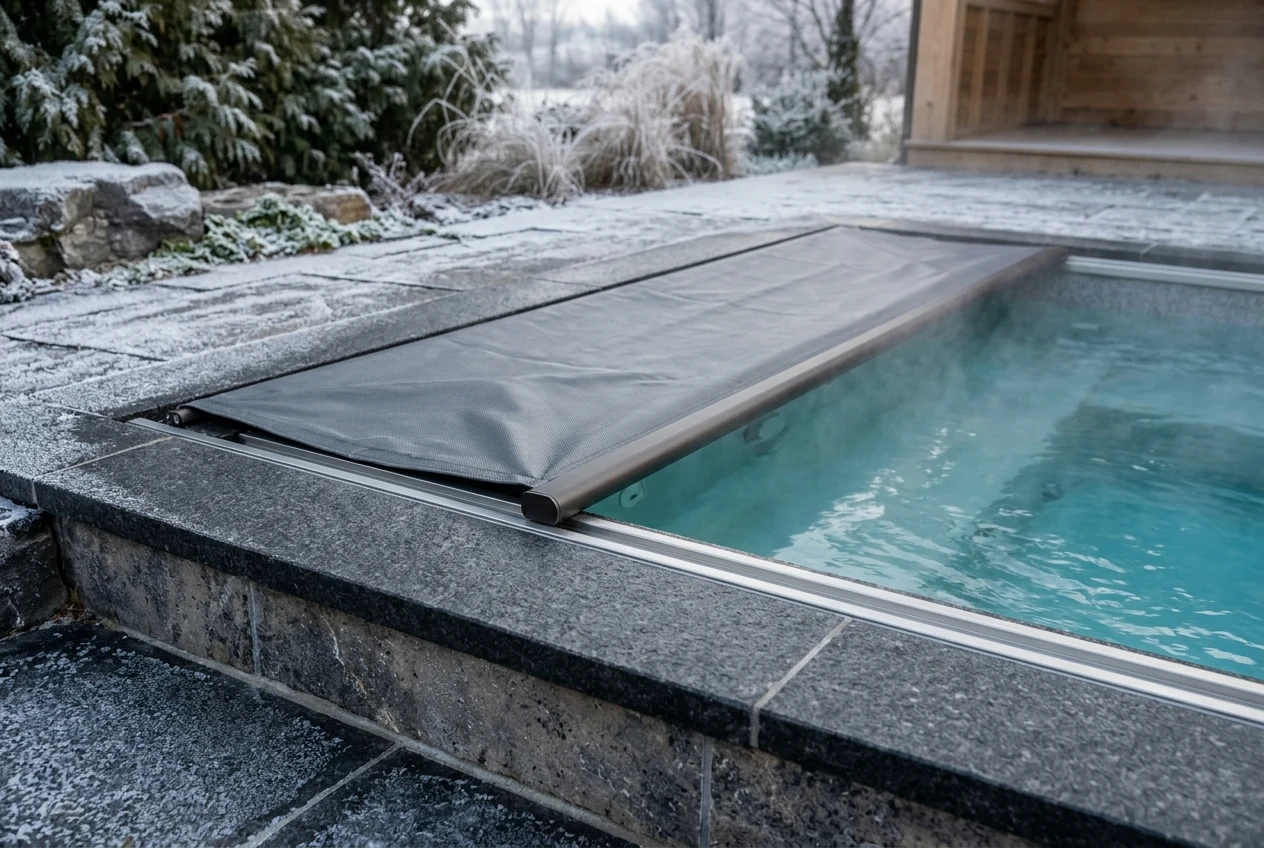
Surface cover retention
Covering a pool when not in use can reduce pool heating costs by as much as 50%–70%, minimize chemical use by 35%–60%, and conserve water by 30%–50%.
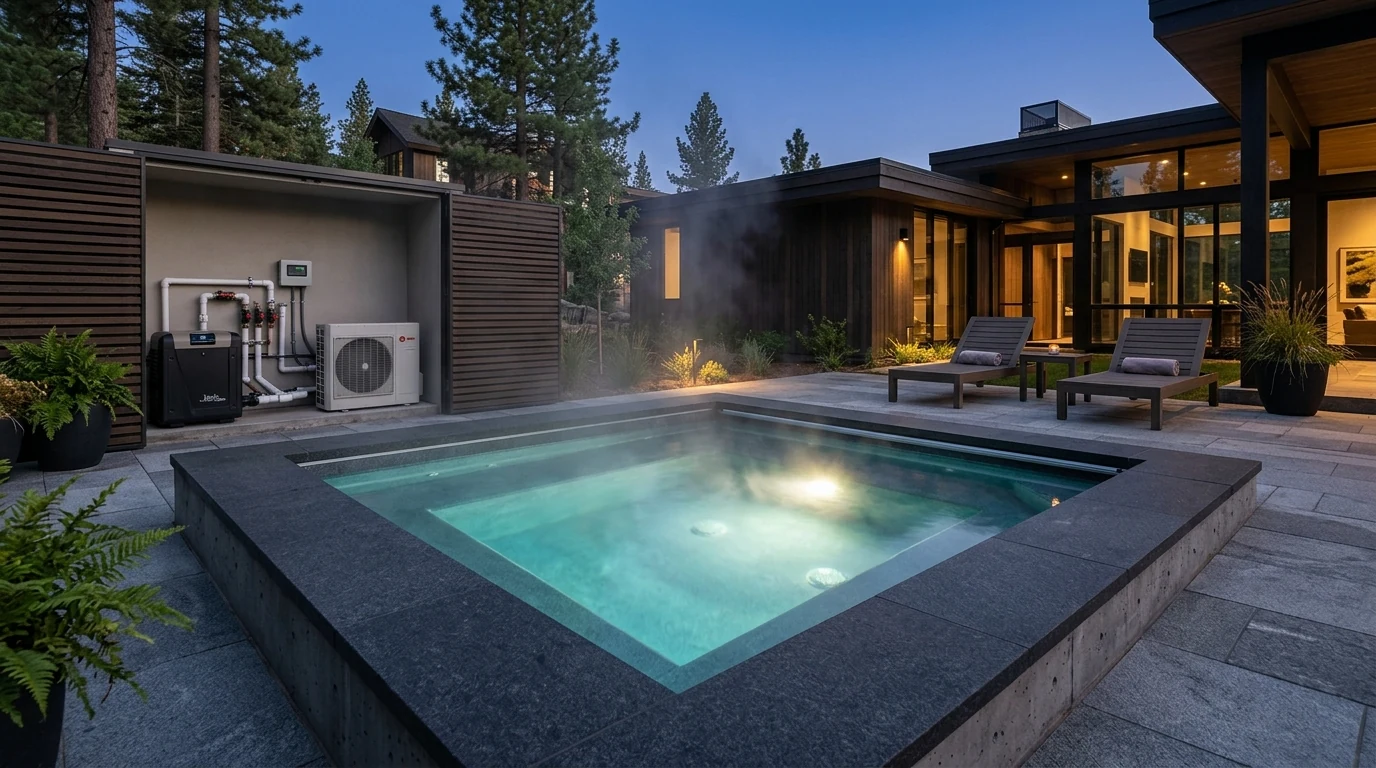
Gas heaters versus heat pumps and hybrid spa heating plants
Under 10 CFR Part 430 Appendix P, the federal active-mode test method for fossil fuel-fired pool heaters is specified in section 2.10 of ANSI Z21.56, with thermal equilibrium defined in section 9.1.3 of ASHRAE 146.
In the same 10 CFR Part 430 Appendix P regulation, the active-mode test method for electric heat pump pool heaters is specified in AHRI 1160, which references ASHRAE 146.
Electric heat pump pool heaters are evaluated under section 5 and section 6 of AHRI 1160 at the High Air Temperature—Mid Humidity (63% RH) condition of 80.6 °F (27.0 °C) Dry-Bulb and 71.2 °F (21.8 °C).
During federal pool heater standby mode testing under 10 CFR Part 430 Appendix P, after active mode tests finish, the thermostat setting is lowered to place the heater into standby mode and the pool heater is operated in standby mode for 60 minutes.
In 10 CFR Part 430 Appendix P section 5.2, the annual energy calculation sets average burner operating hours (BOH) at 104 h and average pool operating hours (POH) at 4,464 h out of 8760 hours in one year.
When sizing a gas heater for rapid spa temperature recovery, Trouble Free Pool notes the fundamental thermal rule that 1 BTU raises 1 lb of water 1 degree.
To determine the minimum size heat pump pool heater, the Department of Energy formula cited by Trouble Free Pool multiplies Pool Area x Temperature Rise x 12.
The U.S. Department of Energy notes that heat pump pool heaters work most efficiently when outdoor air is above about 45 to 50 degrees.
Beltway Pools lists typical DMV-area installed costs at about $5,000 to $10,000 for a gas pool heater, $5,000 to $10,000 for a heat pump, and $3,000 to $6,000 for solar pool heating.
ENERGY STAR states that solar thermal pool heating units typically cost between $2,000 and $4,000 dollars and pay for themselves in 2 to 7 years, depending on climate.
When laying out pad service clearances and electrical feeders in our pool and spa equipment hub, Raypak notes that electric pool heat pumps require 220 volt service, which may require higher installation cost due to breaker panel availability and distance to the pool.
Scroll horizontally to see all columns →
| Heating parameter | Gas heater specification | Heat pump or solar benchmark |
|---|---|---|
| Efficiency floor and COP | Gas-fired pool heaters manufactured on and after April 16, 2013 and before May 30, 2028 shall have a thermal efficiency not less than 82%. | In Trouble Free Pool's cost calculator, heat pump COP defaults to 5.0 as a reasonable average while most gas heaters are around 83% efficiency. |
| Federal test protocol | Fossil fuel-fired pool heaters in active mode follow section 2.10 of ANSI Z21.56 with equilibrium defined in section 9.1.3 of ASHRAE 146. | Electric heat pump pool heaters are tested under section 6 of AHRI 1160 at 63% RH with 80.6 °F (27.0 °C) Dry-Bulb and 71.2 °F (21.8 °C). |
| Sizing rule and ambient window | For gas heater output calculations, 1 BTU raises 1 lb of water 1 degree. | The Department of Energy heat pump sizing formula multiplies Pool Area x Temperature Rise x 12. |
| Installed cost and electrical service | Beltway Pools lists typical DMV-area installed costs at about $5,000 to $10,000 for a gas pool heater, $5,000 to $10,000 for a heat pump, and $3,000 to $6,000 for solar pool heating. | Raypak notes that heat pumps require 220 volt service, which may require higher installation cost due to breaker panel availability and distance to the pool. |
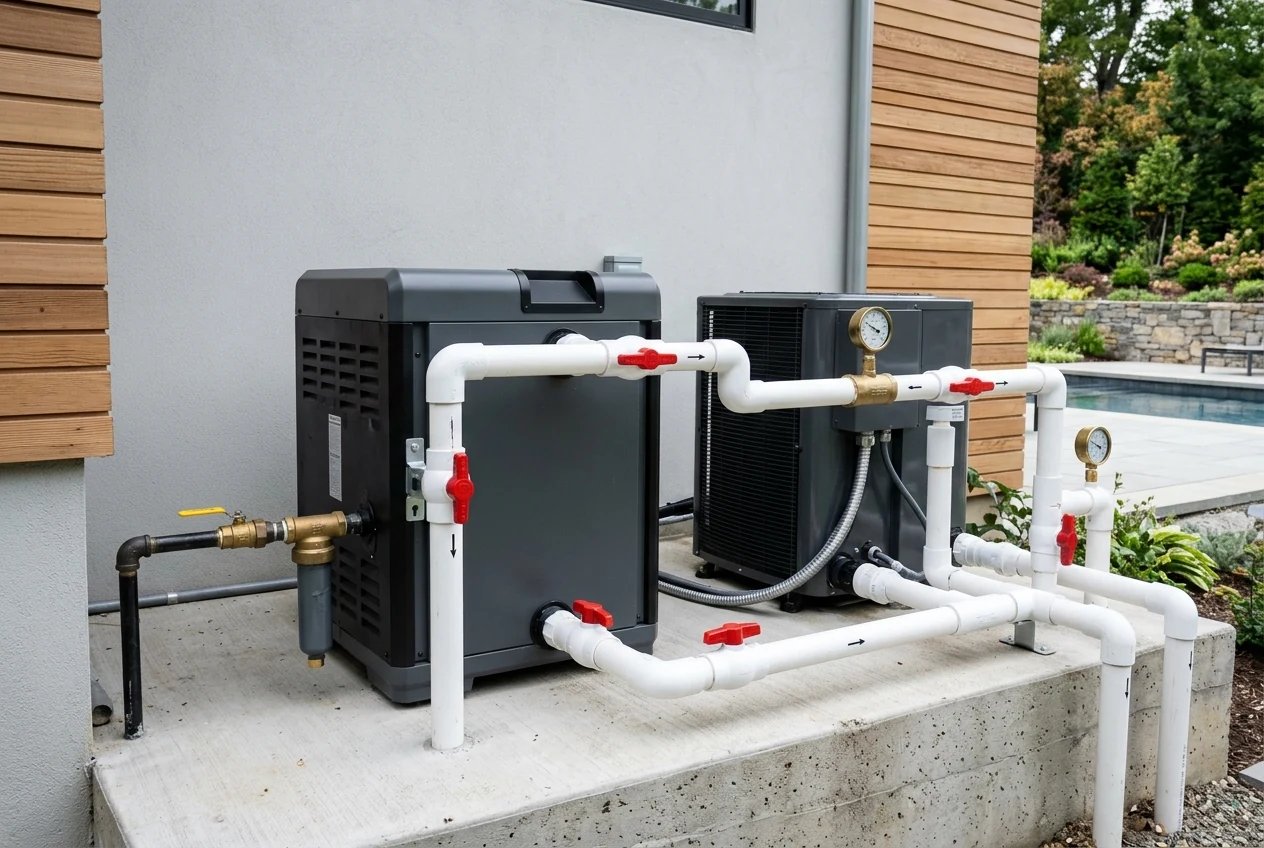
Hydraulic flow rates, fuel gas pressure, and safety interlocks on spa heaters
In the Pentair MasterTemp manual, pool and spa heater model sizes (175, 200, 250, 300, or 400) denote the input rating in Btu/hr multiplied by 1000.
Pentair MasterTemp Table 1 specifies a maximum water flow rate of 120 GPM (454 LPM) across Models 175, 200, 250, 300, and 400, with minimum flow rates of 20 GPM (76 LPM) for Models 175 and 200, 25 GPM (95 LPM) for Model 250, 30 GPM (114 LPM) for Model 300, and 40 GPM (152 LPM) for Model 400.
Where the water flow rate exceeds the maximum 120 GPM—such as with pumps 2 HP or larger—Pentair MasterTemp states that a manual bypass should be installed and adjusted.
Pentair MasterTemp requires a gas supply pressure of not less than 4" (10.2 cm) wc and not more than 14" (35.6 cm) wc, with a dynamic inlet pressure of 4" (10.2 cm) wc while running and no more than a 2" pressure drop between static and dynamic readings.
Pentair MasterTemp gas supply piping must be installed in accordance with the National Fuel Gas Code, ANSI Z223.1, or CSA B149.1, and for low-pressure LP gas the pipe size may be reduced by 1/4" with a minimum pipe size of 1/2".
Pentair MasterTemp safety interlocks include the high limit switch (HLS) opening above 135° F (57° C), the automatic gas shut-off (AGS) switch opening above 140° F (60° C), and the stack flue sensor (SFS) shutting down the heater when flue gas temperature reaches 480° F (249° C).
Under U.S. CPSC guidelines in the Pentair MasterTemp manual, spa or hot tub water temperatures should never exceed 104° F (40° C), a temperature of 100° F (38° C) is considered safe for a healthy adult, pregnant women should beware that soaking in water above 102° F (39° C) can cause fetal damage during the first three months of pregnancy, and thermostats may err by as much as 4° F (2.2° C).
When enclosing gas heaters inside mechanical vaults detailed in our equipment vault location, soundproofing, and ventilation guide, Pentair MasterTemp specifies a desirable pH range of 7.4 to 7.6, total alkalinity of 100 - 140 ppm, chlorine residual never below 0.6 ppm (1.4 ppm minimum level for effective chlorine or bromine residual), and a positive-seal noncorrosive check valve (P/N R172288) between any chemical feeder and the heater.
Closed-cell polyurethane spray foam insulation on concrete and portable spa shells
Natural Stone Institute measurements for a 1" thick stone sample show thermal conductivity (W/mK) and R-value (Hr·ft²·ºF/Btu) of 1.73 to 3.98 (R 0.083 to 0.038) for Granite, 1.26 to 2.15 (R 0.114 to 0.067) for Limestone, 1.83 to 2.90 (R 0.079 to 0.050) for Sandstone, and 5.38 (R 0.027) for Sioux Quartzite.
In The Construction Specifier, sprayed polyurethane foam (SPF) insulation is divided into low-density open-cell (also known as 1/2-pound SPF), medium-density closed-cell (also known as 2-pound foam), and high-density closed-cell.
Open-cell SPF is moisture vapor-permeable, usually requires a properly designed and installed vapor retarder, and generally has an R-value between R-3 and R-4 per 25 mm (1 in.) of thickness.
Closed-cell SPF delivers a higher R-value than open-cell—typically between R-6 and R-7 per 25 mm of thickness—and its relatively low moisture permeability means it rarely requires an additional vapor retarder.
Both types of SPF meet the requirements of an air barrier material at a typically installed thickness of 25 mm (1 in.), and Spray Polyurethane Foam Alliance applicator certification complies with ANSI/ISO 17024.
Closed-cell SPF meets Federal Emergency Management Agency (FEMA) requirements for a Class 5 flood-resistant material that can be submerged for 72 hours and dried following a flood.
After hardening and curing, unrestrained closed-cell spray polyurethane foam (ccSPF) will shrink slightly (approximately 10 percent per manufacturer's testing), inducing more shrinkage forces in cured ccSPF.
For ccSPF installation on concrete shells, manufacturers stipulate minimum substrate temperatures around -6 C (20 F), require ambient temperature not to be within five percent of the dewpoint, note that concrete is a heat-sink substrate where green concrete or form release agents challenge adhesion, and warn against more than two weeks of open storage.
When detailing concrete shell excavation and bench geometry in our inground spa design hub, compare site-applied spray foam against factory cabinets where MasterSpas uses open-cell full foam insulation with an R-value of 24 throughout the spa cabinet.
For structural concrete wall detailing covered in our architectural inground spa design and construction guide. For portable cabinet spas, Hot Spring Highlife Collection spas pair a locking cover meeting ASTM F1346 with either a 20 amp, 115 volt circuit (#12 AWG wire, max 3% voltage drop, 15 feet cord, outlet six (6) feet to ten (10) feet away) or a 50 amp, single phase, 230 volt subpanel (#10 AWG ground; mount the subpanel at least 5 feet [1.5 m] from the spa water edge per NEC 680-38 to 41-A-3).
Shell insulation materials, stone coping conductivity, and surface cover performance
Scroll horizontally to see all columns →
| Envelope material or cover assembly | Thermal resistance or evaporation reduction | Moisture, substrate, or field boundary |
|---|---|---|
| Medium-density closed-cell spray foam | Closed-cell SPF provides an R-value typically between R-6 and R-7 per 25 mm of thickness and rarely requires an additional vapor retarder. | Closed-cell SPF meets FEMA requirements for a Class 5 flood-resistant material that can be submerged for 72 hours and dried. |
| Low-density open-cell spray foam | Open-cell SPF is moisture vapor-permeable, usually requires a vapor retarder, and has an R-value between R-3 and R-4 per 25 mm (1 in.) of thickness. | MasterSpas uses open-cell full foam insulation with an R-value of 24 throughout the spa cabinet. |
| Natural stone coping and tile veneer | A 1" thick stone sample measures k = 1.73 to 3.98 W/mK (R 0.083 to 0.038 Hr·ft²·ºF/Btu) for Granite, 1.26 to 2.15 (R 0.114 to 0.067) for Limestone, 1.83 to 2.90 (R 0.079 to 0.050) for Sandstone, and 5.38 (R 0.027) for Quartzite (Sioux). | Concrete is a heat-sink substrate where ccSPF requires minimum substrate temperatures around -6 C (20 F), ambient temperature not within five percent of dewpoint, and no more than two weeks of open storage. |
| Surface covers and liquid suppressants | EPA WaterSense reports evaporation reduction of up to 95 percent for solid/mesh/hybrid covers, which can also be certified as safety covers under ASTM F1346, 50 to 95 percent for solar/bubble covers, and 15 percent for liquid evaporation suppressant. | Covering a pool when not in use can reduce heating costs by as much as 50%–70%, minimize chemical use by 35%–60%, and conserve water by 30%–50%. |
Surface evaporation physics, pool covers, and spillover heat losses
In EPA WaterSense at Work Section 5.3, California Urban Water Conservation Council (CUWCC) data estimates that water evaporation, filter backwashing, and mineral buildup control account for 56, 23, and 21 percent of pool water use, respectively.
EPA WaterSense at Work Section 5.3 Table 2 estimates annual evaporation water loss at 6,300 gallons/year for a 1,100-gallon spa, 40,000 gallons/year for a 34,000-gallon in-ground hotel pool, 160,000 gallons/year for a 150,000-gallon pool, and 570,000 gallons/year for an 860,000-gallon pool.
EPA WaterSense at Work Section 5.3 Table 3 reports evaporation reduction effectiveness of up to 95 percent for solid/mesh/hybrid covers, which can also be certified as safety covers under ASTM F1346, 50 to 95 percent for solar/bubble covers, and 15 percent for liquid evaporation suppressant.
In the Cover-Pools T4 Versa Owner's Manual, Save-T covers comply with ASTM F1346-91, cover fabric shrinks one to two percent (three to four inches on a 20-foot wide cover), each gallon of water on the cover weighs eight pounds, components are inspected two to three times a year, and non-chlorine shock allows closing the cover within 30 minutes versus 12-24 hours for chlorine shocks (Chlorine 1—5 ppm, pH 7.2—7.8, Alkalinity 80—120 ppm).
When isolating a heated spa from an unheated pool loop in our spillover spa hydraulic loop and check valves guide, the Pentair IntelliCenter Pool Cover Installation Guide (P/N 523457 Rev C) specifies that the Pool Cover Expansion Card (P/N 522039Z / P/N 522975) supports two pool covers, sets the cover home position at about 2 ft. (61 cm) and close direction at 10 ft. (305 cm), and switches affected circuits OFF/ON while adjusting chlorine output from 0 to 50 % when the cover is closed.
Similarly, when operating sheet waterfalls covered in our raised spillover spa waterfalls into swimming pools guide, EPA WaterSense at Work Section 5.3 notes that filter cleaning is needed after pressure increases by 5.0 to 10.0 psi (35 to 70 kPa), and Table 5 estimates annual filter-cleaning water use for a 1,100-gallon spa at 940 gallons/year with a sand filter, 470 gallons/year with a sorptive media filter, and 300 gallons/year with a cartridge filter.
Winter standby strategies to reduce hot tub and inground spa electric bills
To cut winter standby power draw, ENERGY STAR explains that a typical portable spa heater heats water 10 degrees in about 8 hours, and if you use your spa once a week, lowering the temperature three degrees when not in use saves approximately 5–10% of your spa heating costs, and running hydrotherapy jets creates a mixture of water and air that cools the water quickly.
ENERGY STAR notes that reducing pump speed by one-half allows the pump to use just one-eighth as much energy, running a filter 6 hours a day versus 24 hours cuts energy use by 75%, ENERGY STAR certified pool pumps are third-party certified to use 70 percent less energy than conventional single-speed pumps, and certified in-ground pool pumps use 20% less energy than standard pool pumps.
In Watkins Wellness Hot Spring Highlife Collection pre-delivery instructions, spas include a locking cover meeting ASTM F1346, where the 115 volt model uses a 20 amp, 115 volt circuit (#12 AWG wire, 3% voltage drop, 15 feet cord, outlet six (6) feet to ten (10) feet away) and 230 volt models use a 50 amp, single phase, 230 volt subpanel (#10 AWG ground; mount the subpanel at least 5 feet [1.5 m] from the spa water edge per NEC 680-38 to 41-A-3).
For winterized or covered inground spas, the Cover-Pools T4 Versa manual specifies Save-T covers meeting ASTM F1346-91, fabric shrinkage of one to two percent (three to four inches on a 20-foot cover), eight pounds per gallon of surface water, inspection two to three times a year, and closing within 30 minutes after non-chlorine shock versus 12-24 hours for chlorine shock (1—5 ppm chlorine, pH 7.2—7.8, alkalinity 80—120 ppm).
Pre-commissioning heating and thermal envelope verification checklist
Before commissioning a residential or commercial spa heating loop, verify that water temperatures never exceed 104° F (40° C), note that 100° F (38° C) is considered safe for a healthy adult, pregnant women should beware that soaking in water above 102° F (39° C) can cause fetal damage during the first three months of pregnancy, and check water with an accurate thermometer because thermostats may err by as much as 4° F (2.2° C).
- Federal gas heater thermal efficiency floor: Confirm under 10 CFR § 430.32(k)(1) that gas-fired pool heaters manufactured on and after April 16, 2013 and before May 30, 2028 have a thermal efficiency not less than 82%.
- Heater manifold minimum and maximum flow rates: Verify under Pentair MasterTemp Table 1 that flow stays below 120 GPM (454 LPM) and meets the minimum 20 GPM (76 LPM) on Models 175 and 200, 25 GPM (95 LPM) on Model 250, 30 GPM (114 LPM) on Model 300, and 40 GPM (152 LPM) on Model 400.
- Static and dynamic gas inlet pressure window: Measure gas supply pressure between 4" (10.2 cm) wc and 14" (35.6 cm) wc, confirming a running dynamic inlet pressure of at least 4" (10.2 cm) wc with no more than a 2" drop.
- Thermal cutoff and stack flue safety switches: Test the Pentair MasterTemp high limit switch (HLS) above 135° F (57° C), automatic gas shut-off (AGS) above 140° F (60° C), and stack flue sensor (SFS) at 480° F (249° C).
- Concrete shell ccSPF substrate and dewpoint window: Confirm concrete substrate temperatures are above -6 C (20 F), ambient air is not within five percent of the dewpoint, form release agents are cleaned, and foam chemicals have not exceeded two weeks of open storage.
- Automatic cover reed-switch hydraulic interlock: Configure the Pentair IntelliCenter Pool Cover Expansion Card (P/N 522039Z / P/N 522975) under guide P/N 523457 Rev C for two pool covers with home at 2 ft. (61 cm), close direction at 10 ft. (305 cm), circuit OFF/ON switching, and chlorine output reduced to 0 to 50 %.
- Filter pressure-rise threshold and cartridge selection: Service filters once pressure rises by 5.0 to 10.0 psi (35 to 70 kPa) and favor cartridge filters using 300 gallons/year on a 1,100-gallon spa over sorptive media (470 gallons/year) or sand filters (940 gallons/year).
Frequently asked questions
How does a gas heater compare with an electric heat pump for heating an inground spa?
In Trouble Free Pool's Gas and Heat Pump Cost Calculator, an electric heat pump COP defaults to 5.0 as a reasonable average while most gas heaters operate around 83% efficiency.
Why is closed-cell polyurethane spray foam preferred over open-cell foam on an inground concrete spa shell?
According to The Construction Specifier, closed-cell sprayed polyurethane foam provides a higher R-value than open-cell—typically between R-6 and R-7 per 25 mm of thickness—and its relatively low moisture permeability rarely requires an additional vapor retarder.
How much can a pool or spa cover reduce heating costs, chemical consumption, and water evaporation?
ENERGY STAR states that covering a pool when not in use can reduce pool heating costs by as much as 50%–70%, minimize chemical use by 35%–60%, and conserve water by 30%–50%.
How long must a spa cover remain open after adding chlorine shock versus non-chlorine shock?
In the Cover-Pools T4 Versa Owner's Manual (Save-T covers meeting ASTM F1346-91 with one to two percent or three to four inches shrinkage on a 20-foot cover, eight pounds per gallon of water, and inspection two to three times a year), non-chlorine shock allows closing the cover within 30 minutes versus 12-24 hours for chlorine shock (at 1—5 ppm chlorine, pH 7.2—7.8, and 80—120 ppm alkalinity).
Technical references and engineering publications
- U.S. Code of Federal Regulations, 10 CFR § 430.32(k)(1): gas-fired pool heaters manufactured on and after April 16, 2013 and before May 30, 2028 shall have a thermal efficiency not less than 82%.
- U.S. Department of Energy, 10 CFR Part 430 Subpart B Appendix P (Uniform Test Method for Pool Heaters): section 5.2 defines average burner operating hours (BOH) as 104 h and average pool operating hours (POH) as 4,464 h out of 8760 hours in one year.
- U.S. Environmental Protection Agency & Department of Energy, ENERGY STAR Pool Pumps & Pool Heating Guidance: while the federal efficiency baseline for gas-fired pool heaters is 82%, the most efficient models reach 95%, representing 13% savings.
- U.S. Environmental Protection Agency, WaterSense at Work Section 5.3 Commercial Pool and Spa Equipment: Table 2 estimates annual evaporation water loss at 6,300 gallons/year for a 1,100-gallon spa, 40,000 gallons/year for a 34,000-gallon hotel pool, 160,000 gallons/year for a 150,000-gallon pool, and 570,000 gallons/year for an 860,000-gallon pool.
- Pentair Water Pool and Spa, MasterTemp Pool and Spa Heater Installation and User's Guide: Table 1 sets maximum water flow at 120 GPM (454 LPM) and minimum flow at 20 GPM (76 LPM) for Models 175 and 200, 25 GPM (95 LPM) for Model 250, 30 GPM (114 LPM) for Model 300, and 40 GPM (152 LPM) for Model 400.
- Pentair Water Pool and Spa, IntelliCenter Control System Pool Cover Installation Guide (P/N 523457 Rev C): Pool Cover Expansion Card (P/N 522039Z / P/N 522975) supports two pool covers, sets home position at 2 ft. (61 cm) and close direction at 10 ft. (305 cm), and switches circuits OFF/ON while adjusting chlorine output from 0 to 50 %.
- Cover-Pools Incorporated, T4 Versa Automatic Pool Cover Owner's Manual: Save-T covers comply with ASTM F1346-91, fabric shrinks one to two percent (three to four inches on a 20-foot cover), water weighs eight pounds per gallon, components are inspected two to three times a year, and non-chlorine shock allows closing within 30 minutes versus 12-24 hours for chlorine shock (1—5 ppm chlorine, pH 7.2—7.8, alkalinity 80—120 ppm).
- Watkins Wellness, Hot Spring Highlife Collection Pre-Delivery Instructions: spas include a locking cover meeting ASTM F1346, with a 20 amp, 115 volt circuit (#12 AWG wire, 3% voltage drop, 15 feet cord, outlet six (6) feet to ten (10) feet away) or a 50 amp, single phase, 230 volt subpanel (#10 AWG ground; mount the subpanel at least 5 feet [1.5 m] from the spa water edge per NEC 680-38 to 41-A-3).
- The Construction Specifier, Making Sense of Sprayed Polyurethane Foam: closed-cell SPF provides a higher R-value than open-cell—typically between R-6 and R-7 per 25 mm of thickness—and rarely requires an additional vapor retarder.
- The Construction Specifier, Closed-Cell Spray Polyurethane Foam Shrinkage and How to Manage It: after hardening and curing, unrestrained ccSPF will shrink slightly (approximately 10 percent per manufacturer's testing), inducing shrinkage forces in cured ccSPF.
- Natural Stone Institute, Technical Bulletin R-Value for Natural Stone: a 1" thick stone sample records thermal conductivity (W/mK) and R-value (Hr·ft²·ºF/Btu) of 1.73 to 3.98 (R 0.083 to 0.038) for Granite, 1.26 to 2.15 (R 0.114 to 0.067) for Limestone, 1.83 to 2.90 (R 0.079 to 0.050) for Sandstone, and 5.38 (R 0.027) for Sioux Quartzite.