
Gunite Pool Construction: Shoot Window, Cure and What Comes After
With proper design, material selection, and construction, a shotcreted concrete pool should have a service life of 50 to 100 years or more.
In gunite pool construction, the dry-mix process conveys dry concrete materials—often a coarse sand and cement mixture—through a delivery hose and injects the majority of water at the nozzle before shooting the concrete at high velocity onto the receiving surface, whereas the wet-mix process pumps premixed concrete containing coarse sand, 3/8 in. [10 mm] or less coarse aggregate, and cement.
During the gunite pool shoot, the wet-mix process typically uses a water-cementitious materials ratio (w/cm) range of 0.40 to 0.45 while the dry-mix process typically uses a lower w/cm range of 0.35 to 0.40, which reduces water in the concrete mixture and can reduce shrinkage cracking.
The American Shotcrete Association reports that key factors that increase the likelihood of compressive strength significantly exceeding 4000 psi (27.6 MPa) are the material itself and the high velocity of 350 to 400 ft/s [106 to 122 m/s] with which the material is applied onto the receiving surface.
Integrate shell geometry, hydraulic rough-in, and deck structure through our pool and spa design hub, where with proper design, material selection, and construction, a shotcreted concrete pool should have a service life of 50 to 100 years or more.
Subgrade & dewatering hold
When groundwater is encountered during construction, cohesive soils should be dewatered with a sump-pump system and cohesionless soils with shallow groundwater may require a wellpoint system to remove groundwater to a minimum depth of 3-ft below the pool bottom.
Batch shoot window
Under USDA NRCS shotcrete rules, each batch is gunned within 1.5 hours of being batched in normal weather or within 45 minutes when the temperature is over 85 °F, and rebound material is not reused.
Shell cure & finish gate
LATICRETE pool technical design guidance specifies that concrete pool shells must be cured for a minimum of 28 days and that a minimum time interval should be allowed between each successive stage of the project to ensure full cure.
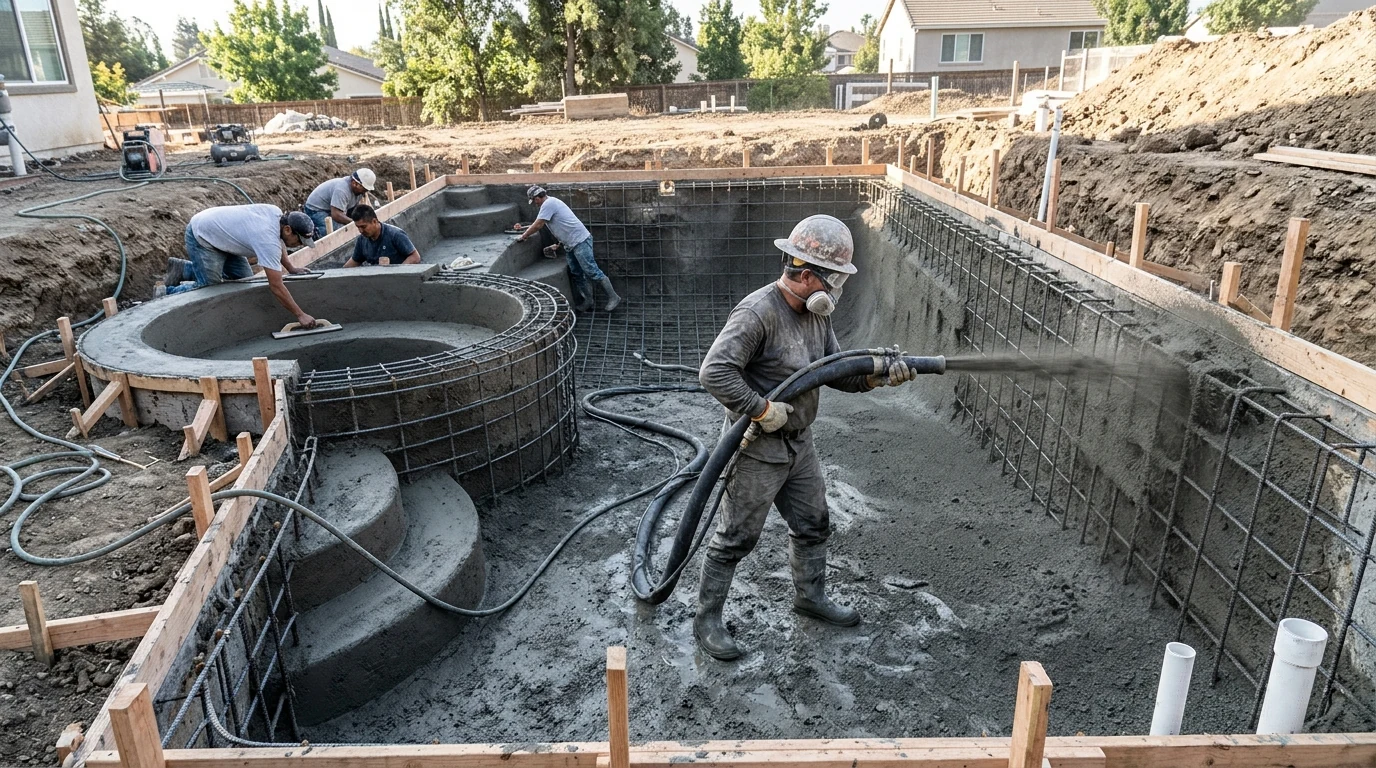
Geotechnical exploration, excavation slopes, dewatering, and subgrade stabilization
Geotech Engineering and Testing pool design guidelines specify that the depth of soil borings should be twice the depth of the pool with a minimum depth of 20-ft, conducting a minimum of two borings for pools of less than 3000 sq. ft. and a minimum of one boring for any additional 1500 sq. ft. of pool area.
Soil borings should be sampled continuously from the surface to a minimum depth of 10-ft and at five-ft intervals thereafter, with all cohesive soils sampled in general accordance with ASTM D1587 and cohesionless soils sampled in accordance with ASTM D1586.
In geotechnical laboratory classification for swimming pool foundations, expansive soils are classified to be soils with a liquid limit greater than 40 and a plasticity index (PI) of greater than 20.
Under Section 305.1.1 of the International Swimming Pool and Spa Code, construction sites for in-ground swimming pools and spas shall be provided with construction fencing not less than 4 feet (1219 mm) in height to surround the site from the time that any excavation occurs up to the time that the permanent barrier is completed.
Geotech Engineering and Testing pool excavation guidelines state that temporary (less than 24 hours), open trenched, non-surcharged, and unsupported excavations for a pool can typically be built on vertical slopes.
Because subsoils in the pool area are generally classified as Type C soils under the OSHA Soil Classification System, specifications should require that water not be allowed to pond in excavations, and if gunite is not placed the same day that excavations are completed, a thin layer of gunite (flash) should be placed over the base and walls of the pool.
In the event that groundwater is encountered during construction, groundwater should be removed using a sump-pump system where cohesive soils are present or a wellpoint system where cohesionless soils are present with shallow groundwater, lowering groundwater to a minimum depth of 3-ft below the pool bottom.
Select structural fill materials beneath and around the pool shell should be placed in loose lifts not exceeding eight-inches in thickness and compacted to 95% of the maximum dry density determined by ASTM D698 (standard proctor) with moisture content within ±2% of optimum value.
Because a pool structure can experience uplift loads from groundwater during flood conditions, Geotech Engineering and Testing states that the pool structure should perform satisfactorily if a design factor of safety against uplift of 2.0 is used.
When computing resistance to groundwater uplift loads, a submerged soil unit weight of 60 pound per cubic foot (pcf) can be used for soil resistance and a dry unit weight of 150 pcf should be used for gunite and reinforcing.
While structural wall thickness and bar spacing schedules are detailed in our gunite and shotcrete shell thickness and rebar schedules guide, forensic expert Scott Cohen warns that differential movement where a shallow feature moves while the main pool stays put can lead to a hinge effect leading to structural cracks on the shell unless builders dig shallow features as deep as the rest of the pool and fill the difference with concrete.
Scroll horizontally to see all columns →
| Geotechnical or excavation parameter | Exploration or subgrade specification | Groundwater or soil movement control |
|---|---|---|
| Subsurface borings and expansive clay | Soil borings should reach twice the pool depth with a minimum depth of 20-ft, using at least two borings for pools of less than 3000 sq. ft. and one boring per additional 1500 sq. ft. of pool area. | Expansive soils are classified as soils with a liquid limit greater than 40 and a plasticity index (PI) of greater than 20. |
| Dewatering drawdown and engineered fill | Remove groundwater with a sump-pump system in cohesive soils or a wellpoint system in cohesionless soils to a minimum depth of 3-ft below the pool bottom. | Place fill in loose lifts not exceeding eight-inches thick and compact to 95% of ASTM D698 maximum dry density within ±2% of optimum moisture. |
| Buoyancy uplift safety factor and unit weights | Use a design factor of safety against uplift of 2.0 so the pool structure performs satisfactorily under groundwater uplift loads during flood conditions. | Compute uplift resistance using a submerged soil unit weight of 60 pound per cubic foot (pcf) and a dry unit weight of 150 pcf for gunite and reinforcing. |
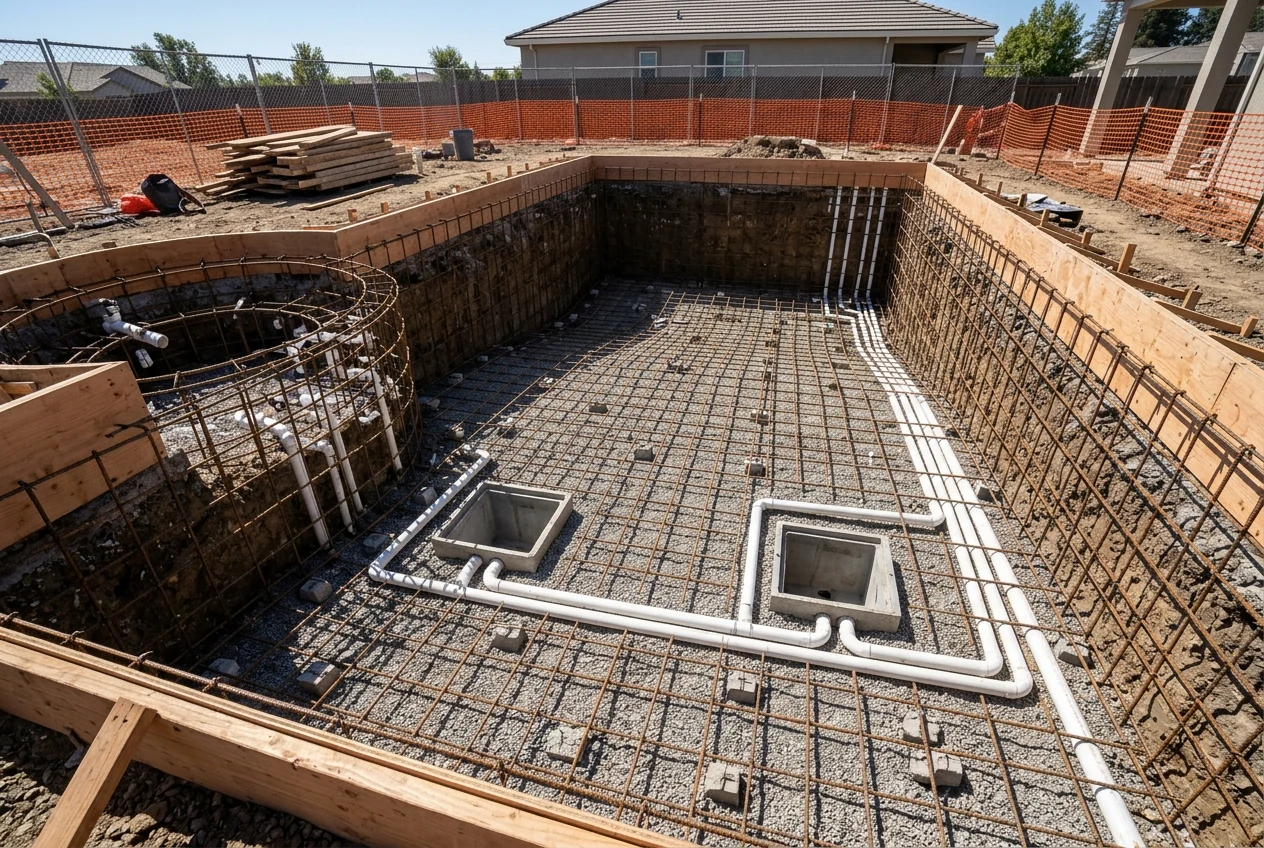
Pre-shoot hold points: concealed plumbing, main drain sumps, hydrostatic relief, and electrical rough-in
Under Section 302.1 of the International Swimming Pool and Spa Code, electrical installations for aquatic facilities shall be in accordance with NFPA 70 or the International Residential Code as applicable under Section 102.7.1.
Section 302.3 of the International Swimming Pool and Spa Code mandates that pipe, fittings, and components shall be listed and labeled in accordance with NSF 50 or NSF 14, and plastic jets, fittings, and outlets used in public spas shall be listed and labeled in accordance with NSF 50.
Sections 302.3.1 and 302.4 of the International Swimming Pool and Spa Code require suction outlet fitting assembly sumps to be inspected for dimensional conformance to APSP 16 and require piping installed in trenches to be inspected prior to backfilling.
During pre-shoot hydro-testing of concealed plumbing trenches, Section 302.7 of the International Swimming Pool and Spa Code states that tests on water piping systems constructed of plastic piping shall not use compressed air for the test.
The Hayward SP1056 Hydrostatic Relief Valve is installed with internal NPT threads in a sump along with the SP1055 Slotted Collector tube on the bottom of the sump.
For underwater lighting rough-in prior to shooting the bond beam, Pentair MicroBrite installation instructions require the Junction Box and low-voltage transformer to be located at least 4 inches (10.16 cm) above ground level or 8 inches (20.3 cm) above maximum water level, whichever is higher, and the Junction Box must be at least 48 inches (1.22 m) from the edge of the pool.
After verifying check-valve and manifold isolation for attached spas in our spillover spa hydraulic loop and check valves guide, Geotech Engineering and Testing specifies that reinforcement should be constructed in general accordance with ACI 506, kept free from oil, loose rust, mill scale, or surface deposits that may affect bonding to gunite, and have steel placement, chair placement, steel grade, steel size, and spacing observed by a geotechnical or structural engineer prior to gunite placement.
The gunite and shotcrete shoot window: mix physics, floor-first sequence, and core testing
For environmental engineering concrete structures, water-containing concrete pool shells require a maximum w/cm of 0.45 with a minimum 4000 psi for low permeability when exposed to water, and require a lower maximum w/cm of 0.42 with a minimum 4500 psi (31 MPa) when exposed to freezing and thawing while saturated.
When pool concrete is exposed to chlorides—including brackish water, salts, and seawater—ACI 350 requires a maximum w/cm of 0.40 and compressive values of 5000 psi (34 MPa) to provide protection for embedded reinforcement.
Guarino and Oakes note that dry-mix shotcrete excels in pools with less than 1000 ft 2 (90 m2) of water surface area and high-detail perimeter-overflow or vanishing-edge pools, where crews typically finish placement in a day unless extravagant features extend shooting into a second or third day.
In wet-mix shotcrete placement, unless the concrete design uses a retarder or hydration control admixture, the batched concrete needs to be placed within 90 minutes of batching.
USDA NRCS shotcrete inspection rules specify that a batch is gunned within 1.5 hours of being batched in normal weather or within 45 minutes when ambient temperature is over 85 °F, and require that rebound material is not reused.
SSG does not use wet-mix shotcrete for pools under 1000 ft 2 (90 m2) because these pools can be done in 1 day and require crews to walk on freshly placed concrete in the floor; with dry-mix shotcrete, the placed material is very stiff and walking on freshly shot material disturbs only the top surface with minor footprints without disturbing the embedded reinforcing bars.
Guarino and Oakes emphasize that it is especially difficult to remove all shavings, rebound, and excess concrete from under the reinforcing steel in the floor/wall cove, making it essential that all concrete is well placed with high velocity from the nozzle for thorough compaction.
On multi-day dry-mix shoots, a high-volume air-water blast prepares the previous day's placement to create an optimum clean, saturated surface-dry (SSD) surface before applying new concrete, and RG has achieved placement rates as high as 110 yd3 (84 m3) per day with one gun using on-site volumetric mixers.
The American Concrete Institute pool shotcrete guide defines rolling as the result of applying shotcrete at angles less than 90 degrees to the receiving surface, resulting in an uneven, wavy, textured surface at the outer edge of the spray pattern.
Under USDA NRCS shotcrete inspection rules, receiving surfaces are maintained in a moistened condition for 3 hours prior to application of shotcrete, shotcrete is not applied to mud, dried earth, uncompacted fill, rebound material, or free water, all ice, snow, and frost is removed, and all contact surfaces are no cooler than 40 degrees Fahrenheit.
USDA NRCS cold-weather rules state that placement may not be started unless the temperature is at least 40 degrees Fahrenheit and rising, must be discontinued if the temperature falls to 40 degrees Fahrenheit and is expected to continue to fall, and require the temperature of the shotcrete at the time of placement to be not less than 50 degrees Fahrenheit.
Geotech Engineering and Testing specifies that gunite should be mixed and placed per ACI 506 and that a minimum of four grout samples from each 400 sq. ft. of pool footprint or 50 cubic yards placed, whichever results in more samples, should be tested for compressive strength in accordance with ASTM C42.
Gunite and shotcrete mix design, batch window, and temperature matrix
Scroll horizontally to see all columns →
| Placement or durability control | Dry-mix and wet-mix benchmark | Exposure or weather limit |
|---|---|---|
| Water-cementitious ratio and freeze-thaw | Wet-mix typically uses a w/cm range of 0.40 to 0.45 while dry-mix typically uses a lower w/cm range of 0.35 to 0.40, reducing mix water and shrinkage cracking. | Water-containing concrete structures require a maximum w/cm of 0.45 with a minimum 4000 psi, or a maximum w/cm of 0.42 with a minimum 4500 psi (31 MPa) under saturated freeze-thaw exposure. |
| Chloride protection and batch window | When concrete is exposed to chlorides (brackish water, salts, and seawater), ACI 350 requires a maximum w/cm of 0.40 and compressive values of 5000 psi (34 MPa). | Gun each batch within 1.5 hours of batching in normal weather or within 45 minutes when temperature is over 85 °F, and never reuse rebound material. |
| Receiving substrate and hot-weather limits | Maintain receiving surfaces moistened for 3 hours before shooting and verify all contact surfaces are no cooler than 40 degrees Fahrenheit. | USDA NRCS CS 33 caps shotcrete temperature during mixing, conveying, and placement at 90 degrees Fahrenheit, while ACI sets the limit at 95 °F and caps steel reinforcement at 90 degrees Fahrenheit. |
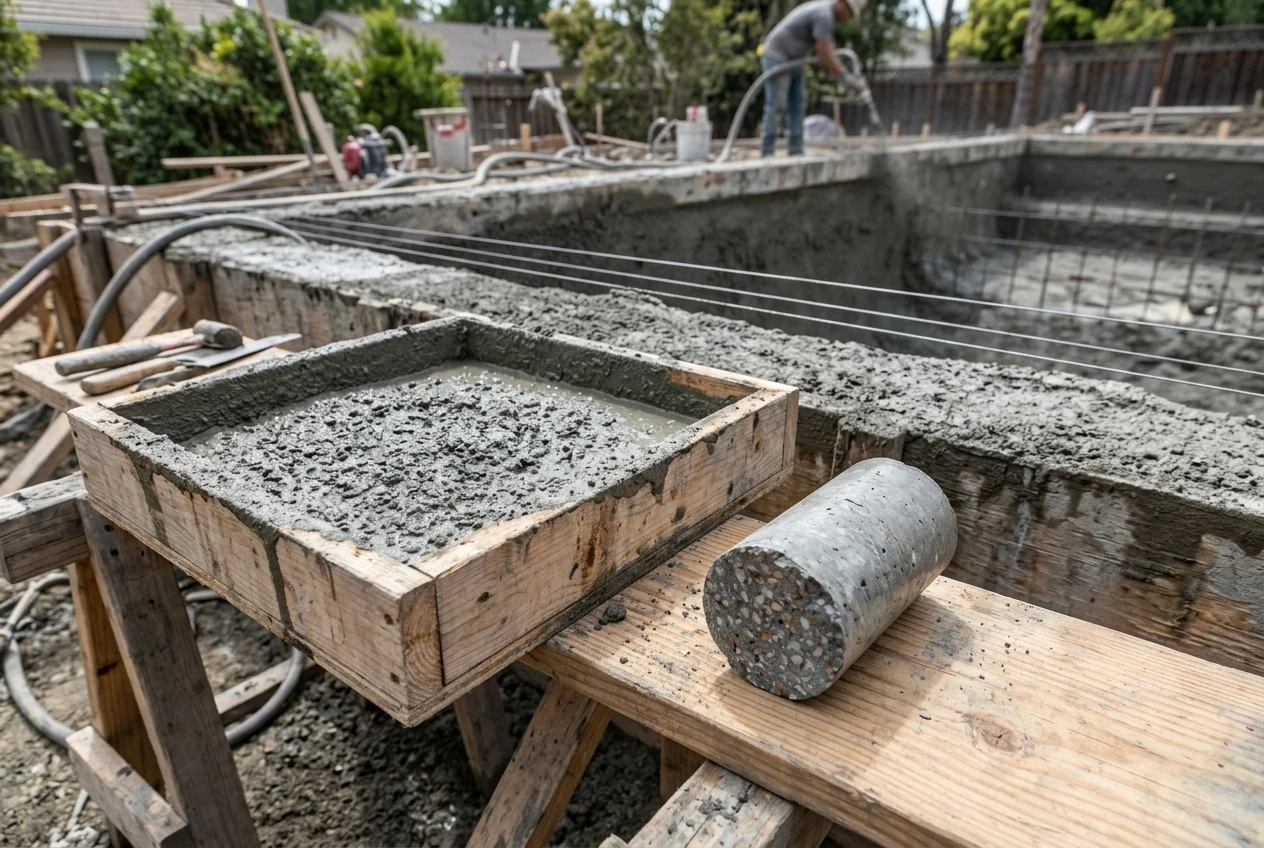
Hydration curing, formwork removal, shell cure lock, and interior finishes
National Ready Mixed Concrete Association curing guidance states that curing begins immediately after placement and finishing and should be continued for a sufficient period of time, typically 3 to 7 days.
According to National Ready Mixed Concrete Association curing guidance, concrete in a dry environment can lose as much as 50 percent of its potential strength compared to concrete that is moist cured.
Continuous fogging or sprinkling is an excellent curing method, soaker hoses can be used on vertical surfaces when air temperatures are above freezing, absorbent materials can retain water, and alternate wetting and drying is not an acceptable curing practice.
USDA NRCS shotcrete inspection rules require that shotcrete be prevented from drying for a curing period of at least 7 days after it is placed.
In LATICRETE pool technical design guidance, once the gunite or shotcrete concrete has set for a minimum of 14 days at 70°F (21°C), the formwork may be removed and the exterior side of the pool wall is filled with a suitable drainage material.
LATICRETE technical design guidance notes that while 28 days is the time concrete typically takes under normal conditions to reach its full design strength, it is a misconception that concrete completes shrinking in 28 days because thick sections of concrete may take over 2 years to reach the point of ultimate shrinkage.
When commissioning elastomeric waterproofing membranes beneath glass mosaic tile as detailed in our waterproof membrane systems under glass mosaic tile guide, LATICRETE flood test procedures specify filling the pool at a rate of 1" (25 mm) per hour, continually monitoring the water level during the length of the flood test (typically 24 - 72 hours) to determine water-tightness, and draining the water at a rate of 1" (25 mm) per hour.
Once tiles are installed and grouted, LATICRETE requires the installation to cure for a full 14 days after the final grouting period at 70°F (21°C) if a latex-fortified portland cement-based grout is used or 10 days if an epoxy-based grout is used.
Before applying cementitious or exposed-aggregate finishes compared in our pool plaster types for spa shells guide, SGM Diamond Brite installation specifications require stopping all water penetration due to hydrostatic pressure (weepers) with Instant Hydraulic Cement, verifying the concrete shell is fully cured at least 28 days, and plugging all pool inlets and main drain lines during plasterwork and exposure.
Post-shoot curing, flood test, and finish hold-point schedule
Scroll horizontally to see all columns →
| Post-shoot construction stage | Mandatory waiting or rate window | Structural or finish verification rule |
|---|---|---|
| Active wet curing and form stripping | Prevent shotcrete from drying for a curing period of at least 7 days after placement. | Once concrete has set for a minimum of 14 days at 70°F (21°C), formwork may be removed and the exterior wall filled with suitable drainage material. |
| Shell cure lock and membrane flood test | Concrete pool shells must be cured for a minimum of 28 days with a minimum time interval allowed between each successive stage of the project. | Fill the pool at a rate of 1" (25 mm) per hour, monitor water level for 24 - 72 hours during the flood test, and drain at 1" (25 mm) per hour. |
| Tile grout cure and plaster thickness | Cure tiled and grouted installations for a full 14 days at 70°F (21°C) with latex-fortified portland cement grout or 10 days with epoxy-based grout. | National Plasterers Council tolerances specify that the cementitious surface coating should have an average minimum thickness of ⅜" and an average maximum thickness of ¾". |
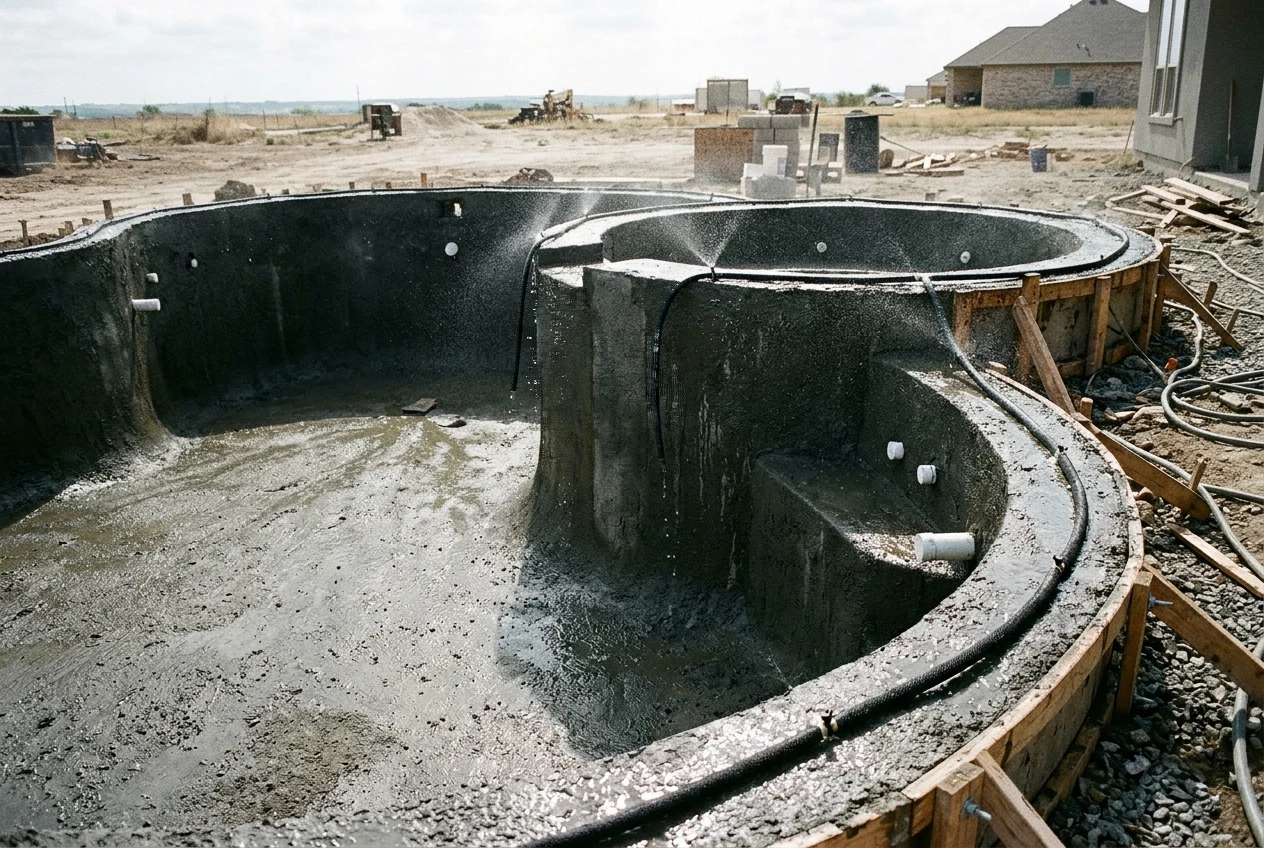
Step-by-step gunite pool construction sequence verification
Verify each hold point in sequence because with proper design, material selection, and construction, a shotcreted concrete pool should have a service life of 50 to 100 years or more.
- Subsurface geotechnical borings: Drill soil borings to twice the depth of the pool with a minimum depth of 20-ft, conducting a minimum of two borings for pools of less than 3000 sq. ft. and one additional boring per 1500 sq. ft. of pool area.
- Engineered fill compaction: Place fill materials in loose lifts not exceeding eight-inches in thickness and compact to 95% of ASTM D698 maximum dry density within ±2% of optimum moisture content.
- Sump and trench piping inspection: Inspect suction outlet fitting assembly sumps for dimensional conformance to APSP 16 and inspect concealed trench piping prior to backfilling.
- Reinforcing steel pre-shoot sign-off: Construct reinforcement in general accordance with ACI 506, keep bars free from oil, loose rust, mill scale, or surface deposits, and have an engineer observe steel placement, chair placement, grade, size, and spacing prior to gunite placement.
- Batch time and rebound control: Gun each shotcrete batch within 1.5 hours of batching in normal weather or within 45 minutes when temperature is over 85 °F, and verify rebound material is not reused.
- Compressive strength core sampling: Mix and place gunite per ACI 506 and obtain a minimum of four samples from each 400 sq. ft. of pool footprint or 50 cubic yards placed, whichever results in more samples, for compressive strength testing per ASTM C42.
- Formwork stripping and drainage backfill: Wait until the concrete has set for a minimum of 14 days at 70°F (21°C) before removing formwork and filling the exterior side of the pool wall with suitable drainage material.
Frequently asked questions
What is the difference between dry-mix gunite and wet-mix shotcrete in pool construction?
Dry-mix conveys dry coarse sand and cement through a delivery hose and injects the majority of water at the nozzle before shooting at high velocity, whereas wet-mix pumps premixed concrete containing coarse sand, 3/8 in. [10 mm] or less coarse aggregate, and cement.
How long is the gunite or shotcrete shoot window after batching?
Under USDA NRCS shotcrete inspection rules, a batch is gunned within 1.5 hours of being batched in normal weather or within 45 minutes when the temperature is over 85 °F, and rebound material is never reused.
Why is continuous water curing required immediately after the gunite pool shoot?
National Ready Mixed Concrete Association guidance states that concrete exposed to a dry environment can lose as much as 50 percent of its potential strength compared to concrete that is moist cured.
How many days must a gunite pool shell cure before waterproofing, tile, and plaster finishes?
LATICRETE pool technical design guidance specifies that concrete pool shells must be cured for a minimum of 28 days and that a minimum time interval should be allowed between each successive stage of the project to ensure full cure.
Technical references and engineering publications
- American Concrete Institute (ACI), Guide for Concrete Pool Shotcrete: with proper design, material selection, and construction, a shotcreted concrete pool should have a service life of 50 to 100 years or more.
- American Shotcrete Association (ASA), Position Statement #1, Compressive (Strength) Values of Pool Shotcrete: key factors that increase the likelihood of compressive strength significantly exceeding 4000 psi (27.6 MPa) are the material itself and application velocity of 350 to 400 ft/s [106 to 122 m/s].
- American Shotcrete Association (ASA), Shotcrete Magazine (Guarino & Oakes): wet-mix typically uses a w/cm range of 0.40 to 0.45 while dry-mix typically uses a lower w/cm range of 0.35 to 0.40, which reduces mix water and shrinkage cracking.
- American Shotcrete Association (ASA), Pool & Recreational Shotcrete Committee Position Statement on Watertight Shotcrete: when concrete is exposed to chlorides (brackish water, salts, and seawater), ACI 350 requires a maximum w/cm of 0.40 and compressive values of 5000 psi (34 MPa).
- Geotech Engineering and Testing (GET), Geotechnical Design Guidelines for Swimming Pools: soil borings should reach twice the pool depth with a minimum depth of 20-ft, with at least two borings for pools under 3000 sq. ft. and one boring per additional 1500 sq. ft. of pool area.
- USDA Natural Resources Conservation Service (NRCS), National Engineering Handbook Shotcrete Inspection Rules: a batch is gunned within 1.5 hours of being batched in normal weather or 45 minutes when temperature is over 85 °F, and rebound material is not reused.
- National Ready Mixed Concrete Association (NRMCA), Concrete in Practice Curing In-Place Concrete: concrete in a dry environment can lose as much as 50 percent of its potential strength compared to concrete that is moist cured.
- International Code Council (ICC), International Swimming Pool and Spa Code (ISPSC) Section 305.1.1: in-ground pool and spa construction sites shall be surrounded by construction fencing not less than 4 feet (1219 mm) in height from excavation until the permanent barrier is completed.
- LATICRETE International, Pool, Spa & Fountain Technical Design Manual: once concrete has set for a minimum of 14 days at 70°F (21°C), formwork may be removed and the exterior side of the pool wall filled with suitable drainage material.
- Pentair Water Pool and Spa, MicroBrite Color and White LED Light Installation Guide: the Junction Box and low-voltage transformer must be located at least 4 inches (10.16 cm) above ground level or 8 inches (20.3 cm) above maximum water level, whichever is higher, and the Junction Box must be at least 48 inches (1.22 m) from the edge of the pool.
- Southern Grouts & Mortars (SGM), Diamond Brite Installation Manual: all water penetration due to hydrostatic pressure (weepers) must be stopped with Instant Hydraulic Cement, the shell must be fully cured at least 28 days, and inlets and main drain lines should be plugged during plasterwork.