
Commercial Hot Tub Code Requirements: 30-Minute Turnover, VGB Dual Main Drains, NEC 680.41 E-Stop & ORP Sanitation
Undersizing a commercial hot tub filtration loop or single-drain suction line causes health-department permit rejection, sanitizer collapse, and fatal entrapment hazards. Under the 2024 CDC Model Aquatic Health Code (MAHC) and International Swimming Pool and Spa Code (ISPSC Chapter 5), every public and hotel spa requires a 30-minute maximum turnover rate and dual VGB drains.
A compliant commercial hot tub must circulate 100% of its water volume every 30 minutes or less, separate its 24/7 filtration loop from the 15-minute jet booster loop, equip every pump with VGB Act dual main drains spaced at least 3 feet apart (≤ 1.5 ft/s grate velocity), cap water at 104°F, place an NEC 680.41 emergency shutoff switch ≥ 5 feet away, and automate ORP/pH dosing.
Whereas a residential portable or inground spa typically operates on a 2-to-4-hour turnover cycle with manual chemical checks, public health and building codes classify any spa in a hotel, resort, athletic club, multifamily apartment, condominium, or homeowner association (HOA) as a high-bather-density commercial aquatic vessel. Four to twelve adults immersed in 600 to 1,200 gallons of 102°F–104°F aerated water create a bather-to-water ratio of just 100 to 150 gallons per person—roughly 15 times denser than a public swimming pool. Coordinating the hydraulic plant early in commercial pool and spa design and pool and spa safety planning prevents structural core-drilling after shotcrete placement.
Master Commercial Hot Tub Code & Engineering Compliance Matrix
Use this code baseline across mechanical, electrical, and plumbing (MEP) permit submittals, tying shell bench geometry from the public spa accessible entry and benching guide directly to the equipment room layout and ventilation specification.
Scroll horizontally to see all columns →
| Subsystem & Governing Code | Mandatory Commercial Threshold | Engineering Formula or Hardware Spec | Permit & Inspection Verification |
|---|---|---|---|
| Filtration Turnover Rate (2024 CDC MAHC Table 4.7.1.10 & 2024 ISPSC Ch. 5) | ≤ 30 minutes (0.5 hr) continuous 24/7 turnover (48 turnovers/day) | Q_min (GPM) = Spa Volume (gal) ÷ 30 min; size VFD pump for 115%–125% of Q_min | NSF/ANSI 50 inline flowmeter reading ≥ Q_min at dirty-filter pressure differential |
| Two-Loop Hydraulic Separation (MAHC 4.7.1 & NSF/ANSI 50) | Independent 24/7 filtration/heating loop vs. 15-min hydrotherapy jet booster loop | Cartridge ≤ 0.375 GPM/sq. ft.; high-rate sand ≤ 12–15 GPM/sq. ft.; heater bypass on jet loop | Piping schematic showing separate suction/return loops and filter media area calculation |
| VGB Act Dual Main Drains (15 U.S.C. § 8003 & 16 CFR § 1450.3 / APSP-16) | ≥ 2 hydraulically balanced suction outlets per pump spaced ≥ 36 in. (3.0 ft) C-to-C or on 2 planes | Each grate rated ≥ 100% max pump GPM; through-grate velocity ≤ 1.5 ft/s (A_open ≥ 0.2139 × Q_max) | SOFA certification sheet, sump depth ≥ 1.5D, 316L fasteners, and 5-year replacement log |
| Suction & Return Pipe Velocity (MAHC 4.7.1.6 & ISPSC Ch. 3) | Suction branch/trunk ≤ 6.0 ft/s (1.83 m/s); pressure return ≤ 8.0 ft/s | v (ft/s) = (0.4085 × Q_GPM) ÷ d_in²; zero valves between paired suction outlets | Hydraulic pipe schedule matching Schedule 40 PVC inside diameters to pump curve max GPM |
| Emergency Pump Shutoff Switch (2023 NEC 680.41 & MAHC 4.12.9) | Single-action E-Stop within direct sight and ≥ 5 ft (1.52 m) horizontally from inside spa walls | Red mushroom push-to-stop switch (42–48 in. ADA height, ≤ 50 ft path) disconnecting all spa pumps/blowers | Field trip test killing circulation, jet booster, and blower motors in one action + audible alarm |
| Water Temperature Ceiling & Timer (MAHC 4.12.9, ISPSC 505/509, ANSI Z21.56) | ≤ 104.0°F (40.0°C) water cap; ≤ 15-minute hydrotherapy jet/blower timer at ≥ 5 ft setback | Tamper-proof thermostat + manual-reset high-limit safety cutout; spring/electronic 15-min deck timer | Calibrated digital thermometer check at ≤ 104°F and tape measurement of ≥ 5 ft timer setback |
| Automated ORP / pH Sanitation (MAHC 4.7.3.2 & 5.7.3) | 3.0–5.0 ppm Free Chlorine (or 4.0–6.0 ppm Bromine), pH 7.2–7.6, ORP ≥ 650–700 mV | NSF/ANSI 50 proportional controller + sample flow switch + pump load interlock + heater check valve | Pump-off interlock test verifying chemical feeders halt within ≤ 1 second of flow loss |
| Vessel Depth & Water Replacement (ISPSC Ch. 5 & EPA WaterSense 5.3) | Max depth ≤ 4.0 ft (1,219 mm); bench depth ≤ 24 in. (610 mm); ≥ 3 gal/bather/day replacement | Drain Interval (Days) = Volume (gal) ÷ 3 ÷ Avg Daily Bathers (or TDS +1,500 ppm) | Sub-metered make-up water log, 7–14 day complete drain record, and contrasting 2-in. bench nosing tile |
Takeaway: Lock filtration turnover flow, dual VGB suction headers, and the 5-foot NEC 680.41 deck setback on the permit drawings before rebar inspection.
1. 30-Minute Filtration Turnover Rate & Two-Loop Hydraulic Sizing (CDC MAHC 4.7.1.10 & ISPSC Chapter 5)
Per 2024 CDC Model Aquatic Health Code (MAHC 5th Edition) Table 4.7.1.10 and the MAHC 5th Edition Scientific & Engineering Rationale Annex, every commercial hot tub must circulate 100% of its total water volume through the filtration, heating, and sanitation plant in 30 minutes (0.5 hours) or less. That 30-minute ceiling equates to 48 complete water turnovers per 24 hours—twelve times faster than the 6.0-hour turnover rate (4 turnovers/day) permitted for standard commercial swimming pools.
The governing hydraulic formula for minimum continuous filtration flow is:
Q_filtration_min (GPM) = Spa Water Volume (US gallons) ÷ Maximum Turnover Time (30 minutes)
For a standard 1,200-gallon (4,542 L) hotel commercial hot tub (10 to 12 bathers at 10 sq. ft. of surface area per bather, 110 sq. ft. surface area):
- Statutory Minimum Flow Rate:
Q_min = 1,200 gallons ÷ 30 minutes = 40.0 GPM(151.4 L/min or 2,400 gallons/hour), operating continuously 24 hours per day. - Dirty-Filter Design Margin (115%–125% Rule): As filter media traps bather body oils, cosmetics, and dead skin, differential pressure across the filter vessel rises by 8 to 10 PSI (18.5 to 23.1 ft of head) before backwashing or cartridge cleaning. To guarantee flow never drops below the 40.0 GPM health-department floor right before filter servicing, size the variable-frequency-drive (VFD) filtration pump and piping for 46 to 50 GPM clean-filter capacity governed by an NSF/ANSI 50 inline digital flowmeter (MAHC Section 4.7.1.9) that automatically ramps pump RPM as filter head loss climbs.
Why Filtration and Hydrotherapy Jets Require Two Separate Hydraulic Loops
A common residential shortcut—using a single two-speed pump to run low-speed filtration and high-speed therapy jets through the same filter and heater—fails commercial code and destroys equipment. In a 1,200-gallon hotel spa equipped with 10 to 12 commercial Venturi hydrotherapy jets, each nozzle requires 13 to 15 GPM at 12 to 18 PSI nozzle pressure, totalling 140 to 160 GPM of booster flow (see our hydrotherapy jet positioning and nozzle flow guide). Pushing 160 GPM through a 40 GPM filtration and heating loop causes two immediate failures:
- Filter Media Channeling & Pleat Collapse: NSF/ANSI Standard 50 limits commercial cartridge filter design loading to 0.330 to 0.375 GPM per sq. ft. of media and commercial high-rate sand filters to 12.0 to 15.0 GPM per sq. ft. Driving 160 GPM through a filter sized for 40 to 50 GPM quadruples the face velocity, channeling sand beds and driving emulsified body oils straight through cartridge pleats.
- Cupronickel Heat Exchanger Erosion: Commercial gas and electric spa heaters (Pentair MasterTemp ANSI Z21.56 Manual) enforce a maximum internal water flow rate of 100 to 120 GPM. Subjecting heater header tubes to 160 GPM strips the protective oxide film via impingement cavitation and erodes cupronickel finning within months.
Consequently, a commercial hot tub splits its plumbing into two isolated closed hydraulic loops:
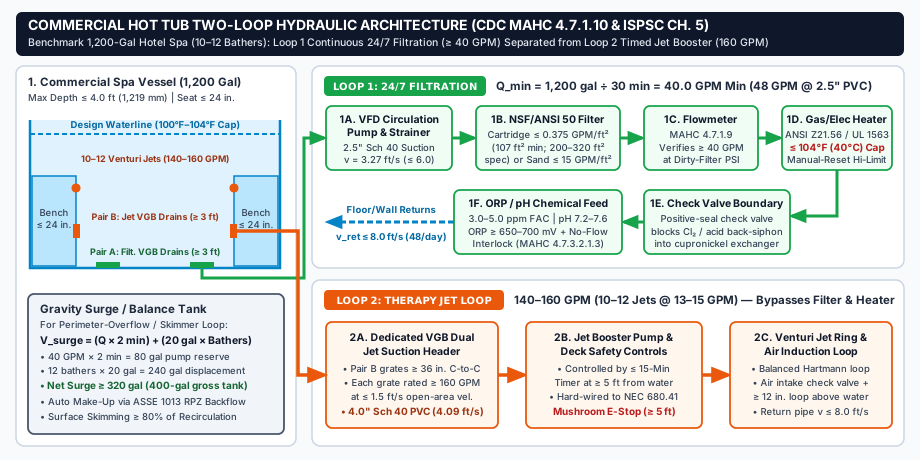
- Loop 1 — Continuous 24/7 Filtration, Heating & Sanitation Loop (40–50 GPM): Draws surface water via NSF-50 automatic skimmers (1 skimmer per ≤ 100–150 sq. ft.) or a perimeter-overflow gutter and gravity surge tank (carrying ≥ 80% of recirculation flow) combined with Pair A VGB dual main drains on the footwell floor → hair and lint strainer pot → VFD circulation pump → NSF/ANSI 50 filter → inline flowmeter → ANSI Z21.56 heater (capped at 104°F) → positive-seal check valve → automated ORP/pH chemical injection manifold → submerged floor/lower-wall return inlets (return velocity ≤ 8.0 ft/s).
- Loop 2 — Intermittent 15-Minute Hydrotherapy Jet Booster Loop (140–160 GPM): Draws exclusively from its own dedicated Pair B of VGB-compliant dual suction outlets (spaced ≥ 36 in. center-to-center on the vertical bench riser wall or footwell) → dedicated high-flow jet booster pump (controlled by the 15-minute deck timer and hard-wired to the NEC 680.41 emergency shutoff switch) → returns directly to the equalized Hartmann Venturi jet ring manifold with a dedicated air blower or atmospheric air intake loop rising ≥ 12 inches above the maximum waterline behind a hartmann check valve.
NSF/ANSI 50 Filter Area & Gravity Surge Tank Sizing Across 3 Commercial Tiers
For perimeter-overflow rimless hotel spas, the gravity balance or surge tank must hold at least 2.0 minutes of filtration pump flow plus 20 US gallons of displaced water per design bather (plus 25% freeboard above high-water alarm level) so the circulation pump never cavitates when twelve bathers exit the vessel simultaneously:
V_surge_net (gal) = (Q_filtration_GPM × 2.0 min reserve) + (N_bathers × 20 gal/bather displacement)
For the 1,200-gallon, 12-bather hotel spa at 40 GPM: V_surge_net = (40 × 2) + (12 × 20) = 80 + 240 = 320 gallons minimum active working surge capacity (specify a 400-gallon gross high-density polyethylene or concrete surge tank with an automatic potable water make-up fill valve isolated by an ASSE 1013 Reduced Pressure Principle backflow preventer or a 2× pipe-diameter physical air gap).
Scroll horizontally to see all columns →
| Engineering Parameter | Tier 1: Boutique HOA / Apartment Spa (600 Gal, 6–8 Bathers) | Tier 2: Standard Hotel / Resort Spa (1,200 Gal, 10–12 Bathers) | Tier 3: Large Athletic / Club Hydrotherapy Spa (2,100 Gal, 18–22 Bathers) |
|---|---|---|---|
| Surface Area (@ 10 sq. ft./bather) | 60–80 sq. ft. | 100–120 sq. ft. | 180–220 sq. ft. |
| Min 30-Min Turnover Flow (Q_min) | 20.0 GPM (25 GPM VFD design) | 40.0 GPM (48–50 GPM VFD design) | 70.0 GPM (85 GPM VFD design) |
| Filtration Suction Pipe (≤ 6.0 ft/s) | 2.0-in. Sch 40 PVC (2.01 ft/s @ 20 GPM) | 2.5-in. Sch 40 PVC (2.73 ft/s @ 40 GPM) | 3.0-in. Sch 40 PVC (3.09 ft/s @ 70 GPM) |
| Cartridge Filter Area (≤ 0.375 GPM/ft²) | 54 sq. ft. code min (100–150 sq. ft. spec) | 107 sq. ft. code min (200–320 sq. ft. spec) | 187 sq. ft. code min (320–500 sq. ft. spec) |
| High-Rate Sand Area (≤ 15 GPM/ft²) | 1.34 sq. ft. min (18-in. tank = 1.77 sq. ft.) | 2.67 sq. ft. min (24-in. tank = 3.14 sq. ft.) | 4.67 sq. ft. min (30-in. tank = 4.91 sq. ft.) |
| Dedicated Jet Booster Flow (Loop 2) | 80–110 GPM (6–8 jets) | 140–160 GPM (10–12 jets) | 220–280 GPM (Dual 110–140 GPM loops) |
| Jet Suction Header Size (≤ 6.0 ft/s) | 3.0-in. Sch 40 PVC (4.88 ft/s @ 110 GPM) | 4.0-in. Sch 40 PVC (4.09 ft/s @ 160 GPM) | Dual 3.0-in. or Dual 4.0-in. Sch 40 PVC |
| Overflow Surge Tank Net Capacity | 200 gal net (250-gal gross tank) | 320 gal net (400-gal gross tank) | 580 gal net (750-gal gross tank) |
| Max Drain & Refill Interval (Days) | 8.0 days (@ 25 bathers/day) | 10.0 days (@ 40 bathers/day) | 10.0 days (@ 70 bathers/day) |
Takeaway: Never route high-flow hydrotherapy booster jets through the filtration tank or heater; size Loop 1 for ≤ 30-minute continuous turnover and Loop 2 for dedicated VGB suction and Venturi return.
2. VGB Act Dual Main Drains, Grate Velocity (≤ 1.5 ft/s) & Suction Pipe Sizing (15 U.S.C. § 8003 & ANSI/APSP/ICC-16)
Enacted under Public Law 110-140 Title XIV (15 U.S.C. § 8003) and enforced by the U.S. Consumer Product Safety Commission under 16 CFR § 1450.3 (incorporating ANSI/APSP/ICC-16), the Virginia Graeme Baker Pool and Spa Safety Act (VGBA) applies to every public, hotel, motel, resort, health-club, apartment, condominium, and HOA hot tub in the United States. Because a commercial spa concentrates high-horsepower circulation and jet booster pumps into a compact footwell (where maximum water depth is capped at 4.0 feet / 1,219 mm and submerged bench depth at 24 inches / 610 mm per 2024 ISPSC Chapter 5 and our spa seat and footwell depth guide), suction entrapment prevention governs every underwater fitting.
To eliminate all five statutory entrapment mechanisms—hair entanglement, limb entrapment, body/torso suction hold-down, evisceration/disembowelment, and mechanical entrapment of jewelry or swimwear—every suction pump on a commercial hot tub must satisfy five hydraulic and geometric rules:
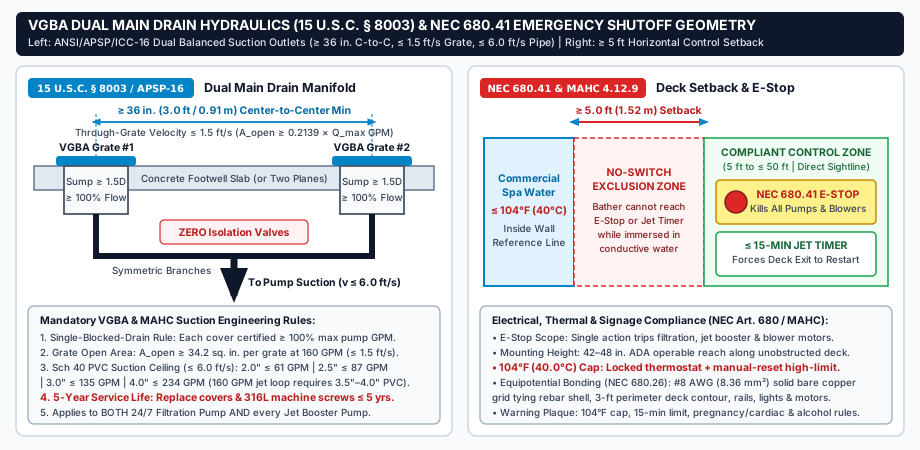
- Dual Hydraulically Balanced Drains Spaced ≥ 36 Inches (3.0 ft / 0.91 m) Center-to-Center: Under CDC MAHC Section 4.7.1.5 and
ANSI/APSP/ICC-16, both the 24/7 filtration pump (Pair A) and each hydrotherapy jet booster pump (Pair B) must pull through at least two interconnected suction outlets spaced at least 36 inches (3.0 ft) apart measured center-to-center (not edge-to-edge) so a single bather cannot block both grates simultaneously. If a compact commercial footwell is narrower than 36 inches between bench risers, the two suction outlets must be installed on two different architectural planes (such as one grate on the horizontal footwell floor and one grate on the vertical bench riser wall, or on two opposite vertical walls). - 100% Single-Blocked-Drain Rating & Symmetric Tee Header (Zero Isolation Valves): Paired suction outlets must connect via equal-length, symmetric Schedule 40 PVC branches into a central tee fitting before the common suction trunk runs to the equipment room. No isolation valve may ever be installed between paired suction outlets. Each individual drain cover, sump, and branch pipe must be certified under
ANSI/APSP/ICC-16to carry ≥ 100% of the maximum possible pump system flow rate when the companion drain is 100% occluded by a bather. - Maximum Through-Grate Open-Area Velocity ≤ 1.5 ft/s (0.46 m/s): At 100% system flow passing through a single unobstructed drain cover, water velocity through the grate slots must not exceed 1.5 ft/s, preventing hair knot formation and torso vacuum lock:Required Open Area A_open (sq. in.) ≥ (Q_max_GPM × 0.3208) ÷ 1.5 ft/s = 0.2139 × Q_max_GPMFor a 160 GPM hydrotherapy jet booster pump, each individual VGBA suction grate must provide at least
0.2139 × 160 = 34.2 sq. in.of effective open slot area and carry a permanent manufacturer flow stamp ≥ 160 GPM for its installed orientation (floor vs. wall) and sump depth. - Maximum Schedule 40 PVC Suction Branch & Trunk Velocity ≤ 6.0 ft/s (1.83 m/s): Per CDC MAHC Section 4.7.1.6 and ISPSC Chapter 3, water velocity inside any rigid suction pipe must not exceed 6.0 ft/s when carrying 100% of design flow:v_pipe (ft/s) = (0.4085 × Q_GPM) ÷ (Inside Pipe Diameter d_in)²A frequent engineering error on hotel spa submittals is sizing a 160 GPM jet booster suction line in 3.0-inch Schedule 40 PVC (
d_in = 3.042 in.). At 160 GPM, 3.0-inch PVC runs at(0.4085 × 160) ÷ 3.042² = 7.06 ft/s—exceeding the 6.0 ft/s statutory ceiling (135 GPM max) and failing plan check. A 160 GPM jet booster loop requires 3.5-inch or 4.0-inch Schedule 40 PVC suction piping (4.0-in. d_in = 3.998 in.yields 4.09 ft/s at 160 GPM, up to 234 GPM max at 6.0 ft/s). - Sump Depth (≥ 1.5D) & Mandatory 5-Year VGBA Cover Replacement Log: Field-formed concrete sumps must maintain a vertical clearance of at least 1.5 times the nominal pipe diameter (1.5D) between the underside of the VGBA grate and the top of the suction pipe opening (e.g., ≥ 6.0 inches depth for a 4.0-inch suction port), or utilize a factory-tested
ANSI/APSP/ICC-16polymer sump bucket. Because continuous immersion in 104°F water with 3.0–5.0 ppm chlorine degrades UV-stabilized PVC and polycarbonate, federal regulation 16 CFR § 1450.3 mandates that every suction cover and its 316L stainless-steel machine screws (threaded into integral brass or polymer inserts, never self-tapping screws) be replaced on or before the cover’s embossed expiration period (typically 5 years from installation).
Schedule 40 PVC Suction (≤ 6.0 ft/s) & Return (≤ 8.0 ft/s) Pipe Capacity Table
Scroll horizontally to see all columns →
| Nominal Sch 40 PVC Size | Average Inside Diameter (d_in) | Internal Area (sq. in.) | Max Suction Flow @ ≤ 6.0 ft/s | Max Return Flow @ ≤ 8.0 ft/s | Typical Commercial Hot Tub Assignment |
|---|---|---|---|---|---|
| 1.5 in. | 1.590 in. | 1.986 sq. in. | 37 GPM | 49 GPM | Individual skimmer/return branch on 600-gal HOA spa |
| 2.0 in. | 2.047 in. | 3.291 sq. in. | 61 GPM | 82 GPM | Filtration loop (40–50 GPM) or individual therapy jet return manifold branch |
| 2.5 in. | 2.445 in. | 4.695 sq. in. | 87 GPM | 117 GPM | Preferred low-head filtration suction/return header on 1,200–2,100 gal hotel spas |
| 3.0 in. | 3.042 in. | 7.268 sq. in. | 135 GPM | 181 GPM | Jet booster suction up to 135 GPM max (6–9 jets) or 160 GPM pressure return header |
| 4.0 in. | 3.998 in. | 12.554 sq. in. | 234 GPM | 313 GPM | Mandatory suction header for 140–220 GPM commercial hydrotherapy jet booster pumps |
Takeaway: Verify Schedule 40 PVC suction pipe velocity at 100% single-branch flow (≤ 6.0 ft/s) and require 4.0-inch suction headers on any 140–160 GPM hotel jet booster loop.
3. NEC 680.41 Emergency Pump Shutoff (E-Stop), 104°F High-Limit Lockout & 15-Minute Timer
Electrical and thermal life-safety controls on a commercial hot tub are governed jointly by NFPA 70 (National Electrical Code) Article 680 Part IV, 2023 NEC Section 680.41, and CDC MAHC Section 4.12.9. Every installation other than a single-family dwelling—including hotels, resorts, fitness centers, apartments, condominiums, and club spas—must install three physical deck and equipment-room safeguards:
1. NEC 680.41 Emergency Switch for Spas and Hot Tubs (≥ 5 ft Setback)
Under NEC Section 680.41, a clearly labeled emergency shutoff or control switch must be installed for the purpose of stopping the motor(s) that provide power to the recirculation system and jet system. Its architectural placement and wiring must meet four inspection criteria:
- Single-Action Multi-Motor Disconnect: Pushing the red mushroom-head emergency stop button must simultaneously de-energize the 24/7 filtration pump, all hydrotherapy jet booster pumps, and any forced-air blower (via motor-starter contactor coil drop-out or shunt-trip GFCI circuit breakers), immediately relieving suction vacuum at every underwater drain and halting surface turbulence. Per MAHC Section 4.12.9, activating the E-Stop should also trigger an audible alarm and front-desk supervisory alert.
- Not Less Than 5 Feet (1.52 m) Horizontal Setback: The switch must be mounted at least 5.0 feet (1.52 m) horizontally away from the inside walls of the spa (unless separated by a permanent wall or barrier). This 5-foot exclusion zone ensures a wet bather immersed in conductive water cannot touch the electrical enclosure while allowing a bystander or staff member on deck to hit the switch instantly.
- Direct Sightline & Unobstructed Deck Path (≤ 50 ft): The E-Stop must be readily accessible to users, within direct line of sight from the commercial hot tub, located within 50 feet along an unobstructed deck path (never locked inside a back corridor or mechanical room), and mounted at 42 to 48 inches above finished deck grade with permanent weatherproof signage reading
"EMERGENCY SPA PUMP SHUTOFF". - Class A GFCI & #8 AWG Equipotential Bonding Grid (NEC 680.26 & 680.44): All circulation pumps, jet booster motors, electric heaters, air blowers, and underwater luminaires (see our underwater LED and fiber-optic spa lighting guide) require Class A GFCI protection (5 mA trip threshold) and a continuous #8 AWG (8.36 mm²) solid bare copper equipotential bonding grid tying together the reinforcing rebar cage (see shotcrete shell rebar schedules), a 3-foot perimeter deck contour bond 4 to 6 inches below subgrade, stainless handrail anchors, light niches, and pump motor bonding lugs.
2. Statutory 104°F (40.0°C) Temperature Ceiling & Manual-Reset High-Limit Lockout
Under CDC MAHC Sections 4.12.9 and 5.7.4.4, 2024 ISPSC Section 505, UL 1563, and ANSI Z21.56, commercial hot tub water temperature must never exceed 104.0°F (40.0°C), with hospitality operators typically maintaining a 100°F to 102°F (37.8°C to 38.9°C) setpoint. When a human body is immersed in water above 104°F, sweat cannot evaporate and convective heat transfer reverses inward, driving core body temperature past 102°F (38.9°C) within 10 to 15 minutes. That rapid thermal rise causes peripheral vasodilation, blood pooling in the lower extremities, and orthostatic hypotension (syncope/fainting upon standing up to climb the spa steps)—a leading cause of commercial spa head trauma and drowning—alongside cardiac arrhythmia and first-trimester fetal neural-tube defects.
To enforce the 104°F ceiling (Pentair MasterTemp Installation Manual), thermostat controls must be locked inside the plant room inaccessible to guests, and the heater must include an electronic 104°F cap backed by a redundant manual-reset mechanical high-limit safety switch that cuts gas or electric power if outlet water reaches 104°F–108°F, plus a minimum-flow pressure switch that disables firing whenever filtration flow drops below 20–40 GPM.
3. Mandatory 15-Minute Hydrotherapy Jet Timer & Warning Plaque
Per CDC MAHC Section 4.12.9 and 2024 ISPSC Section 509, the hydrotherapy jet booster pump and air blower must be controlled by a spring-wound or electronic push-button timer capped at 15 minutes maximum cycle duration and mounted at least 5 feet (1.52 m) horizontally from the inside spa wall. Locating the 15-minute timer ≥ 5 feet away forces bathers to stand up and step out of the 102°F–104°F water onto the cooler deck to restart the jets—interrupting continuous hyperthermic immersion and revealing any orthostatic dizziness on deck rather than underwater. Adjacent to the spa entry and E-Stop, facilities must post a permanent corrosion-resistant warning plaque (minimum 1-inch header lettering) stating:
- Maximum Water Temperature: 104°F (40.0°C) — check water temperature before entering.
- 15-Minute Immersion Limit: Prolonged immersion in hot water can induce hyperthermia, dizziness, fainting (syncope), heat stroke, and drowning; exit after 15 minutes and cool down before re-entering.
- Medical & Pregnancy Precautions: Pregnant women, elderly persons, and individuals with heart disease, diabetes, or high or low blood pressure should not enter without prior medical approval.
- Alcohol & Medication Prohibition: Do not use the spa while under the influence of alcohol, anticoagulants, antihistamines, vasoconstrictors, vasodilators, stimulants, hypnotics, narcotics, or tranquilizers.
- Supervision & Emergency Shutoff: Children are prohibited without continuous adult supervision; emergency pump shutoff switch location is marked at ≥ 5 ft from the water edge.
Takeaway: Mount both the red mushroom NEC 680.41 E-Stop and the 15-minute therapy jet timer in direct sight at least 5.0 feet horizontally from the inside spa wall.
4. Automated ORP / pH Chemical Controllers, Sanitizer Residuals & Water Replacement Schedule (CDC MAHC 4.7.3.2 & 5.7.3)
Water chemistry in a commercial hot tub degrades an order of magnitude faster than in a swimming pool. As documented in the 2024 CDC MAHC Scientific & Engineering Rationale Annex, three simultaneous mechanisms strip sanitizer residual during a single 15-minute bather session:
- Extreme Bather Organic Load per Gallon: Each soaking adult sheds roughly 0.5 to 1.0 pints of sweat per 20 minutes at 102°F–104°F, introducing urea, ammonia, amino acids, creatinine, sebum, and skin flora into just 100 to 150 gallons of water per bather. Ten guests in a 1,200-gallon hotel spa impose the same nitrogenous chlorine demand per unit volume as 200+ swimmers in a 300,000-gallon municipal pool.
- Venturi Air-Jet CO2 Stripping & Rapid pH Surge: High-velocity Venturi hydrotherapy jets and air blowers aerate 104°F water vigorously, outgassing dissolved carbon dioxide (
HCO3− + H+ → H2O + CO2↑). Loss of carbonic acid drives spa pH rapidly upward from 7.4 toward 8.0–8.2+ within minutes of jet activation. - Hypochlorous Acid (HOCl) Dissociation Collapse at High pH: Free Available Chlorine (FAC) exists in pH-dependent equilibrium between fast-killing hypochlorous acid (HOCl) and sluggish hypochlorite ion (OCl−), which is 80 to 100 times slower at penetrating pathogen cell walls (
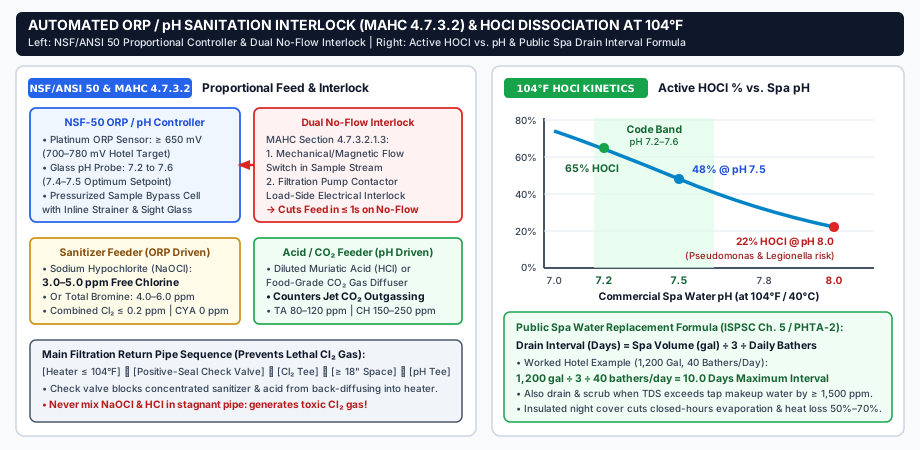
HOCl ↔ H+ + OCl−,pKa ≈ 7.46at 104°F). At pH 7.2, approximately 65% of free chlorine is activeHOCl; at pH 7.5, activeHOClis 48%; by pH 8.0, activeHOClplummets to 22%. Without real-time acid or CO2 pH correction, a spa showing 3.0 ppm total free chlorine on a DPD test kit at pH 8.0 has only 0.66 ppm of activeHOCl—allowing Pseudomonas aeruginosa (hot-tub folliculitis) and Legionella pneumophila (transmitted via inhaled hydrotherapy aerosol mist) to amplify inside pipe biofilms.
NSF/ANSI 50 Automated Controller & Dual No-Flow Interlock (MAHC 4.7.3.2.1.3)
To maintain pathogen inactivation across bather surges, CDC MAHC Section 4.7.3.2 requires an NSF/ANSI Standard 50 listed automated chemical controller that continuously measures Oxidation-Reduction Potential (ORP ≥ 650 mV statutory floor; 700–780 mV hotel target) via a platinum-tip sensor and pH (7.2–7.6) via a glass electrode inside a pressurized bypass sample cell. The controller proportionally drives a peristaltic liquid sodium hypochlorite feeder (or bromine feeder) and a diluted muriatic acid pump or food-grade CO2 gas diffuser (which forms carbonic acid smoothly without depleting Total Alkalinity or raising chloride TDS).
Crucially, MAHC Section 4.7.3.2.1.3 and Pentair MasterTemp Manual (pp. 12–14) mandate a three-part chemical injection safety architecture:
- 1. Sample-Cell Mechanical/Magnetic Flow Switch: An inline paddle or magnetic flow switch inside the controller’s bypass sample loop immediately opens the feeder relay circuit if water flow through the sensor cell stops or a strainer clogs.
- 2. Filtration Pump Load-Side Electrical Interlock: Chemical feeder power outlets must be electrically interlocked with the primary filtration pump motor starter (or VFD run-status relay) so sanitizer and acid dosing halt within ≤ 1 second whenever the filtration pump shuts off or trips on NEC 680.41 E-Stop.
- 3. Downstream Heater Check Valve & Injection Separation (Prevents Cl2 Gas): All chemical injection tees must be installed downstream of the heater behind a chemical-resistant positive-seal check valve, with the sanitizer injection fitting and acid injection fitting separated by at least 18 to 24 inches of return pipe. Without dual no-flow interlocks and a positive check valve, concentrated sodium hypochlorite and hydrochloric acid injected into a stagnant pipe during pump-off mix directly to generate lethal chlorine gas (Cl2):NaOCl + 2 HCl → Cl₂(g)↑ + NaCl + H₂OThat trapped chlorine gas pocket is then blown directly into bathers’ faces at the spa return inlets the moment the pump restarts.
Commercial Hot Tub Statutory Water Chemistry & LSI Parameters
Scroll horizontally to see all columns →
| Water Chemistry Parameter | Commercial Spa Statutory Range | Optimum Operational Target | Engineering & Kinetic Basis |
|---|---|---|---|
| Free Available Chlorine (FAC) | 3.0 to 5.0 ppm (mg/L) min (10.0 ppm max closure) | 3.5 to 4.5 ppm (un-stabilized) | 3× higher floor than pools (1.0 ppm) to buffer rapid 104°F bather sweat/urea demand |
| Total Bromine (Alternative) | 4.0 to 6.0 ppm (mg/L) min (8.0–10.0 ppm max) | 4.5 to 5.5 ppm | Hypobromous acid (HOBr, pKa ≈ 8.6) retains ~80% active non-ionized form at pH 7.8 |
| pH | 7.2 to 7.6 (7.8 absolute ceiling) | 7.4 to 7.5 | Maintains 48%–65% active HOCl while preventing eye/skin irritation and heater corrosion |
| Oxidation-Reduction Potential (ORP) | ≥ 650 mV statutory floor | 700 to 780 mV | Measures real-time oxidative sanitizing activity independent of total ppm reading |
| Combined Chlorine (Chloramines) | ≤ 0.2 ppm target (≤ 0.4 ppm action limit) | < 0.2 ppm (UV / ozone assist) | Prevents respiratory irritation in indoor hotel spas and indicates breakpoint oxidation |
| Cyanuric Acid (CYA Stabilizer) | 0 ppm indoor; ≤ 15–30 ppm outdoor max | 0 ppm (never use Trichlor) | CYA binds free chlorine and slows Pseudomonas kill kinetics; acidic Trichlor ruins heaters |
| Total Alkalinity (TA) | 60 to 120 ppm | 80 to 100 ppm | Buffers pH bounce without excessive carbonate outgassing from Venturi air jets |
| Calcium Hardness (CH) & LSI | 150 to 250 ppm (LSI −0.3 to +0.3) | 150 to 200 ppm | 104°F water raises LSI Temperature Factor (TF = 0.9), scaling heaters and spillways if CH > 250 ppm |
Because 104°F water elevates the Langelier Saturation Index Temperature Factor (TF = 0.9 vs. TF = 0.6 at 76°F), keeping Calcium Hardness between 150 and 200 ppm prevents calcium carbonate crusting inside heater headers and across wet tile edges (see our spillover spa hydraulic loop and weir-scale guide and waterproof membrane and epoxy grout specification for tiled concrete spas).
Mandatory Public Spa Water Replacement & Drain Interval Formula
Even with a 30-minute turnover rate and 750 mV ORP control, unfilterable Total Dissolved Solids (TDS), bather sweat salts, and oxidation byproducts accumulate rapidly in 600 to 2,100 gallons of hot water (U.S. EPA WaterSense at Work Section 5.3). Under 2024 ISPSC Chapter 5 and PHTA/ANSI-2 public spa operations standards, operators must replace a minimum of 3.0 US gallons (11.4 L) of fresh water per bather per day and perform a complete vessel drain, pipe biofilm purge, surface scrub, and fresh refill according to the statutory formula:
Maximum Drain Interval (Days) = Spa Volume (gallons) ÷ 3 ÷ Average Daily Bathers
For a 1,200-gallon hotel commercial hot tub serving an average of 40 bathers per day: 1,200 ÷ 3 ÷ 40 = 10.0 Days. The facility maintenance team must drain, scrub, and refill the spa at least every 10 days (or immediately whenever measured TDS exceeds start-up potable make-up water by ≥ 1,500 ppm).
Takeaway: Specify an NSF/ANSI 50 ORP/pH controller with dual no-flow interlocks, keep Calcium Hardness at 150–200 ppm for 104°F LSI balance, and log complete drain-and-refill cycles via Volume ÷ 3 ÷ Daily Bathers.
5. Pre-Inspection Submittal & Commissioning Verification Checklist
Before scheduling final health-department and electrical building inspection, execute and record these eight field verification tests in the facility commissioning and maintenance handover log. During closed overnight hotel hours, pairing the enclosure barrier (CPSC Publication 362) with an insulated vapor cover from the automatic and commercial spa covers specification cuts 104°F evaporative water and heat loss (~8,750 BTU per gallon evaporated per EPA WaterSense) by 50% to 70%, stabilizing overnight TDS and commercial spa energy consumption.
Scroll horizontally to see all columns →
| Inspection Item | Governing Code Section | Field Test / Submittal Proof Required | Mandatory Pass Criteria |
|---|---|---|---|
| 1. 30-Minute Turnover Flow | CDC MAHC 4.7.1.10 & ISPSC 504 | Read NSF-50 inline flowmeter under clean and simulated dirty-filter (+8 PSI) head | Continuous 24/7 filtration flow ≥ Volume_gal ÷ 30 (≥ 40.0 GPM on 1,200-gal spa) |
| 2. VGB Dual Drain Spacing & Cover Stamp | 15 U.S.C. § 8003 & 16 CFR § 1450.3 | Measure C-to-C spacing on Pair A (filtration) and Pair B (jets); inspect SOFA certificates | ≥ 36.0 in. (3.0 ft) C-to-C (or 2 planes); single-drain GPM rating ≥ 100% max pump flow; ≤ 1.5 ft/s grate velocity |
| 3. Suction Pipe Velocity & Valve Audit | CDC MAHC 4.7.1.6 & ISPSC Ch. 3 | Inspect Schedule 40 PVC manifold piping between paired suction outlets and pump pot | Symmetric tee header with zero isolation valves between drains; branch velocity ≤ 6.0 ft/s at max GPM |
| 4. NEC 680.41 Emergency Shutoff Test | 2023 NEC 680.41 & MAHC 4.12.9 | Measure horizontal distance from inside spa wall; depress red mushroom E-Stop under full load | Setback ≥ 5.0 ft (≤ 50 ft sightline, 42–48 in. height); all filtration, jet, and blower motors stop instantly |
| 5. 104°F High-Limit & 15-Min Jet Timer | MAHC 4.12.9, ISPSC 505/509, UL 1563 | Verify locked thermostat, test manual-reset high-limit cutout, and time hydrotherapy jet cycle | Heater cuts out at ≤ 104.0°F (40.0°C); jet timer runs ≤ 15 min and is mounted ≥ 5.0 ft from water edge |
| 6. ORP / pH No-Flow Safety Interlock | CDC MAHC 4.7.3.2.1.3 & NSF/ANSI 50 | Close sample-cell flow valve and trip filtration pump breaker while chemical feeders are actively dosing | Both chlorine/bromine and acid/CO₂ feeders de-energize in ≤ 1 second; downstream heater check valve holds seal |
| 7. Bench Depth, Step Nosing & Bonding | ISPSC Ch. 5 & NEC 680.26 | Measure waterline-to-bench depth, total footwell depth, contrasting nosing tile, and #8 AWG bond continuity | Total depth ≤ 4.0 ft; bench depth ≤ 24 in.; riser ≤ 12 in. with 2-in. contrasting nosing; < 1.0 Ω bond continuity |
| 8. Make-Up Sub-Meter & Drain Log | ISPSC Ch. 5 & EPA WaterSense 5.3 | Verify ASSE 1013 RPZ backflow preventer on make-up line, water meter, and posted drain schedule | Posted drain interval ≤ Volume ÷ 3 ÷ Avg Daily Bathers, TDS meter on site, and 5-year VGBA cover logbook active |
Takeaway: Complete and sign the 8-point field commissioning test—including live NEC 680.41 E-Stop trip and MAHC 4.7.3.2.1.3 no-flow chemical interlock shutoff—before opening a commercial hot tub to bathers.
Frequently asked questions
What is the required filtration turnover rate for a commercial hot tub?
Under 2024 CDC Model Aquatic Health Code (MAHC 5th Edition) Table 4.7.1.10 and 2024 International Swimming Pool and Spa Code (ISPSC Chapter 5), a commercial hot tub must achieve a maximum filtration turnover time of 30 minutes (0.5 hours) or less, completing 48 full water turnovers every 24 hours. Minimum continuous filtration flow equals Spa Volume (gallons) ÷ 30 minutes—meaning a 1,200-gallon hotel spa requires at least 40.0 GPM continuously (48 to 50 GPM clean-filter design flow to maintain 40.0 GPM at dirty-filter differential pressure).
How do VGB Act dual main drain requirements apply to commercial spas?
Under the federal Virginia Graeme Baker Pool and Spa Safety Act (15 U.S.C. § 8003 and 16 CFR § 1450.3 incorporating ANSI/APSP/ICC-16), every suction pump serving a public or hospitality spa—both the 24/7 filtration pump and each high-flow hydrotherapy jet booster pump—must draw through at least two hydraulically balanced suction outlets spaced at least 36 inches (3.0 feet) center-to-center or located on two different architectural planes. Each individual suction cover and branch pipe must handle 100% of maximum system flow at a through-grate velocity of 1.5 ft/s or less and a Schedule 40 PVC suction branch velocity of 6.0 ft/s or less, with zero isolation valves between paired drains.
Where must the NEC 680.41 emergency shutoff switch and 15-minute jet timer be located?
NFPA 70 (National Electrical Code) Section 680.41 and CDC MAHC Section 4.12.9 require a clearly labeled, single-action emergency pump shutoff switch (E-Stop) in all commercial, hotel, resort, health-club, and multifamily spas. Both the red mushroom E-Stop and the 15-minute maximum hydrotherapy jet timer must be mounted within direct sight of the spa and at least 5 feet (1.52 m) horizontally from the inside walls of the vessel (within 50 feet along an unobstructed deck path at 42 to 48 inches ADA height), preventing immersed bathers from touching electrical controls while forcing a deck exit to restart the jets.
Why is a commercial hot tub legally capped at 104°F (40.0°C)?
CDC MAHC Sections 4.12.9 and 5.7.4.4, 2024 ISPSC Section 505, UL 1563, and ANSI Z21.56 establish 104.0°F (40.0°C) as the statutory ceiling for commercial spa water. Immersion in water above 104°F blocks evaporative sweating and drives core human body temperature past 102°F (38.9°C) within 10 to 15 minutes, triggering peripheral vasodilation, orthostatic syncope (fainting when standing up on the spa steps), cardiac arrhythmia, heat stroke, and first-trimester fetal neural-tube risk. Commercial heaters require a locked thermostat plus a redundant manual-reset high-limit safety cutout.
What chlorine, bromine, pH, and ORP levels do health codes require in a hotel spa?
Per CDC MAHC Section 5.7.3 and 4.7.3.2, a commercial hot tub must maintain 3.0 to 5.0 ppm Free Available Chlorine (or 4.0 to 6.0 ppm Total Bromine), pH 7.2 to 7.6, combined chlorine (chloramines) at or below 0.2 ppm, and Oxidation-Reduction Potential (ORP) at or above 650 mV (700 to 780 mV operational setpoint). Because 104°F jet aeration strips dissolved CO2 and drives pH toward 8.0—where active hypochlorous acid (HOCl) drops from 65% to 22%—codes require an NSF/ANSI 50 automated ORP/pH controller with a dual no-flow safety interlock (MAHC 4.7.3.2.1.3).
How often must a commercial hot tub be drained and refilled under public spa codes?
Under 2024 ISPSC Chapter 5 and PHTA/ANSI-2 public spa standards, the maximum water replacement interval in days equals Spa Volume (gallons) ÷ 3 ÷ Average Daily Bathers (equivalent to 3 gallons of fresh replacement water per bather per day). For a 1,200-gallon hotel hot tub averaging 40 bathers per day, complete draining, biofilm line purging, shell scrubbing, and refilling must occur at least every 10 days (1,200 ÷ 3 ÷ 40 = 10.0 days), or sooner whenever Total Dissolved Solids (TDS) rises 1,500 ppm above start-up tap water.
Methods and sources
Code thresholds, hydraulic formulas, and equipment interlock specifications in this guide are grounded in the following federal statutes, model aquatic codes, national electrical standards, and OEM engineering manuals:
- U.S. CDC: 2024 Model Aquatic Health Code (MAHC), 5th Edition — Code Language (November 2024), Sections 4.7.1.5–4.7.1.10 (≤ 30-minute spa turnover and suction outlets), 4.7.3.2 (automated ORP/pH controllers and no-flow interlocks), 4.12.9 (104°F cap, 15-min timer, and emergency shutoff), and 5.7.3 (disinfectant residuals).
- U.S. CDC: 2024 Model Aquatic Health Code (MAHC), 5th Edition — Scientific & Engineering Rationale Annex (November 2024), Annex 4.7.1.10, 4.7.3.2, and 4.12.9 (HOCl dissociation kinetics at 104°F, CO₂ aeration stripping, Pseudomonas and Legionella amplification control).
- 15 U.S.C. § 8003 — Virginia Graeme Baker Pool and Spa Safety Act (VGBA) and Public Law 110-140, Title XIV (121 Stat. 1794) (federal public pool and commercial spa anti-entrapment drain cover and dual main drain requirements).
- 16 CFR § 1450.3 — U.S. CPSC Incorporation of ANSI/APSP/ICC-16 (Standard for Suction Outlet Fitting Assemblies for Use in Pools, Spas, and Hot Tubs: single-blocked-drain flow ratings, sump geometry, and 5-year service-life embossing).
- NFPA 70: National Electrical Code (NEC) Article 680 Part IV and NEC Section 680.41 — Emergency Switch for Spas and Hot Tubs (≥ 5 ft horizontal setback, direct sightline, single-action pump disconnect, Class A GFCI, and #8 AWG equipotential bonding grid).
- 2024 International Swimming Pool and Spa Code (ISPSC / ANSI/PHTA/ICC-2), Chapter 5: Public Spas and Public Exercise Spas (≤ 4 ft maximum depth, ≤ 24 in. seat depth, ≤ 30-minute turnover, ≤ 15-minute jet timer, and public spa water replacement formula).
- Pentair MasterTemp Pool and Spa Heater Installation and User’s Guide (ANSI Z21.56 / CSA 4.7), pp. 12–14 (104°F electronic and mechanical high-limit thermostat lockouts, minimum flow switch, and downstream positive-seal check valve protecting cupronickel heat exchangers from chemical back-siphonage).
- U.S. EPA WaterSense at Work, Section 5.3: Commercial Pool and Spa Equipment (November 2023) and U.S. CPSC Publication 362: Safety Barrier Guidelines for Pools and Spas (April 2023) (evaporative heat/water loss at 104°F, make-up water sub-metering, night vapor barriers, and controlled enclosure access).